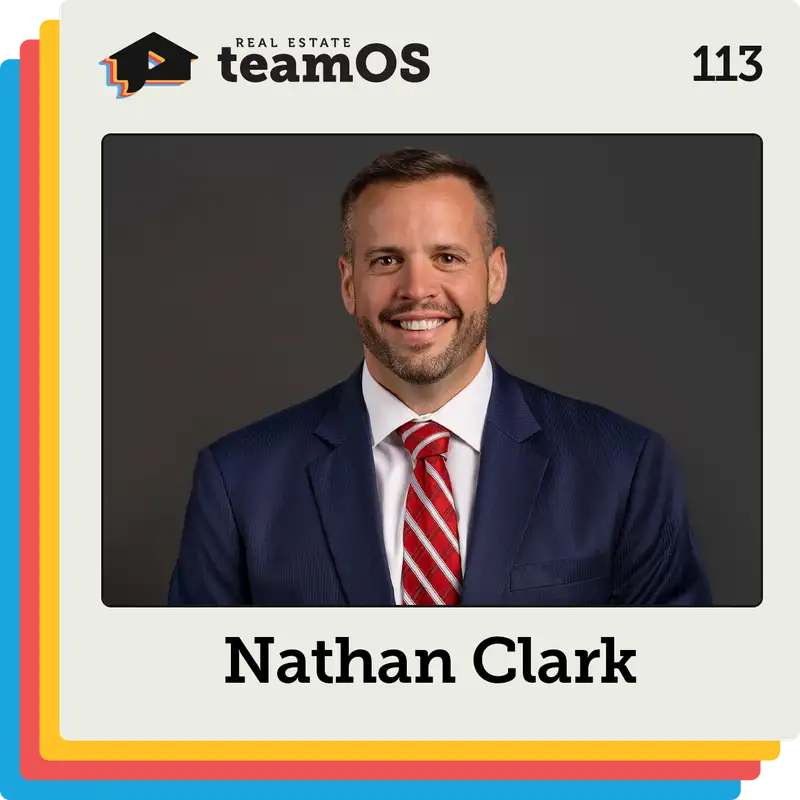
30% Net Profit from a Real Estate Team That Runs Without You with Nathan Clark | Ep 113
Speaker 1 (00:00):
30 to 35% net profit from your real estate team, working on it just 15 to 20 hours per week. Through a lot of trial and error, some hard learned lessons and against the herd mentality and a personal crisis, Nathan Clark has figured out how and he explains it to you in this conversation. The 40% cost of goods sold ceiling that separates growing teams from teams that are stuck. How to get paid three times on every transaction and how that's generating 40 to $50,000 a month in working capital for them. Why 20 to 25 agents has been their most profitable team size and the ideal agent to ISA ratio to support that and why he changed splits twice and how he did it differently the second time. Get all that and much more with Nathan Clark right here on Real Estate Team OS.
Speaker 2 (00:55):
No matter where your business is today or where you want to take it, you'll get there faster and more profitably with an operating system. Welcome to Team OS, your guide to starting, growing and optimizing real estate team. Here's your host, Ethan Butte.
Speaker 1 (01:09):
Nathan, I'm so glad that we got introduced recently. I'm really happy to reconnect today for this conversation. Welcome to Real Estate Team OS.
Speaker 3 (01:17):
Thanks for having me, Ethan. I'm excited to be here today.
Speaker 1 (01:19):
We are going to get into ... I love the conversations we've had on profitability, how to keep it top of mind, some common myths and misperceptions and kind of like cultural norms in the business that we're going to maybe beat up a little bit in favor of a more profitable approach. But we're going to start where we always do, Nathan, which is a must have characteristic of a high performing team. What comes to mind for you on that?
Speaker 3 (01:43):
The speed of the leader. I think the speed of the company really is the speed of the leader. The faster the leader can implement things, the faster they could pivot, make changes that need to happen, especially right in this environment, in this business. It seems to be changing every six months, six weeks. So the speed of the leader I think is a very important characteristic you'll see with very successful teams is people be able to move really fast and get a lot done. And that leader sets that example.
Speaker 1 (02:10):
Yeah. Setting the example, setting the tone, essentially establishing the culture at some level. It's funny when I think about my own career in moments where I was like, I wish I was perhaps surrounded by a little bit more urgency. It's really modeling and demonstrating that urgency that's probably the best trigger to get people to follow along and participate and engage in that way.
Speaker 3 (02:29):
100%. I think another characteristic would be is the most successful teams that I've met. A lot of husband and wife teams. I see that as a very common thread with it. But I think that really comes back to being all in, kind of the burn the boats mentality. When I got started, I was 20 years old. I failed at everything else. And like most people, that's how you get into real estate. So I really had a chip on my shoulder, wanted to make sure this worked and burned the ship, made everything work. It happened. It was me and my wife, and we started this, but it was a had to win mentality and all in. And I find that's another characteristic of really good team leaders. It's like all in, they're not nibbling around the edges, playing around, this is it. We're going to make this work.
Speaker 1 (03:13):
I see a lot of team leaders getting involved in a variety of different things and some of them can do it well, but not all of them can. And it's like I start seeing like I'm nibbling around the edges, not only of my core business, but also I'm nibbling around on the edges of a variety of other things. Any thoughts on the power of focus related to this?
Speaker 3 (03:34):
Yeah. Well, my mentor, Todd Walters, always told me, "Do you know where they ride two horses?"
Speaker 1 (03:40):
No.
Speaker 3 (03:40):
Only one place, the circus. And that is a problem that we all have. And a lot of times at business, we think, "Hey, I was good at real estate, so let me do manufacturing parts or some totally or oil investments and stuff like this. " It's like, stay in your lane. And that's been something that I've really focused on and listened to my whole career. There's been a lot of opportunities, I guess we'd say. It's like, "Hey, do you flipping houses, rehabs, doing all this stuff?" And it's just really been, now I'm going to focus on the business because my business turns about a 30, 35% net profit a year. And what I'm able to do with that, I don't find another investment that I can kind of duplicate that kind of return on. So I just pour everything into that and I found that what works the best for me.
Speaker 3 (04:26):
And when I look around, I see a problem with a lot of leaders is Jack of all trades, master of none, is they're focusing on, oh, they do these, they do these investments, they're doing cash lending, they're doing all these different things, coaching, running a business. And I just kind of go back to riding multiple horses. Get good at one thing, master that punch, that one punch by doing it 10 million times versus having 10,000 punches that you're okay at.
Speaker 1 (04:52):
Yeah. I love that quote and I'm never going to forget where people ride two horses. So for anyone whose eyes opened up or ears perked up when Nathan said 30 to 35% profit margin, we are going to get there in a few minutes, but first I would love to know, Nathan, at what point in your real estate journey did team occur to you? When did it make sense for you to grow beyond you and your wife to bring other folks around the business? What was going on at that point in your business?
Speaker 3 (05:18):
Well, yeah, I got into the real estate business. My father did this before me. We both worked at RE/MAX and my dad got in, he was young also and he was a mentor of Tom Hopkins and he was like, "Nathan, I'm getting past my age that I have to keep on working a lot. My phone just rings. I get referrals." And I was always in awe because I'd come to the office and I'd be cold calling, doing open houses and his phone would just ring. And people are like, "Hey, Chris, you sold a house for me 30 years ago. Come on back. I want to sell it again." I said, "Wow, that's amazing." And one of the things that he told me was like, "You need to find Tom Hopkins." And at the time, I think it was like 2004, Tom Hobbs 2004. So I met a man, Todd Walters, Craig Proctor, and I went to one of the conferences, I met them and I called my father and I was like, "I think I found the guy." And what they breached was really a system and a process.
Speaker 3 (06:10):
And I remember Todd was talking to about building it with an end in mind and a team system and freedom to actually have a business that you own and just like something you own, it doesn't own you, that you have to show up all the time and serve it. It serves you and having freedom to do other things out there. And that really resonated with me. My big word would be freedom, being able to control my time and have freedom. And I looked at that as a point of saying, "Hey, I'll work my butt off, Ethan, to be able to build a business like that. " And you have to. It didn't happen right away. It was me and my wife, but the vision was always to be able to have a business that ran without my constant involvement, that I could decide if I wanted to go to work that day or not.
Speaker 3 (06:57):
And that's what we've built. And the business now runs without me. I'm involved with the sense of I like to do the things that I'm involved with with it because it drives me. And yeah, I work about 15 hours a week, 20 hours a week or more if I decide to. We enjoy, we drag race, my wife and I, we have five race cars now. So we do that. We have a 12-year-old son. We travel. We have a lot of fun out there. The whole summer, I'm gone behind a race car doing stuff like that, but be able to focus on things that I really enjoy doing with it. Not that there's bad things that come, there's always problems, but be able to solve them, I enjoy doing.
Speaker 1 (07:38):
When was that? When did you connect up with Todd and Craig and develop this vision for yourself and what were the earliest stages of the team?
Speaker 3 (07:48):
Oh, well, this would be about 2004, 2005. It was in Arizona. I remember calling my father and saying, "Dad, I think I found Tom Hopkins." So he's like, "All right, well, let's go. " And 2005, I started hooking up with those guys and crafting the idea of a team. And it was, like I said, my wife and I for probably the first year, I think the first year in real estate, I sold about 25 houses myself, just hustle and open houses, stuff like that. And then after that, the next year, my wife came on that year. She was working at an attorney's office. We were both 21 years old. She came over, she would bang the signs on the front lawn, handle the paperwork. I'd go on listing appointment after listing appointment, follow the systems, the processes, started building those. And then that year we hit one ... The next year, we hit number one team in RE/MAX.
Speaker 3 (08:37):
We brought on an agent. We did about 130 transactions. It was me and I was doing about 80, 90 deals myself, and another agent was picking up buyers. I was the ISA. I was the inside sales, outside sales. We did that. Then we just started adding another OSA, another, we call them outside sales agents.
Speaker 3 (08:56):
And we did that, went to about 150 sales, 170 sales. And about 2012, we hit 200 transactions, and I was kind of hitting that point where looking at the financial model. VMAX is a great company, but I was giving them 120 grand a year. I was like, "I think I can do this on my own." And just opened up our own company, Nathan Clark team. And we went from 200 transactions to over 600 transactions and found our brokerage, Your Home Sold Guaranteed Realty 2018 with Todd Walters, with really the idea that we would do where we bring this public to a roll up. I know you guys have talked about that before on your podcast, Ethan, and the idea is taking this public with the whole process of how we operate and we've been working on that for the last couple of years.
Speaker 1 (09:42):
Cool. Man. Okay. You've opened up so many things that I would like to follow up on. I guess the one I'm going to go to straight away is 200 to 600 transactions. That's obviously 3X growth. It obviously didn't happen overnight, but what was the difference in your day-to-day week to week and maybe the core staff and structure helping support all of this volume at 200 versus at 600? What happened in that window? Because my assumption is that a lot of people kind of go off the rails maybe in that zone because they're doing what you did, which is, "Okay, I'm going to do 80 to 90 myself and I can do 80 to 90 myself and get a handful of people around me that can do 30 each. And next thing you know, we're at 200 transactions, but that's a lot different than a business doing 600 transactions.
Speaker 1 (10:31):
And so I love any insights or memories or tips you have from that period."
Speaker 3 (10:36):
Yeah. And I think realistically, I know a lot of the people here have all different price points, average volume. So if we look at income, I would bet 200 transactions at that time was probably around 1.2 to 1.5 million of GCI. And so the transaction looked like me doing a boatload of it. And
Speaker 2 (10:55):
I think
Speaker 3 (10:55):
That's what most teams operate now was maybe the team leaders doing 60, 70% of the volume and the team OSAs as agents are picking up the rest and that's how we really look. So we were working with, at that time of doing 200 transactions, there was probably about five OSAs, five agents and myself, and they were probably doing 10, 15 deals a month, I mean, excuse me, a year. So you got about, not even. So they were doing about 100 and I was 120 and I was doing the rest of the 80. And that's the whole process in itself. And so I was the ISA. We'd bring an ISA at that. So the model would be is one ISA per five agents is what we've seen work. And so I was at ISA. So at that time, between really zero and 150 transactions, I was the ISA.
Speaker 3 (11:46):
It was about 150 that we had to bring on an ISA to help call the leads. So my daily schedule, as you asked, was I was the calling the leads, booking the appointments for everybody on the team, cherry picking. So the best appointments that would come in, could they come list me, all that stuff, I would take those and I would hand everything else. And I would take all the listings. All the buyers would go to the agents and I would take all the listings. And we were about 60, 70% listings at the time. So a lot of the stuff was coming that way to me. And then at the end of the day, you're working eight in the morning until 10, 11 o'clock at night. It wrecked my health life. I was about 330 pounds. That was how things were done for probably about 13 years of my career.
Speaker 3 (12:30):
So I was about 33. And in 2014, I was able to step out of production. And that was really around the $3 million income mark, the GCI about three million, that I was able to step out of production. And that's a very dangerous part for a lot of people. Most people I find they step out too soon.
Speaker 3 (12:52):
And this is coming from ... I've rebuilt the team a couple times making mistakes and then having to come back to it. Mistakes being like the financial model is a financial model that just doesn't work. And I'd eventually find that out and go, "Hey, I got to change the splits that I have with the agent because this isn't working." And whenever you do that, Ethan, you lose agents. Yeah.
Speaker 1 (13:15):
Because the split needs to come back toward the organization, not out toward the agent, which is going to have them pop their heads up and look around. And certainly someone's going to undercut that easily.
Speaker 3 (13:25):
Right. And Dale, that was something that I did a couple times and realized I don't want to do this again. We got to make it work. I would rip the bandaid off, rebuild the team. And that was about 2012, 2013. Right after I opened, I think I lost, I had like six or seven agents, eight agents, and I changed some splits because it had to happen and I lost like five or six of them. And I was like, I remember I called my father and I was like, "I don't know what I'm going to do, but about to go to a conference right now and I just got a resume of five or six of them that they're handing in their retirement on the team here." I was like, "I got to make it work." And so came back and rebuilt it. And that was where I kind of learned about financial modeling the hard way.
Speaker 3 (14:05):
And I think a lot of people avoid that and I got it kind of by dumb luck, but avoid really setting it up right from the beginning and just avoiding that and just letting it continue. But it was grinding me because I was sitting there, "Man, I'm doing all this work. I'm taking all the risk. I'm putting all the money up. I'm calling all the leads, doing all this stuff. And these guys are making more than me taking these appointments and selling them and I'm making 10% profit, if that, and taking all the risk while they're making 50% doing nothing." And that kind of got to me. I said, "I can't keep this going. " But if I didn't, I'd never be able to grow. I'd never be able to make it to where we are today of being able to have more money to be able to put back into the business and make things grow.
Speaker 1 (14:46):
Okay. We're going to go deep, a lot deeper into that. But before we do, I would love for you just to kind of, for folks that aren't familiar with you, they are not familiar with the Nathan Clark team. They're not familiar with your home sold guaranteed realty. I'd love for you just to kind of like level set on either or both of those organizations like markets you serve, size, structure, culture, anything you want to share about either of those organizations.
Speaker 3 (15:08):
Yeah. So I'll start with my market area in Rhode Island. So in Rhode Island, the market size is about a half hour. That's how we measure things here. The whole state's a half hour long. If you get a 95 at the bottom of the state and you count 30 minutes, you'll be in Massachusetts. We're a half hour big. We got about a million people that live here. We had 8,000 agents and there's about 15, 16,000 transactions per year in the entire state. We service the entire state, Southeastern Massachusetts and Eastern Connecticut. We got right now a team size about 24 agents. We have five ISAs, five inside sales agents, and about seven full-time staff member running the office. And including me, I think it'd be eight, being able to do that.
Speaker 3 (16:02):
As far as the market, I think the average sale price is about 400, 450,000. In my area, that's a sweet spot. And we do about 60% sellers, 40% buyers transactions. Some months, some of the years fifty fifty. As far as your home sold guaranteed realty, that's our umbrella company that we work under. And that's really where it's kind of a hive mentality where our systems and the processes have all come from. And we teach those to other broker owners and licensees under your home solar guaranteed realty. It's not a franchise where you're paying a percent of your income to them. We really pay for the licensing rights, the marketing rights that we get from them and a licensing fee every year. And we get all our systems and processes that we all work on together and we're able to make it better, find out what's going on.
Speaker 3 (16:52):
And we do this. There's about 75 brokerages across America and Canada that we work with, about a thousand agents altogether, very profitable models. And our vision is to be able to go public with this if we're doing a roll up and we're increasing the value of the company daily. More people we add on and be able to, like I said, be able to do that roll up. So that's really the end in mind of having the business that
Speaker 1 (17:18):
We can sell. Speak to this idea of starting with the end in mind, the end, of course, being a business that has value without you. I think that's something that most business owners should be thinking about from the beginning, but I'd love to hear it in your words and with some stories underneath it.
Speaker 3 (17:34):
Right. Well, I think we got to kind of look back at the real estate industry and it's kind of a funny business. And the risks that we take, the no guarantees of anything that we have, there's no healthcare, there's no guaranteed salary or anything like that we come into. So you got to be like, "Hey, you may love doing this now, but at some point you're not going to love doing it every single day and you might want to be able to retire, you might want to do something else." But you got to ask yourself, if you look around, I don't know about you, Ethan, have you ever been to a retirement party for a realtor?
Speaker 1 (18:04):
No.
Speaker 3 (18:04):
Have you ever heard of a retirement party for a realtor?
Speaker 1 (18:07):
No, I've only heard it in this context, which is kind of like a leading rhetorical type of question. That's the only context I've heard about one in.
Speaker 3 (18:15):
So we've got to ask that as why is that's happening is really we should start with the end in mind of like, what do you want this business to look like? What do you want it to do and what do you want your life to look like? And maybe that's fine. Maybe you say, "Hey, I want to be 80 years old behind the desk, still pumping houses into MLS and selling houses. There's nothing wrong with that. " Success is really defined by the person and that's your life and you do what you want with it. Personally, my success was owning a business that you owned and like something that you owned, you call it and it comes to you. It's not constantly calling you and you have to run to it to serve it. And having something that you could sell that was an asset that somebody would actually want to buy.
Speaker 3 (18:53):
And the problem with most brokerages, pretty much most, I would say almost 100%, most people won't buy them. Most people, they have the big risk of the key man risk, we call it, right? Is the key man risk would be Ethan, you run the team, you do everything, you're the top sales guy. If you left, your name's on the company, if you left, this would all fall apart. This would never work. I'm never buying that because I'm just buying myself a job. What I will buy is your book of business. And then when everybody sells a house out of your book of business, I will send you a referral and that's the best that most companies can ever get. And to be honest with you, it never works out. There's some three year pay down the road. Most of the time that doesn't work out with it because their business isn't what they had because there was no structures, processes, systems that was duplicatable.
Speaker 3 (19:38):
What I mean by duplicatable, if you look at a company like McDonald's, how many billions of dollars is McDonald's worth? But if you think about it, it's the same McDonald's I have here in Rhode Island that if I flew to Colorado, I can get the same French fries, the same hamburger, and it's run by 16 year old kids that can't make their bedroom. In Colorado, the same kids that are here in Rhode Island, they can't even clean their car or anything like that, but for some reason they run a billion dollar business. Well, what's that? That's really systems, right? That's the systems that you put the fries down this long, you add this much salt, the salt shakers- Same
Speaker 1 (20:09):
Equipment, same raw materials, same processes, same training. Yeah.
Speaker 3 (20:14):
And you need to have that kind of mentality. And I love that idea with business is that how do you systemize and process real estate that the same thing happens every single time, the same customer experience, the same outcome that you're doing that can happen and you could teach this to other people. And it is possible, right? When I was selling real estate, I always had the mentality. I think a lot of agents maybe listen to this and team leaders be like, "Yeah, but I can only do it the best. I can only install that for sale sign the best and take pictures of the house the best." And we learn to take hats off and give those to other people. And the thing with sales is you got to learn to be able to step out of sales and see if you have a real business to do that.
Speaker 3 (20:53):
And that will show you if you have a real business or not. Most companies, most teams that I talk to, and Ethan, if you tell me you see the same thing, that the agents that's the leader of the company is subsidizing the business, meaning they're taking their income and they're pouring it back into the business. But if you took that agent out, that team leader out and took their sales out, the team would fall apart. If you took that agent out and paid them, like they were a regular real estate agent, profit would plummet and production would plumb it. That tells you there's a problem with the process and the systems that you really started with. So when I would start this business, I'd always look like for a system and a process in mind and starting with your financial model. Most 99% of brokerages I talk to, the reason they can't grow and the reason their leads suck and the reason their agents don't produce is because of their financial model.
Speaker 3 (21:49):
It's so constricting the growth that first things first, paying agents 50%, anything more than 50% is lethal. Most businesses, I mean, our cost of sale is 40%. So if we were paying 40% and that was just the cost of sale, and then 50% to an agent, that would leave me 10% to pay rent, to pay employees, to pay for advertising. And obviously you can't do that. Well, that's pretty much the model of a lot of companies out there. Yeah.
Speaker 1 (22:25):
So let's break that down. In fact, as an example, let's go back to when you needed and wanted to ... Needed, I think is where you'd probably land, change your splits. And where you lost five or six of those agents, the story that you told just a few minutes ago, what was going on in the business at that time? What kind of woke you up to it? Again, level setting cost of sale and agent split.
Speaker 3 (22:54):
All right. So the agent split, that's a common one, right? So I was doing fifty fifty. I think we'd taken 10% off the top to go to the ISA, the inside sales agent to book the lead and it was fifty fifty. So you're
Speaker 1 (23:06):
Splitting fifty fifty on 90% from there.
Speaker 3 (23:09):
Yeah. So 45, 45. And then the day what was bothering me is like, I'm selling 80 houses and guys, 80 houses before computers, right? I go to the town hall, have to pull the title, pull the field card, drive by comps. I mean, so I was working a lot. I don't know how much, but I would sleep at the office. And I was sitting there going, "Man, I'm making $150,000 a year and I'm selling 80 houses. I'm taking home 150 and I'm happy. I'm in my 20s, but I'm sitting there going, but making 1.3, I'm only left with 150 out of the year." After you pay taxes, I'm like, I'm kicking my taxes back out, asking for an extension, not having any money to pay them in April, working from January to August when it's due, just to pay the taxes in August. And then woo-hoo, September, October, November, December, I put some money away, just enough to pay taxes again the next year.
Speaker 3 (24:02):
I'm sitting there going, "This is nuts." And a lot of people still do that. I get it. And I was looking back and the agents working for me are making 100, $150,000 a year, taking no risk. I was sitting there saying, "I can't keep on doing this. " And just said, "Listen, I think we went down to 40% and then later on I went down to 30% to them." And I learned how to do it the second time around better than I did the first time. The first time was, "Hey, listen, we're going to 40%. Okay, I quit." Then they leave and they're not in business anymore. They just didn't see the value. So next time later on when we had to go down to 30%, it was just including, it was showing more value to them that it wasn't just a loss in income, but look what I'm going to give you in return for that 30%.
Speaker 3 (24:50):
And one of those things was being able to collect more money from the sellers.
Speaker 3 (24:54):
30% of a ping pong versus 30% of a watermelon is two very different 30%. And so being able to help focus on, "Hey, listen, you're getting 40% of, let's say a $5,000 commission, okay, so that's what? $2,000 an average commission. Okay. I'm going to give you 30% of an average $10,000 commission, right? So you're going to have a higher split than today. Well, excuse me, 30% of a $10,000 commission would be $3,000, but you're going to get more of those transactions because we can take that money and advertise. But at a 10% profit, there's no way I can advertise to be able to get you better leads, which we want to do, better leads being more expensive advertising. I think not to go down a rabbit hole with it, but a lot of teams are dead stuck on either paying for leads with referrals, meaning they don't control the lead source or they're buying really low intent buyer and seller leads from just IDX websites, Boomtown, Commissions Inc., Whatever you want to call it, Google searches with have really low intent buyer and seller activity and it burns your agents out because the closing rate on those-Because
Speaker 1 (26:06):
They have to spend way more time to close it.
Speaker 3 (26:08):
10% of the people answer their phone, 5% of the people maybe are looking to make a move, and then 1%, two of those percent. But imagine you're getting a thousand leads to find a hundred people that are doing something, you got to call them, nobody answers their phone doing this stuff, and maybe you get 10 leads that can get to the closing table with that. So it's just not a duplicatable model, and it's really tough being OSA. But the owner of the company's stuck, right, Ethan, because he's saying, "I can't afford anything more. I'm paying $50, $100 for these leads, but there are better sources of lead." I mean, radio, television, stuff like that, those leads will cost thousands of dollars, but they do sell and they're a lot higher and more intent. But to get to that level, you have to have more profit to be able to do that type of advertise.
Speaker 3 (26:53):
And of course, we talk about a lot is value. Price is only an objection in the absence of value. And while every agent runs towards being the cheapest, those agents, that's the first way to go out of business is being the cheapest.
Speaker 1 (27:11):
Yeah, which is to say nothing of the brand signal itself. What are you saying about yourself when you're saying, "I'm cheap."
Speaker 3 (27:20):
And it also tells you the type of clientele that you hire. We all have this mentality of the Walmart is, "I'll just sell more houses, I'll make more money, and if I just sell a thousand more houses or I just get a thousand more agents to come work for me, and it's impossible to do that. There's one Walmart and that's why. And you're not Walmart and you don't want to be Walmart. And there's different clientele that go to Walmart and you don't want to attract those clients. I'll tell you the worst customers I've ever had, Ethan, are the cheap customers. They're never worth it. They cost you more time. They're never happy. They beat you up the whole entire time and you're like, I wish I never took you on at the end of it. " So the customers that I find see the value, see our systems, listen to our processes, want to do our systems, enjoy working with us, listen to us the whole entire way.
Speaker 3 (28:05):
Oh, and by the way, they pay us three times more money than the other people because they see the value. So we get stuck in this paradigm and it really comes from the leaders of these companies because they don't know any other way to sell value versus just being cheap themselves. And if you look at your brokerage model, your brokerage model is, "Hey, you only give us a couple points to work here." Well, what do you think that brokerage can give you for value and return? They have nothing to offer you but being cheap. And that's just a losing model in my sense that we've never gone after that clientele. We get paid three times on the transaction. We get paid upfront from the client. They'll give us up to $4,000 upfront. We get paid much higher than the average agents out there get paid.
Speaker 3 (28:47):
We get paid 4.5% on the buy side and 7% on the sell side. And we get another point at the closing of about $4,000 in transaction fees on a closing.
Speaker 1 (28:58):
Okay. Go one layer deeper on each of those because I am certain that not everyone watching or listening is familiar with this concept.
Speaker 3 (29:06):
Yes. Yeah. And it's very different, but we'll just talk about getting paid upfront. That's another paradigm that a lot of agents have that in this business called real estate, you're expected to go take on a client, put them in your car, drive around for unknown months, showing them unknown houses, burning your gas. Right now it's 450 a gallon and burning your tires, burning your time, and maybe you'll get paid or maybe you won't get paid. And good luck with that. And if you look at the metrics that we look at like 50, 60% of the time, they don't buy a house. And that's what drives the cost of everything up because he's like, "Wow, this is a huge burnout." So I don't like that. I don't subscribe to that mentality, just like any other business. If I'm going to hire an architect or I'm going to hire a lawyer, I give them a retainer and they go to work for me.
Speaker 3 (29:55):
And that's how we treat working with customers. It's like, you're going to give me a retainer, I'm going I'm going to go work for you and I'm going to do a good job. And everybody plays different when you're getting paid. And my agents play very different than versus just somebody says, "Okay, I'll be your buyer's agent." And they sign a buyer's agreement and okay, maybe we'll find your house and maybe we don't. Versus, "Nope, here's $1,000 and you're my client and I'm going to go now work for you and do that. " So we've charged money upfront for our buyers and sellers and the outcome has been substantially different. We were, like everybody else, that won't work, but we did it and everything got better and the transactions got better, more people bought houses. Because think about this, right? We noticed the problem with sellers.
Speaker 3 (30:39):
Sellers, in the case, Ethan, they would put their house in the market and 35% of them would never move forward and put their house on the market. They'd sign a listing agreement with us and then we'd call them for a week, "Hey, let's get out there and do pictures." They'd be like, "Oh, we're waiting." And they would never come. Or we'd put the house in the market and then within two weeks, Johnny would come home with a bad grade in gym class and they'd be like, "You know what? It must be because the house is on the market. You know what? We're not going to sell." And meanwhile, I spent whatever money to generate that lead, time, money, photography, all this stuff. And they go, "I'm sorry, Nathan. When we put it back in the market, we'll call you again." Meanwhile, I just lit probably $5,000 on fire, an effort and time to do that.
Speaker 3 (31:20):
And we were like, "I don't want to do that anymore. That's just dumb." And so we charge now upfront for the client and the client happily pays it.
Speaker 1 (31:28):
You just communicate it properly.
Speaker 3 (31:30):
We just have value. We just show, "Hey, this is what we're going to do and look at all this value we're going to give you. " And it's $2,000 upfront to get started. We take check, MasterCard, Visa, PayPal, and they're like, happily do it. And we can give a better transaction to that client, but guess what we found happened? They all sell. But not only do those sellers sell, they sell for more money. It's a better transaction. We get a five-star review, which is our game. Our model is we want a five-star review at the end of it. They're much happier than the people that don't give us money. And it came to the point when I had to go to my agent and say, "Hey, we're going to do this. " They were like, and no, this isn't going to work. This is it.
Speaker 3 (32:09):
Company's going under. This is actually another crazy thing that Nathan's doing. And that was about a couple years ago. Now to this day, they won't take a listing without getting paid upfront. They'll pay the listing. They'll bring the listing back and pay for it before they let it themselves to let this thing not happen because they believe in it so much. And that just added huge revenue upfront, which also increases the value of a company dramatically. We make about 45, $50,000 a month on upfront fees alone. And to have working capital versus a lost leader like selling real estate, most teams do, increases the value of your company substantially, but it also allows you to do a lot more. I can do more for the customer than an average agent could do because I have more working capital in the deal. And the end of the day, who wins is who can pay the most for the customer.
Speaker 3 (32:59):
And that's a quote from Dan Kennedy. "But whoever can pay the most for the customer wins. And that means I can advertise more than you. I could pay more to get that customer to call me than you. I could beat you out of those things. I can offer more value because of what we have. And so while the herd, which is always wrong, is running towards cheap, cheap, cheap, cheap, cheap, cheap, cheap, cheap and trying to do that stuff, what they don't know is they're putting themselves out of business. The same way what they charge is when we sit there and say," Oh my God, you get 7%. "Well, where did the notion come from that everybody charges whatever, 4%, 3%? There's no set norm out there, but I'm just saying, where did that overcome from? It's because we got into business and we looked to the person next to us and said," Well, Ethan charges 4%.
Speaker 3 (33:43):
I'm going to charge 3.9% and I'm going to give them an Apple every time I do business with them. "Well, the next person gets a business, what do you think their mentality is? Well, Nathan charges 3.9. Well, I'm going to charge 3.8, and I'm going to give them two apples, right? And what they don't realize though is Ethan isn't making any money at 4%. So what's happened to me at 3.8% because we copy everybody else and say," I'll just put a little more value on top or I'll give them something else with it. "But it's like, you can go to Applebee's and get a $10 steak or you can go to get Martin's and pay $100. It's not the same steak. It's a steak, but it's at a much different environment, much better system and you're going to have a much better time. And it also calls out to two totally different customers.
Speaker 3 (34:27):
So I don't want to miss the point here. We don't get this, these fees and we don't get this money paid three times at the closing just by luck or dumb clients or anything like that. We get very educated clients that want our systems, our processes. And to get those systems and processes, my company's very expensive to run, okay? I'm not running on the back of a Toyota Camry. These are the things that it's going to get to you, but we can demonstrate that they could see, oh my, I can see how this is so much better than the other agent I talked to and it's going to get me a better result of what I want, which is not always the top dollar. It's not always the quickest. It's whatever they want. We make sure that's curtailed and be able to do that custom to them.
Speaker 3 (35:06):
It takes people, it takes processes and it takes a way that we can be able to deliver that every single time. And with that, they're willing to pay. And as long as we always demonstrate that and call out to our niche of people, we find that's very successful out there. We're not trying to do business with 100% of the market. We're trying to do business with our niche of people. It's about 10% of the market.
Speaker 1 (35:26):
Okay. There's a lot in there, but just for the sake of time, because I have a few other things I definitely want to ask you about. One of the things you told me, I forget whether it was before we hit record or whether it was on today or whether it was on a previous conversation, you mentioned that the most profitable window for you was around two dozen agents. When I think about two dozen agents, I think of a lot of people being in what's popularly referred to as the messy middle, where there's somewhere between that five to 10 agents where they can really still have a handle on the situation, a family feel, low overhead, et cetera, and everyone's just running and it's just got this different vibe versus 50 agents where if I have really good systems and processes and I have 50 people doing it, I can leave production and still make the same money as back in that previous iteration.
Speaker 1 (36:12):
But somewhere in between, a lot of businesses kind of get off the rails a bit. And so that agent count, I know it's not the primary criteria for defining the messy middle, but I associate it with that. And I think some other folks do too. So that number you offered me stood out as like, huh, that's a little bit different than what I would've expected. So I'd love to hear you out on that.
Speaker 3 (36:36):
Yeah. We've been up to 36 agents. We've been way up there on age account for that and had as little as two agents. 12 agents is a sticky spot. You can be very profitable with 12. I think you need to get about 15. 12 is when you could start jumping out of production. 15, you should definitely be out of production. If not, you got a series of problem of what's happening with your lead gen. If you can't get out at 15 agents or you got a problem with the agents, not selling. Or do you have
Speaker 1 (37:06):
To insert an expensive management layer?
Speaker 3 (37:08):
Yeah. We have accountability. And I think just speak on that really quick.
Speaker 1 (37:13):
Yeah.
Speaker 3 (37:13):
We love being loved by everybody. I get it, right? It's natural. I want to be liked by everybody. It's been a
Speaker 1 (37:18):
Problem in my life.
Speaker 3 (37:20):
So we love to have carrots. So you got the carrot and the stick, and we love to be the team leader that just comes out and throws out carrots, here's appointments, here's leads, here's all these things, here's admin, here's support, and please sell houses, but there's no stick if they don't. And if you're going to build a championship team, you got to have championship results and you got to have championship standards. We look for a minimum of two to three transactions per month from every team member that joins. And if you've been on my team for a couple of years, you should be at five, six a month. I got agents netting $400,000 a year. It's a great income. They work 40, 50 hours a week. We give them all the stuff. I'm happy, very pleasing. It's gratifying to me to be able to see these guys make a great income.
Speaker 3 (38:03):
Average income for an agent that starts in the first 12 months is about 80 to $100,000. They should do about 16 to 20 transactions. Then following years should do about 30 transactions. And then the third plus year, they should be 40, 50, 60 transactions plus. As hard as they want to work, we open up the funnel and give it to them. But we attract really motivated people that just say, Nathan, I just want to make money. I like selling real estate. I don't like doing all the other stuff. And to be honest with you, most of my team members, every single one of my team members is in the top 5% number of transactions in the state, outselling 95% of agents. And they make more money than 99.99% of brokers and agents net take home every year than them. It's a great process. They love it.
Speaker 3 (38:43):
So you keep them, but that takes a very tough thing. If you're taking all the sales, cherry picking everything and then just giving them the crumbs, that's going to make it hard for them to want to grow because you're competing with them. But back to your models, what does that happen? About 15 to 20 transactions. I've been at 15 to 36, 20 to 24. I would say 24 because you need to have a bench. People come and go, life happens, but about 20 agents was our most profitable ever with it because you start also hitting a point of, I guess kind of like cannibalizing yourself where you got to start having more leads, which means more ISAs, more advertising. And there's only so much market you could take and it gets really expensive to start. It's not going to be the same price per lead to go from 600 transactions to 800 transactions.
Speaker 3 (39:34):
So put it this way, I was speaking to a young man and he was doing fantastic. I think they did about 420, 430 transactions last year. And he was doing, let's say, four and a half million. And he's like, "Well, what's your goal next year?" And 660. "Okay, where'd you get the 660 from? ""Well, I think we should do that. " I'm like, "Okay, that's great." And I can see already, just like myself for a long time, I was stuck into the arm wrestling of number of transactions.
Speaker 3 (40:02):
I just want to be number one or whatever. And I was like, "Okay, so how are you going to do that? " "Well, I'm going to do this. I'm going to get more agents going to do that and you're going to do this in 12 months. You're going to have a 50% growth. On a big company, 20% growth is a fantastic year. 50% growth is like something you do when you're growing and phases are going from 50 to 100 transactions, but 420 to 660, I've never done a 50% growth at that level, but he wanted to get to $6.6 million with it. I said," Okay, so let's look at what you have to do with this. "And this is the plan. I think kind of started dawning on him, this is going to be a lot of risk. It's going to eat all your profit and it's probably not going to happen.
Speaker 3 (40:36):
It ain't going to happen. It's like saying," I want to go on a diet and lose 200 pounds this year. "So I said," Well, let's look at this. What are you collecting per client? "And I think he was averaging about 3.5%, about 10, 11, $12,000 per transaction. I said," Okay, what would happen if we could bring that number from 12,000 to 16,000? "You got about five, let's say five, so 16,000, 17,000, I think it was number $5,000 more per client. Well, if you got 420 clients and you're getting $5,000 more, okay, there's $2.1 million that you just added to your income level. And that would mean roughly, I think he had to go up about 1% what he had to collect. He had to go from about three, three and a half to four, four and a half to make that happen. And to hit 6.6 would be easy, just grow from 425 transactions to 450 transactions and collect up one point more with it.
Speaker 3 (41:25):
And so we mapped it out that way of saying, okay, what do you want to focus on, collecting one point more or trying to grow 50%? And he didn't know how to collect one point more. So I went over that with him. I'm not a coach. I was just helping him out because I've been there and it was really eyeopening saying," These are the things I should focus on, and this is what I could do to try to collect that. "And he went at it and now he's on his way and I'm sure he'll be successful with it. And he has about 12, 13 agents that he's doing 400 and some transactions with. And his profit margin, it's probably somewhere around 20% on that 4.6 million, but he'll be at 6.6 with a 20% profit margin now, which is a much better piece of that big pie and bigger pie.
Speaker 3 (42:08):
And now he'll be at the case with, he'll be fully out of production once that happens to be able to do that and keep that money. And everybody wins. The agents will get more money and the company will grow with it. So he'll jump up to that 15, 20, he'll be able to hire a lot more. But the idea of adding more transactions is also just as dangerous I think Ethan is saying," I'll just add more agents. "Because the agent's going to all come with the same problem as finding the business. And what are you going to do to give them the business is not pay-per-click leads, not more leads to call. You got to actually give them actually business for people. You got to find a way for your phone to ring and to get people to call you that want to sell and buy real estate.
Speaker 1 (42:51):
So you've done a great job of talking into more revenue, more top line per transaction. You've certainly, although not as directly as some people have beat up the idea of being overly celebratory about top line measures like units sold, agent count, top line revenue. When we're talking obviously about profitability and net profit, we're talking about things throughout the entire business, not just growing the top line without adding any expense in the middle is obviously a good thing. You did talk about diminishing returns on some of the ad spend a little bit. Any other tips about removing things from some of the expense lines to also drive profitability?
Speaker 3 (43:35):
Well, yeah, the big thing is I think controlling your numbers, knowing your numbers. Every successful team that I've ever met has one thing in common, they know their numbers. And one thing I pride myself in is I think I know my numbers better than anybody else. And when I mean know your numbers, I mean, you get down to the nitty gritty of like, I know our average lead to call time, what it takes for us to call someone back where we are, and we make KPIs for everything. Somebody calls the office, my front desk job is to make sure that phone doesn't ring more than two times before they answer. That's her KPI. And we put KPIs around everything and we track, track, track and reward around those KPIs, which are growth or stick or carrot. We talked about that and being able to put that around how long it takes an agent to call an ISA to call someone back, how many appointments they need to make a day, how many sales, how many showings an agent needs to have per week, how many new buyers need to take on, how many contracts you have to write.
Speaker 3 (44:36):
All that stuff is all broken down. And even on the admin side of what we have to do to make those things happen, so you got to know your numbers. And you got to know your numbers when you're looking at the books. And when I say look at the books, that ain't when the attorney does, if your tax accountant does them at the end of the year in April, you're looking at 2025, you're looking at your books weekly, monthly, minimum was once a month you're having a P&L meeting with, if it's just you, it's just you. And you look at your P&L, you get your P&L and you break it down. It's some good things to write down that I found the most successful model when it comes to a P&L is like I said, you cannot go over 40% cost of goods sold. Cost of goods sold would be what you pay the agent, what you pay the ISA, if there's a referral in there.
Speaker 3 (45:19):
Well, we can go either way on the referral. Yo might say that's advertised, but I would put it in there. But basically your OSA and ISA would be the biggest expenses. And then if you paid anybody else a piece of the pie in your transaction, you can't go over 40%, which leaves you 60% of gross profit to pay for advertising, which you shouldn't go over 15% for advertising. So now you're at 55% cost if you stay within that or less. 15%, 14%, 15% for your payroll, for your employees. So you should pay yourself as an employee, and that's going to put you about 70% right there. And with that, you should be able to take out of that office rent, stuff like that. Your rent should be one, 2%, maybe 3%, depends on market you're in, cell phones or phones, half percent to 1%, little things like that.
Speaker 3 (46:10):
So you're left with about 25% profit on there. And that's just off the income and then transaction fees and stuff like that adds on top of it. If you have a mortgage company, anything else that you sell, you put that on top of the profit of 25%. So that's how we're able to get about 35% profit. The company, the sale runs about 25% and then the add-ons that we get with it bring it to about 35%. But that's the model that you stay in and you're watching the numbers come in and you're saying, "Hey, something's happening here." And that'll give you the first indication, are you building this the right way? Now, luckily for people like all this stuff we've built out, your home sold Guaranteed Realty. So it's not like I've tested it, we've tested it millions of times from our scripts, to our dialogues, to our lead generation.
Speaker 3 (46:49):
It's not something that we're just guessing on. We've all sold Guaranteed Realty sold thousands of houses. I've sold over 6,000 houses. I did not have these systems at the beginning, but we've built them. And what people get when they join your home sold guaranteed realties, all our systems, processes, KPIs, where you should be, what you should do, and your job is to go put those into your business and make that work is working with people to have those things work. But it's starting with that function of where everything should be. And I guess everybody has their own opinion, but that's what's worked best for us with it to be able to have those things. If
Speaker 1 (47:22):
You're watching and listening and you really enjoyed that last passage, I'm going to point you to, and they're going to be linked up down below, whether you're watching in YouTube, you're watching or listening in Spotify, you're watching or listening in Apple podcasts. I think we're going to have video there soon or you're watching or listening at realestateteamos.com. If you want more of this financial talk, I'm going to add episodes with Mike Schum, with Andy Mulholland, with Antoine Thomas. A lot of this language runs through those episodes as well. And so if you're really looking for a better handle on your financials, Nathan has obviously done a great job here, and I've got some other ones for you to check out as well. Nathan, this has been a pleasure. Before I go to my three pairs of closing questions, I'd love to know any thoughts that you have on the future of the team model and real estate.
Speaker 1 (48:06):
We obviously covered a lot of ground and you shared a lot of thoughts on things to watch out for, things that you've learned over the years.You're rolling up businesses in a brokerage model. Just from your seat, what do you think about the past, present, future of teams at a high level? You can go anywhere you want with this.
Speaker 3 (48:24):
So teams, now where that's going to thrive, where the business is going is if you're an agent, you're dead. If you're an agent working by yourself, you're the steam engine and the car was just invented, right? And the team model is the sports car. And so you're really ahead of everybody because a team of people is always going to be able to outproduce one agent working by themselves, doing everything, and they're always going to be able to offer more value and do more services. To be honest with you, I would see a constricting of fees coming up in the next several years where prices shrink, but what's going to do that is AI. What's going to change that is going to be the process of what you can do with just a few people, now 10x's, right? And you could do more of a profit where the margins will go down, what you're paying people, you can use AI to do a lot of those things.
Speaker 3 (49:15):
And so you can charge the customer less and teams will be able to jump on that a lot more than an agent will. And you'll see a team that's doing five, 600 transactions. They'll be able to do two, 3,000 transactions with AI and they'll just be able to do a lot more for a lot less and the agent just won't be able to compete. And that's, I think, going to happen no matter what you do. Commissions will probably go down quite a bit. Right now, the guys that are already doing things and getting ahead of those things, like already working AI, knowing where the business is going to be, their margin's huge because no one's had to drop yet. But eventually when it compresses, they'll be able to compress, but the guys that get there first are going to be winning. And those are always teams.
Speaker 3 (49:56):
The agent model has been dying for a long time and it's not getting better. You're not going to be able to beat the service that a team would get. But I always like to say too, is like, we got to get the right idea of what a real team is. A team is not five or six gals or guys that get together and say, "Hey, let's sell real estate and call each other a team." I'm talking about a real team, like a real sales process works. If you were working for S&P 500 trading company, it would be the leads come in, there's lead generations, a marketing department, there's an inside sales department that books appointments, people go on appointment calls, there's a transaction department, there's all these different facets with it. And it's a system that runs, not dependent on one or two people, but there's 20, 30, 40, 50 people that run in the organization, like a real company.
Speaker 3 (50:39):
And you need to start having that enterprise mentality of building that to do this. And just like enterprises, they crush small businesses, the same thing's really going to get really fast with teams with it. Get really good with AI would be my other tips. You should be really, really good with it. And the better you get with it, the more award you're going to have before everybody else.
Speaker 1 (51:01):
Really well said. There's a level of specialization and efficiency in that enterprise model that you're describing that just can't be replicated any other way. Also, just a quick nod to our fun pre-recording conversation about your late night experiments with Open Claw, which we don't have time to go into now. I'm going to move into my final pairs of closing questions. You can answer one or the other. And the first one is, what is your very favorite team to root for besides your own team? And it doesn't have to be a real estate team. Or what's the best team you've ever been a member of? Favorite team to root for or best team you've ever been a member of, and it doesn't have to be a real estate team.
Speaker 3 (51:37):
What's a team that I like to root for? The underdog. I've always liked the underdog. I'm a Patriots fan. I'm here in New England. We were underdog for a long time and seen the Tom Brady story come up. Drew Bledsoe gets hurt as this young kid comes in 20 years old, 21 years old, and just a Cinderella story. And I think everybody likes that, but I always like the underdog. I like to see the guy that's really trying really hard take out the Goliath. And I think that's natural to a lot of us with it, because that's always been mine. I love people. I love teams with people. The people asked me with, I work so much better with a team of people than by myself, just ideas and bouncing them off people and ideas coming back with it. So I like all teams of people with entrepreneurs is like, "Hey, let's try to solve problems and be able to go from there."
Speaker 1 (52:26):
Yeah. I'm a University of Michigan guy, so I was also very wrapped up in the Tom Brady career and story and became a Patriots fan through that. Nathan, what is one of your most frivolous purchases or what's a cheap skate habit you hold onto even though you don't need to?
Speaker 3 (52:41):
Oh, frivolous. I race cars. I don't know if I said that in the beginning. Frivolous purchases, yeah. I mean, millions of dollars into race cars. Racing is a great business to get into if you want to take a large pile of cash and turn it- And light it on
Speaker 1 (52:58):
Fire?
Speaker 3 (52:58):
It turned into a small pile of cash. So it's the dumbest sport for people would even, if I told you the price of things, you pay for things. If anybody races that's on here, they're like, "Yeah, it is a drug. It is frivolous. I hide money from my wife all the time. I'm like a drug addict, not letting her know the problem." So only way I couldn't get her- Even
Speaker 1 (53:17):
Though she's involved in
Speaker 3 (53:18):
It. Well, that's how I had to do it. I had her get addicted. We both just go through it. But luckily we're very blessed to have a business that allows us to do that, but very frivolous.You want to talk about frivolous? Yes. Racing is a very frivolous piece. We've probably
Speaker 1 (53:30):
Burned more value in tires than in the past 36 months than the full value of the vehicle that I've been driving for several years.
Speaker 3 (53:38):
People complain about gas prices. Race fuel's about 20 bucks a gallon, and about a quarter mile you go through a gallon. Wow.
Speaker 1 (53:47):
Okay. What does it look like for you, Nathan? What are you doing when you're investing time in resting, relaxing, and recharging? Or what does it look like? What are you doing when you're investing time in learning, growing, and developing?
Speaker 3 (54:00):
Well, things switched. I'll kind of tell my biggest point where things switch with what does the time look like relaxing. In 2020 was COVID. So 2021, my wife got diagnosed with stage four cancer and things were really busy. We had my son who's 12 now, so he must have been about seven, eight at the time, nine at a time. And if you've ever seen anybody get sick, it's a lot of work. They go to the doctors, they're exhausted, their hair falls out. I don't know, God bless you, if you ever done this by yourself, how people do it. It takes a family to be able to get that done. But that changes your paradigm. Luckily, she's done a full recovery. She had to come out of the business at that, that kind of forced her out. And it was a blessing in disguise because she was able to focus more on my son and making sure things ran here.
Speaker 3 (54:54):
And then it forced me to stop focusing on the business and be able to focus on other people. And God's blessed us with great people that work with us. Rachel, Kerry, Chris, great people at my organization. They all said, "Go home, Nathan, and we got this. " And I went home for one year. I didn't work and I took care of her and I was able to do that. And that was from this happening. And I never came back. After that happened, we looked and I was like, "Well, you guys are doing fantastic. I'm done." And it forced me out of that, but it was an eye-opening thing. So when you look at business with that, things happen in your life. And I am so blessed and I'm so happy that I worked really hard to build this, that this happened because I don't know what I would do.
Speaker 3 (55:39):
If that happened to her and I had to work 60 hours, 50 hours, 40 ways to be able to pay for hundreds of thousands of dollars in medical expenses and all these things and take care of her, what a stressful thing that happens in life. So remember, I was 40 years old. I was 39, 40 years old. I was kind of in a point that we could do it. And I was sitting there going, "That changed my paradigm on viewing on things. We're not here forever. Our bodies think we are, but we ain't." And it comes quick. I remember I was 20. I'm 43 now. I'm an old man and like that. And be prepared, get these things off because something like that happens to be able to have a backup plan is huge and very thankful for people to do this. And that's why I love sharing it with people.
Speaker 3 (56:20):
I don't charge for coaching or anything like that. I help people out. People call me all the time, help them out and to do this because I think there's a lot of great people out here. They just need direction and the right way to do it.
Speaker 1 (56:32):
Yeah. Man, thank you so much for sharing that. I appreciate that so much. And with that, if someone has gotten to this point, we've gone about an hour, which is kind of on the long end for these episodes, but I enjoyed every minute of it. If someone else has gotten here, I assume they did too, and they might want to learn more about you, connect with you. Where would you send anyone who's gotten to this point in the conversation and might want to learn more or connect?
Speaker 3 (56:56):
Yeah, they can feel free to email me nathan@nathanclarkteam.com. They can get ahold of me. That's my email address. I'll give you a link, Ethan, if they want to learn more about the systems and processes. We have a shameful plug here, not an unshameful plug here. Yeah, no shame. We do webinars twice a week, to be honest with you, just to show you our system and hopefully you want to join and come up. And we take agents, we take people, we just show them our systems and they can go build it. So we'll show you the whole backend that can't go over just in this hour that we talked that basically I talked. And yeah, I'll give you that link. And if you want to share that, then people can sign up for the webinar and come on, it's free and they'll learn a bunch of stuff.
Speaker 1 (57:34):
Cool. I will drop that link down below in the description, no matter where you're watching or listening. Nathan, thank you so much for your time. Thanks for everything that you shared. And thanks, of course, to everyone who spent this time watching and listening.
Speaker 3 (57:45):
Thank you, Ethan.
Speaker 2 (57:48):
Thanks for checking out this episode of Team OS. For email exclusive insights every week, sign up at realestateteamos.com.