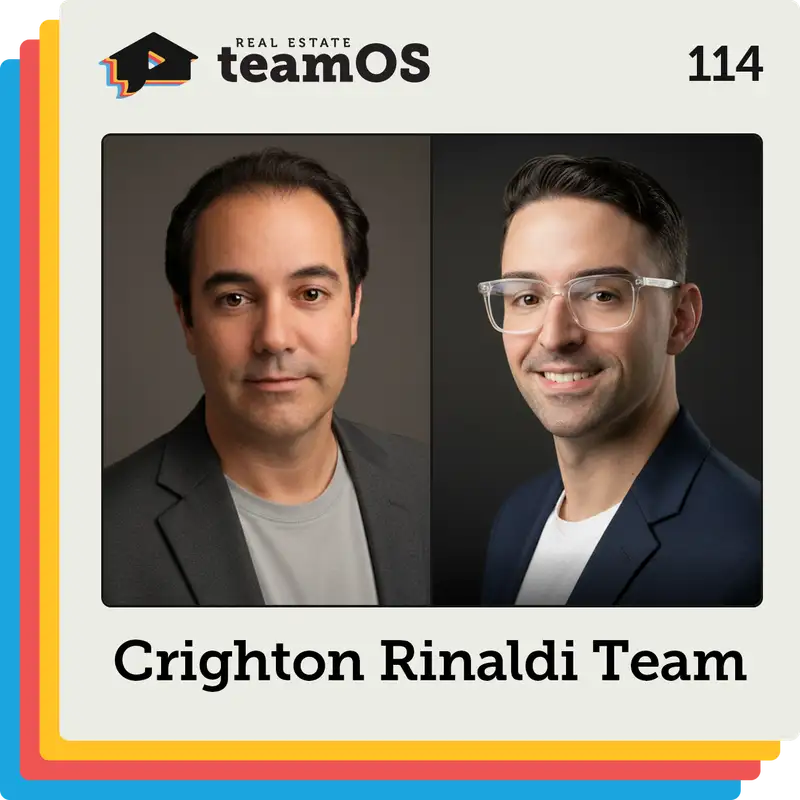
From Appointment-Fed to Well-Rounded Agents with Ryan Crighton and Danny Rinaldi | Ep 114
Speaker 1 (00:00):
Many real estate teams are designed to feed agents ready-made appointments, and it can be a good model. It can work, it can be efficient. But Ryan Creighton and Danny Rinaldi tried it and found they were building weaker agents. These two leaders of a 23 agent team in Las Vegas join us to share what they're doing instead. Here in this conversation, you'll learn how pulling back done for you appointments produce stronger agents and more business, how their accountability structure reinforces itself with less direct involvement, how a hybrid sales manager role drives agent and team success, and the vibe first recruiting approach drawing new agents who exceed set standards. Enjoy Danny Rinaldi and Ryan Creighton right now on Real Estate Team OS.
Speaker 2 (00:43):
No matter where your business is today or where you want to take it, you'll get there faster and more profitably with an operating system. Welcome to Team OS, your guide to starting, growing, and optimizing real estate team. Here's your host, Ethan Butte.
Speaker 1 (00:58):
Danny, Ryan, it is great to have you both here today. Thanks for joining me together and welcome to Real Estate Team OS.
Speaker 3 (01:05):
Ethan, thank you so much for having us.
Speaker 1 (01:07):
Yeah.
Speaker 4 (01:08):
Excited to be here.
Speaker 1 (01:09):
Yeah, me too. We got Creighton. We got one of the Rinaldis. And so we're talking to the Creighton Renaldi team, but we're going to start where we always do guys, which is what is a must-have characteristic of a high-performing team? And we'll start with you, Ryan.
Speaker 3 (01:22):
Especially right now, you've got to, like we had discussed before, you've got to really be in the weeds with your team. You got to show them that you're willing to get dirty and aggressively put yourself out there. And I feel like that's what we're doing. We've also got a great system that's set up for accountability to promote performance at a high level.
Speaker 1 (01:47):
We're going to get into a few of the things that you just offered there. And for anyone that's wondering, what was Ryan? We were just talking about the power hour that we're going to do immediately after we're done recording here, getting on the phones with the team, prospecting, setting appointments, calling into ponds, et cetera. We're definitely going to get into what accountability looks like. But Danny, for you, is there anything you want to add on in terms of a must have characteristic of a high performing team?
Speaker 4 (02:08):
Yeah, ditto to what Ryan said in regards to the team wanting to see that you're in the trenches with them, the weeds with them. They look to leadership for what to do. And that's why a lot of people join a team instead of becoming a solo agent. But I also think vibe is really, really important. I know culture is a very cliche phrase these days. It's often misused. If a company has a Waffle Wednesday or a Bagel Friday, it's like, oh, we have a great culture, but is it really? So we really use the term vibe. And vibe is just something people can pick up on subconsciously, intuitively when they walk into a room with you. So we've been very conscious about cultivating that vibe. No drama, no politics, no clicks and things like that. Because I think a lot of top producers are the type of people where they're like, "You can just lock me in a room with a list of contacts and I'll just start calling people.
Speaker 4 (02:54):
I don't need culture." But most people do. And that was a big eye-opener for me. So just being very conscious of the culture and the vibe that you're portraying for people that are on your team and as people join your team, I think is critical, not just to their wellbeing, but to how they eventually do perform when they're with you.
Speaker 1 (03:10):
Yeah, really well said. I get asked from time to time like, "Hey, you've done 150 plus episodes of this show. What are some top themes?" And one of the ones that I go to very often is that culture matters more than you think, especially if you think it doesn't matter. It is a big deal. And to your point, not everyone needs it, but everyone can benefit from it because even that top performer who's isolating herself or himself to do what they want to do still needs a well to tap into because not everyone can be up 100% all the time and not everyone has all the answers to all the questions. The other thing that I liked that shared there was that agents do look to the leaders. And the thing that's key about that is they don't always ask the leader. Yeah, you're available to answer questions, but they look to.
Speaker 1 (03:52):
And so you're modeling the behavior you want to see. Ryan, I would love to know what was going on in your business. You've been at this for a couple dozen years. What was going on in your business when you thought team or brokerage? What was your solo agent career like and what was going on when you decided you wanted to build something?
Speaker 3 (04:11):
So for me, I came into the business with my older brother. We started a brokerage immediately. So I've never seen the other side of things. I've never seen the big box brokerages or other independent brokerages. I've just done our own thing. And for a long while, we were just a family smaller brokerage that had us, some friends really here. And we started during the downturn in 08, we kind of adjusted tactics and we heavily invested in the market and invested in distressed properties. I also was an REO agent at that time and very, very listing heavy and I couldn't handle all of the buyers. And that's where I started working with people. And one of them was Danny's brother, Frank, helping me close those buyer leads that I was getting on all the listings. And it kind of morphed from there. And then we officially joined up Frank and I together in 2019.
Speaker 1 (05:05):
Okay. So this is a team inside a brokerage and you're the owner of both or part owner of both?
Speaker 3 (05:12):
Yes.
Speaker 1 (05:12):
Yeah. Okay. And so you and Frank started Creighton Rinaldi team and it was built off what every team should, which is too many leads, too much opportunity to do this the right way. Anything else about that partnership? When did it go from, okay, Frank is going to help me with this because we see eye to eye or we share similar values around client experience or whatever it was about that dynamic that made you guys click off the top. But you've got a couple dozen agents on this team inside this brokerage. When did you decide we're going to kind of push this thing? Because 15, 20, 25 agents is a lot different than three guys that like to work together.
Speaker 3 (05:55):
What I would say is when I went to Frank and said, "Hey, let's join up. Let's do this together because we enjoy working together." And at that time, my brother was taking a step back. He's traveling all over the world right now. So I enjoy working with someone. And I've never really done the complete solo thing. I always have someone to bounce ideas, someone to work against, work with, I mean. And so Frank and I made a very good team together like that. And then once we brought Danny on initially as an ISA, but he helped us see the organization, the set up and was much more operational, like savvy than us. And from there, we were able to properly handle a greater amount of agents, I would say, and just be more systematized. I mean, Danny could go off that because he loves the systems.
Speaker 3 (06:46):
Yeah.
Speaker 1 (06:46):
I was just going to say, it's a great handoff. I was going to ask anyway, Danny, like what was going on for you in your life when you decided to join the team besides that your name was already on the team name?
Speaker 4 (06:54):
Yeah, yeah it
Speaker 1 (06:54):
Helped. There's maybe like a minor obligation there, but like what was going on for you? What was your entry point into the team and what did you see as interesting for you and valuable for the organization like right out of the gate?
Speaker 4 (07:06):
Yeah, absolutely. I mean, back in 2020, during COVID, during the pandemic, my wife and I were living in New York. I've spent the first 30 something years of my life in Brooklyn, New York. And I was working down in the financial district in New York, going back and forth on the subway every single day, like some people see the cliche in New York life. And then COVID happened, started working from home. My wife started working from home. All of a sudden I got all this time back in my life. And I think during the pandemic, it affected people different ways. And a lot of people sort of were reevaluating, "Is this really what I want to do with my life? Do I want to be here? Could I go somewhere else?" And my brother Frank was always telling me, "Hey, come to Vegas, come to Vegas, come to Vegas." But New York people don't leave New York until they're forced to.
Speaker 4 (07:46):
And then we said, "You know what? There was a brief moment in time where we had the emotional pull. Let's go to Vegas. Let's do real estate. Let's work with Frank. Let's work with Ryan. Let's work with family." And I initially joined the team, like Ryan said, as an ISA, because my background was always just in phone sales, insurance, debt consolidation, debt settlement, financial products. It was always just on the phone. It was something I was good at. So the ISA felt like a nice intro for me into the world of real estate. And like you said, it's great if you're calling the prospects and trying to book appointments and you already have the last name, definitely helps. So I was making calls, I was working with the agents. And what I have found is that most agents told me the same thing, which is I'm great when I get in front of people.
Speaker 4 (08:24):
Once I get to that listing appointment, once I get to that buyer consultation, once I get to that showing, I'm good. I just don't have a pipeline full enough to do that consistently where I can just have commission checks coming in every single month. So initially it started out as a way to help agents get leads, help feed the agents so they can stay busy and productive. But then I realized it also turned into me as this novice who just has some phone skills, was really mentoring and coaching a lot of these seasoned agents on how to keep their pipeline full, sales tactics, nurturing tactics. So it sort of became a hybrid ISA coaching role. And then through followup boss, which is just amazing, we started putting together all these automations, smart list systems, ponds, lead flow, and the role just sort of organically evolved into a sales management role, which is what it is now.
Speaker 4 (09:10):
So it was really initially from a place of helping the agents get busy and stay productive and do deals. And it turned really into helping them just plan their day, plan their week and hit their goals. And that's sort of where we're at now.
Speaker 1 (09:22):
Awesome. Well, we're going to get into more details around the role, but one quick follow up for you before I have Ryan kind of characterize the team as it is here in Q2 of 2026. And my follow up for you, Danny, is like, as you got into real estate, I'm sure you had some ideas about it. You had heard stories, you had maybe had conversations. Certainly there was like a, what am I getting myself into in that conversation, whatever that was in the beginning. But did anything, within your first six to 12 months of being inside a real estate business, working with real estate agents, was there anything for better or for worse that surprised you about the business? Anything that was different from what you expected?
Speaker 4 (10:00):
Yes. I found that it's more important to be excited and enthusiastic than to be knowledgeable. Now, ideally you can be both and that's the ideal. But I see a lot of the time brand new agents start on the team and they know nothing about real estate, but they're excited and they're booking appointments, they do a deal really early on and then they get all this knowledge and then they get all logical and then they slow down and their results go down the tubes. So I think I found what was really important to me was how far you can go just by excitement, enthusiasm and a good attitude. And the knowledge is important. You're definitely going to need that, but it's not all just about knowing what the interest rates are, knowing how to do a CMA, setting up the perfect listing alert in the MLS.
Speaker 4 (10:42):
You have to have a good heart, you have to have empathy for people and you just have to have a positive go getting attitude. So that was helpful for me as a new person. And I try to instill that because we have a team of predominantly newer agents with the first place they work once they get their license. So that was a big eye opener for me that you can get by a lot further than you think without needing to know everything.
Speaker 1 (11:01):
I love that. I'm so glad I asked. Ryan, characterize the Creighton Rinaldi team however you like today, like markets you serve, size, structure, culture, anything you want to share.
Speaker 3 (11:15):
So we've got, well, we're now up to 23 agents on the team. We have Danny and I. Danny's mainly the sales manager. I'm the lead along with Frank. Frank runs now a lot of our investments and we do also flips. I think right now the numbers, when we looked them up from last year to this year, we've done half the business we did last year in the first 30, or I'm sorry, the first quarter of Q1 of 2026. So constantly growing, increasing, finding our footing. What I would say about our team is we're never perfect. We're always learning and trying to better ourself. And that's one thing that I get along very well with Danny about is, again, we're always trying to do better and I think that does very well for our clients because we're always trying to do better for them. And that's one of our mottos here at the team is it's let's look out for the client in every way possible.
Speaker 3 (12:17):
Once you start looking at them as a commission check, that's it. You lose those clients right away. You're never going to have repeat business. You're never going to get referrals. So we're a team who cares. That's us. And we think of each other like a family here. We do every Monday, we do family breakfast. We start the week off at the office. We do our sales meeting. We have breakfast for everyone at the meeting. And we've got a very good synergy between our agents. They don't always work on deals together, but if they've got questions amongst each other, they all help each other out. And we kind of build off each other's wins here. And it's a pretty powerful thing.
Speaker 1 (12:53):
Really good. And you serve the whole Vegas Metro.
Speaker 3 (12:56):
We do. We serve Vegas, Henderson, and Boulder City.
Speaker 1 (12:59):
Cool. And so far I've heard a new agent is a primary avatar, if not the primary avatar. How are you serving these folks? What I'm keying off here is treat people like friends and family from the get- go and they'll start behaving like friends and family, which is relationship, referral, et cetera. You actually have to care because when you don't, people can feel it right away. No one wants to be treated that way in any aspect of their lives and certainly not in a real estate transaction. What does lead generation look like for you all? I assume you're feeding and helping these new agents build books of business. What does that look like?
Speaker 3 (13:38):
Absolutely. So we do quite a bit of marketing. We do mailers, we do PPC campaigns. We're heavy into with YLOPO as well. We're a Zillow Flex team or a Zillow-
Speaker 2 (13:52):
Preferred.
Speaker 3 (13:52):
Preferred. Zillow preferred. I don't spaced it for a minute, but we're a Zillow preferred team. Even when we were market based pricing, I mean, we would get the notifications every single week. And I would say because of our standards and our accountability, it would say you're outperforming 100% of ... I mean, what do we get that 10 months in a row? You're outperforming 100% of agents around the country. I mean, we're very, very accountability based. So although we're this family friendly environment, there is definitely a need by our agents to do well with their performance. And I think that's where we've been very successful. So although we're taking on newer agents, we have a great training program to get them up and operational as quickly as possible. We fill them up with leads at the right space. So we don't immediately give you the Zillow preferred leads right away because we feel that if you ... I mean, it's an easier lead.
Speaker 3 (14:52):
In fact, we had an agent go out last night and they're writing an offer up this morning with a client. And when you're so used to that, you lose skills in other areas. So we try to get your skills going very quickly and on other types of lead sources, and then we introduce like the Zillow preferred leads and other sources and we feel it builds a better agent.
Speaker 1 (15:14):
Really good. Danny, when you and I were, when the three of us were chatting earlier, you kind of talked about this divide that Ryan talked about in the last two things that he shared there. One is this kind of family feel. This is a place where we all know each other, we spend time together, we treat each other maybe a little bit differently than we would in maybe more a colder, more hardcore air quote, business setting. You like have a different vibe to use your word for it. At the same time, standards and accountability and like top one half of 1% performance nationally on a program with a lot of really good organizations in it. And I know that you're recruiting or at least having some of those early conversations. I'm sure you're involved in the onboarding and training process as well. Talk about the way that you're talking about that balance between family and accountability.
Speaker 1 (16:04):
I'm just going to minimize or simplify it into those two words. How are you talking to agents about that and how is that received in general, perhaps compared to maybe some of the other things that you're getting a sense that they're hearing when they're interviewing other places?
Speaker 4 (16:17):
Yeah. So I spend the predominant amount of my time in recruiting interviews or during when they're in that recruiting pipeline, just talking about our vibe. So I definitely talk more about the vibe than the accountability in the other areas. Now, if they have questions about lead sources, splits, training, mentorship, coaching, all that stuff, I'm obviously going to get into that with them. But I really lean in with the vibe just because over the years I've found most brokerages that you interview out, they're going to talk about, "Hey, we give you leads, we give you training, we got a beautiful office, we're number one, somehow everyone's number one." But really what it comes down to is like, are you feeling that the place that you're joining, are you feeling that this conversation is going in the direction that lends itself to where you want to go with your life and your career?
Speaker 4 (16:58):
But the accountability, so they come in for the vibe, but the accountability aspect of it sort of is something that is enforced naturally. It's just like organic in the ecosystem here. So what do I mean by that? So we love getting people before they join the team. I always tell them, "Hey, look, before you make ... I think everything went great in this interview. I'd love to work with you. You mentioned you want to work with us." It's really important that you come to our team meeting, our family breakfast on Monday from 10:00 AM to 11:00 where we go over our wins, we go over challenges, we do a great training, but it's your opportunity to meet other people on the team and feel the vibe. And when they come to that meeting, our leaderboard is up and they could see all the people that are making thousands and thousands and thousands of calls every single month.
Speaker 4 (17:34):
And they see the face, the avatar and the leaderboard, then they see the person sitting next to them. And then when we're going over the wins with a very few exceptions, the people who just got a new escrow, just got a new listing, just had a new closing are usually the people that are making the most calls on the leaderboard. So whereas I used to have to sort of enforce this and put standards in place, it's sort of this self-enforcing environment now where they just make the connection on their own. "Oh, if I want to make a lot of money, if I want to do deals, I got to make a lot of calls. I got to have a lot of conversations. I got to go on a lot of appointments. "So more often than not, especially in the last year or so, people join the team and they blow our standards away.
Speaker 4 (18:09):
And we used to tell people make 200 calls a week. Now if you're making 200 calls a week, it's like weird that's all you're doing. People are just really flying by that. So I think it's leaning in with vibe, getting them into the environment, and then they realize the key to them succeeding in that environment is doing the work.
Speaker 1 (18:26):
Love that. You also shared with me that you've consumed some of these episodes and you picked up an idea from Brett Jennings and folks should definitely go check this out if you like what Danny's about to share here. So episode 98, in it, Brett shared this pure accountability pod structure. He broke down his system that he's now looking to acquire a bunch of teams and implement. And his bet is on the idea that this system can make other teams that he acquires performant. Talk about what you heard in that conversation and where that fits into what accountability looks like on the Creighton Renaldi team.
Speaker 4 (19:06):
I just think it's an excellent scalable model. It's something that was sort of on our mind, like, how do we do something to get the agents more involved with helping each other? So it was out of necessity and something I've noticed, I'll get into both of those real quick, which is as you start to recruit, your one-on-one time becomes more scarce. And when we bring someone on, we make a commitment to help them grow, learn, develop. They're going to have this FaceTime with me. And if you're having six, seven one-on-ones in a day, your seventh one-on-one, you're probably not going to be as operating at high of a level of coaching as you were with that first person. It's just the way it is. We all have limited energy. So from necessity, we said it's probably good to start organizing some of these agents into small groups of four or five pods.
Speaker 4 (19:48):
But then what I noticed on top of that was in the past, my experience is I could tell someone something over and over and over again. I can demonstrate it, speak to them about it for six months and it just doesn't sink in. But then they hear another agent on the team tell them to do it and they do it instantly. So I said," Hey, you know what? We might as well just make this a system where I'm doing some training, I'm doing some coaching, but the agents can feed off each other, learn from each other. And there's usually one person in each pod who's doing a little bit more deals or having a little bit more success than the other person. And now the last couple of pods I've done last week, I'm maybe talking for five or 10 minutes of the hour, whereas the agents are starting to role play with each other, coach each other, what works for you, what doesn't work for you.
Speaker 4 (20:26):
And it's great. I get to sort of watch and relax a little bit, but I found that people learn from their peers more than they do from you. And that's just an unfortunate or fortunate part of leadership, depending on how you look at it.
Speaker 1 (20:39):
I love that. And because you're right, I mean, this idea of scalability in sales leadership and sales management and accountability comes up constantly on this show. It has for over two years now because it is a challenge. You only have so much time in the day and to the other point that you raised, we only have so much energy and we always ... I don't know about you guys, but I usually come in pretty hot to the morning and just like slow burn throughout the day. Ryan, I'd love to go back to you and we've heard a bit from Danny about how he thinks about the business, what he's doing with the agents, some of the wins with them. I would love to hear anything you'd like to share kind of in this zone. I'll give you a few kind of characteristics of where I am in my head.
Speaker 1 (21:19):
And that is the benefit of having a sales manager or a leader alongside you who isn't selling, because I know that you are, and this partnership seemed, because Frank is working on these other aspects of the business. Danny is obviously dialed into the team element. And so I assume that both of those are shaped up against kind of an ideal role for you. So what role have you put yourself in? What was the benefit of having someone like Danny come alongside you in this? And what does a good day or a good week look like for you at this point?
Speaker 3 (21:52):
So as much as I tried to get away from it a while back, I really enjoyed the deal. I enjoy sometimes a bit of an inconsistent day, you know what I mean? Being out meeting with clients or helping work through deals with the agents. I've been fairly ... I'm a problem solver as well, so I like getting in and kind of dealing with these big problems that these agents come across and helping them find a solution. That's one of my joys. I don't know. It might be weird, but that is one of my joys. And it's hard to do that and be consistent with other aspects that are needed when running a team. And so what's great about Danny and being in the sales manager position and not in production at all, he is solely set up to assist our agents and help increase their production.
Speaker 3 (22:35):
That's his whole position within our company, and I love that. So in very few teams I feel like have someone that supports their agents as much as we do, that's all he's got to do is help get you doing more business. And the benefit to you is you're making more money. You came here to do better, and that's what we're set up to do. And it allows me to work with them on their deals to close more deals within the transaction, not getting up to that point. And that's really what I enjoy. That's fun for me, not coming in and doing the exact same thing every day. But to grow a team and to do well, you do need that consistency. So I think we're a very good marriage.
Speaker 1 (23:15):
Danny, you're guiding kind of the coaching conversations, productivity and ideas and helping people collaborate with one another. This kind of like, I'll just generically say deal doctoring component that you bring in, Ryan, is something that Danny kind of can't.
Speaker 2 (23:29):
Yes.
Speaker 1 (23:30):
He's done a whole ton of deals. Danny hasn't. So I definitely see how this partnership works really nicely. What advice would you have for a team leader who's watching or listening who maybe thinks I'm with Ryan, I do like the deal. Right now I'm still selling because I either A, love selling or B, I have to because the business doesn't work without my production. I mean, that's very common as well. Who thinks maybe I don't know if I can afford to bring on someone to partner with me in a similar way where you're freed up to be your best self and be of highest value to the agents and to also be of highest value to yourself and what you want to do with your clients. I imagine there's someone watching or listening that's like, "I like the sound of this. I don't know if or how I could put this together and make all the numbers work."
Speaker 3 (24:20):
And that was very tough for me to step aside. I'm very hands on and it's hard for me to delegate responsibility. We have a coach as well that helps us on a management side of the business and really has helped me see the benefit of working with people, delegating certain responsibilities, especially things that I'm not good at because it would be very hard for me to let go. And since we've done that, we've been able to grow in a healthier manner, honestly. So you definitely have to make a list if you're going to try and grow to a larger team of what you're good at and what you're not good at and what you're not good at and absolutely don't like doing because you shouldn't be doing some of those things and bringing someone on to help you with them will help you achieve your results quicker and better.
Speaker 3 (25:08):
So yeah, it is tough. You got to make the jump. And it's very hard for real estate professionals. I've seen it all the time because we're control freaks, a lot of us. You know what I mean? I don't like giving any aspect of my deal because then I can't control it in every way and something might go awry. And you've got to give that up a little bit. And once you do and you put some talent behind helping you run those areas that you're not good at, you'll end up doing them better.
Speaker 1 (25:35):
Yeah. Really good. Danny, can I assume correctly that you did not succeed a sales manager, that in fact you were the first person maybe to have the role as it is today. And if that's the case, how did you guys shape it up and define it? When it was, okay, you've proven that the ISA function could be super helpful. You kind of talked a little bit right off the top about, it started bleeding this direction anyway, like I'm doing a little bit more coaching now. How did you define the role and what success looks like in the role? What did that process look like in the transition from ISA to your role as it is today?
Speaker 4 (26:11):
Yeah, it's a great question. Very good question. It was constantly evolving and still is evolving. And I don't know if it'll ever stop evolving. So basically what the thought process was, here's me, I'm the only ISA right now. I'm making all these phone calls. We started investing in marketing, the database was getting bigger, the nurture pool, you can only nurture so many people at a given time, and the amount of agents we had was growing as well. So we had this idea, well, if I'm already helping them on the coaching side, prospecting, helping them with their own prospecting in addition to the prospecting I'm doing, why don't I just step back, teach them to do exactly what I'm doing, and then instead of there being one ISA feeding, let's say at the time, 10 agents, 10 agents doing what I was doing and feeding themselves, and then I can just listen to their phone calls.
Speaker 4 (26:59):
So initially, it was very much a sales management role that was very hands-on with coach, and it still is, but in a different degree, hands-on with coaching, listening to phone calls, role playing, adjusting scripts, leaving notes and follow-up offs like, "Hey, text this to this person." So just really like hands on, here's what you do next, not theory. And as the team grew, we sort of just kept that and scaled it out. So someone that's brand new on the team, let's say, I'll give you what the role looks like in the eyes of a brand new person. Someone joins the team day one, as soon as they get their license or they join and get their license brought over here. I'm doing some quick role playing with them. We have some AI tools that we help them with as well, but pretty much within 24 hours, I'm scheduling a time where one-on-one I'm going to be making phone calls with them.
Speaker 4 (27:40):
So even as the sales manager now, everyone that joins the team one-on-one, I make phone calls with them because I have found if I just tell someone, "All right, good, go make some calls." They may or may not, but if I'm doing it in front of them and I'm like, "Hey, I'm going to go make like 20, 30 calls. Maybe I get someone on the phone, maybe I don't." But then once I get to call like 20 or so, I want to go one-on-one with you. You do one, I'll do one, you do one, I do one. And I've found that the adoption rate of people prospecting, which used to be very low is, I don't want to say 100%, but now if someone doesn't start calling almost that day or that week, it's almost weird now. So very in the trenches, very hands on.
Speaker 4 (28:17):
It's a very flat organization. So they're making calls, I'm making calls, they need help nurturing lead script, leave little cliff notes for what I should call this person about on the page, I'm doing that. And then at the same time, there's also this operational aspect to it, which is I'm going through the database in my free time, looking for opportunities. So it's really a hybrid role between management, recruiting, and then the operational accountability and system side of things because I don't view those as ... I mean, I know obviously if an organization is really large, you have to separate those into different roles, but I believe if it's one person doing it and it's linked, they all compliment each other very well.
Speaker 1 (28:54):
You mentioned using different tools to do different aspects of it. I assume that technology has been a helpful part of how you're able to cover this much ground on a day-to-day basis without burning yourself out. I'm not asking you to name specific tools or brand names or whatever unless you feel like it, but what role is today's technology played in allowing you to run actively and be of service across that swath of responsibilities? Because I've heard of organizations about your size that have some division of labor here in particular, whereas you're still bridging a lot of it.
Speaker 4 (29:32):
Yeah, absolutely. So obviously we use Followup Boss. We love Followup Boss. We use all the action plans, automation, smart lists, everything's very easy to find, which I love, and it's very easy to train a brand new agent on that. We utilize Wylopo for a lot of our lead sources and remarketing. We use a lot of the Zillow tech as well. We utilize Maverick. They have a great AI call trainer, which is amazing. It really works well for us simply because I don't know what it's like. I know in other States, it's not like this, but in Nevada, there's this very long process between when you pass your real estate test and then when you get your license. It could be up to two months. So someone passes their real estate test, they're all excited, they're in this honeymoon phase, but they can't do anything for two months.
Speaker 4 (30:13):
And eventually I just run out of stuff to talk to them about after like eight weeks in a row. So having them on a system where they can make these phone calls, do this prospecting in their own free time has been an enormous tool for us to help hold them over to the real calls once they get licensed. But yeah, you have to leverage technology, being able to track, audit and reassign leads when they've been neglected, whether you assign them to a pond or one of your top performing agents, extremely valuable, especially as a team grows. I can't just check every lead that someone's missed or missed call. You need some type of automation in place to do that. So I would say we don't make automation and technology and AI everything we do. I still believe in the human element and being in the weeds with them and just getting my own eyes in the database, but you do need it to compliment at a certain point or you're just going to burn out.
Speaker 3 (31:01):
To build on some of the tools we have, especially with Maverick, we're able to see and check like what is our appointment ask ratio? Are people asking for the appointments? So we divide up the workload into dials, conversations, just like the leaderboard on FUB, dials, conversations, appointments. And we know if we're hitting X amount of deals off so many appointments, we're doing well. And if it's, we're having more appointments and not getting those deals, where are we missing it? Where do we need to ... And that goes for, especially the new agents. They'll start making a ton of calls, not having a lot of conversations. And Daniel said, "Well, listen, we need to work on your opener. That's it. The only thing we're going to work on right now is your opener to get you having more conversations. Then once you start having more conversations, when is the right time to ask for the appointment and how are you asking for it?
Speaker 3 (31:48):
" And making sure to ask for it every time. So we kind of work people through the workflow and Danny's great at analyzing that and getting people better at it and delivering the message right because for me, that's a little tough. "Hey, why aren't you doing this type thing? "But Danny works with people very well and helps them see where there might be an error and how they can learn and grow from it. But I would say one thing, like when Danny came on as initial ISA, we were a very, very different team and we were trying ... The goal at that time was we wanted to deliver to an agent like a ready to go appointment. And that was really like the golden egg. You know what I mean? We were trying to do this. And what we realized is by taking away this whole element of the prospecting, we had weaker agents.
Speaker 3 (32:37):
And now I would say we're doing a much better job at developing like really well-rounded agents that are good at every piece and they're doing a lot more business because of it. And I would say that other teams I think that are still doing what we tried to do, and even if they're successful at it, the agents, they're only good at their piece of the puzzle. And if you have an issue in the chain, you know what I mean? It's going to all fall apart. And so I would say that's ... I'm very happy with the agents that we have here because they're well-rounded agents that are, they understand the business, they understand how to work with clients, but they also understand how to acquire clients and work with them very well throughout the whole deal.
Speaker 1 (33:20):
Yeah. I super respect that. And it makes me think about just going back to where you open on Danny working on the opener with somebody because this particular metric is subpar and not fitting and then rolling that all the way out to we want complete agents and we're proud of complete agents because we know for a fact that not every agent is going to be with us for the duration of their career. Not that you don't want that, not that you're not serving them that way and not that the vibe doesn't promote that, but just a matter of fact, is they're all not all going to be there. And you guys strike me as the kind of people who might believe as I do that you want to leave things better than you found them. And I think you're being really respectful of their careers in keeping an eye out for that.
Speaker 1 (34:04):
It also reminds me of like, I don't know, training a basketball player. Yeah, every team needs that guy that can come off the bench and hit a three better than 40% of the time and play six to 12 minutes a game. But I don't think most agents want to be that person. They want to be ... I'm just going to go with ... I'm in Colorado Springs on the front range here. I'm going to go with ... Everyone wants to be Nicola Yokich. I led the league in rebounds this year. I led the league and assist this year. I led the league in shooting efficiency, which includes threes from the field and from the free throw line, like a super insanely well-rounded person is just in a better position to win in any environment.
Speaker 3 (34:45):
And it gives the client a better experience.
Speaker 1 (34:48):
Thank you.
Speaker 3 (34:48):
For us, it's all about what could we do to give the client a better experience and a better representative.
Speaker 1 (34:54):
Yeah, totally agree. Ryan, you've been in Las Vegas in the real estate market for over 20 years. It is probably the most volatile market in the United States over in this millennium. What have you observed about winning through the ups and downs as you went through some of these seasons, ups and downs? I mean, certainly COVID was an up for literally every market in the United States. So Dan, you're in play on some of this too, but what would you observe about winning in up and down markets? What do you want to be true all of the time? How do you adapt when things are going super well? Or how do you adapt when things are kind of on the rails? I mean, I heard REO was something that you spent a lot of time in, so I guess that's part of that answer. But you're the first folks I think I've had on from Las Vegas.
Speaker 1 (35:46):
It is one of the most volatile markets and you've seen a lot. So I figured I would just ask any advice from your experience through the ups and downs.
Speaker 3 (35:55):
It's definitely a market that keeps you on your toes. And I feel like we're always, in a way, trying to stay ahead of the game. You're always learning. The growth doesn't stop of knowledge because if you're not shifting and working as the market shifts, you go by the wayside. You really do. And it's a very, very competitive market here. There's some great agents out there that work in this market with us and we don't see them as adversaries. We do a lot of deals with them, but it's definitely competitive. And there's a lot of them that are our friends and I love going up against listings with them or a buyer and seeing who can win them over. But it's definitely a market that keeps you on your toes at all times. Even when it's going great and it feels like it's an easier market, it's really not because I mean, those are the markets you want to do extraordinarily well on.
Speaker 3 (36:56):
But when it's pulling back and right now, I think it was December, January, February, were some of the slowest transactional volume months that our market has seen since the crash. And I mean, we did a decent amount of business in because we really, we worked very hard. We didn't give up during the slower times at the end of the year. We had a lot of prospecting to set us up for a stronger spring season, or I'm sorry, start of the year season.
Speaker 4 (37:25):
And if I could just add one thing to that real quick, and I think part of, and everything Ryan said is accurate. Anytime the market's up, down in between, as long as I've known Ryan, he's always said something, "Well, there's opportunity." There's always opportunity regardless of the market. And I have a little bit of a weird perspective on this because once again, I've never been a field agent. I went from my previous career to an ISA to this. So I've never been the type of person that's obsessed with market stats. And I find that there's an epidemic in real estate that you have to just be knowledgeable about every little niche aspect of the market. You need to know every number up to date by the hour. And is it good to be maybe vaguely aware of these things? If you have a client who really wants to press you on this stuff?
Speaker 4 (38:04):
Absolutely. I found it's more valuable when you're speaking with other agents. I found it has very little application when you're speaking to clients, but from a psychology point of view, I try to almost not really get too into the weeds with numbers. And the reason for that is our clients are worried about politics, our clients are worried about the economy, our clients are worried about inflation. If we get stuck in our head about that too, we can't be the positive light for that person, if that makes sense. And then from an agent perspective, I found the more an agent entrenches themselves in market stats. When the market's really good, they just go, "Oh, I'm amazing." But when the market is bad, they go, "Oh, it's because the market's bad. That's why I'm not doing deals right now." And we could almost plant this negative seed in our head if interest rates are high or pendings are down or cancellations are up, we use that and lean on that as an excuse for why we're not going out and doing what we're supposed to do.
Speaker 4 (38:55):
So what I always tell the agents on our team is like, "Be aware of the market. It's good to have knowledge of what's going on, but the more engrossed you are and the minutiae of what's happening in the market every day, the less likely you're probably going to go do what you have to do because you're going to give yourself excuses more
Speaker 1 (39:09):
Likely." Yeah. I mean, we have limited time, limited attention, and what are we focused on, the most successful teams. Like you all, I mean, you sold as much in the first quarter as you did in half of what you sold all of last year, right? That's not by accident. I've talked with a number of folks on the show that are in a similar situation. They've been growing year over year in great chunks in what's certainly one of the toughest markets in recent memory in general, just in terms of transaction volume, but they're growing market share and in that way, growing their businesses. And so much of it is just doing the next right thing and staying focused on the stuff that works, which is, I'm hearing positive attitude, lots of contacts, good conversations and a lot of care for clients. Last kind of high level question, either of you can take this and either of you can add on to it.
Speaker 1 (39:56):
Obviously the show is about real estate teams, the team model. A lot of people are doing it a lot of different ways. Any thoughts on the real estate team model going forward? Will we see more of them? Is it just what it is? Why does this work for agents? I have some of my own thoughts, but I always like to ask people that are in the field doing it. Any thoughts on the team model at a high level and potentially the future of the team model?
Speaker 3 (40:23):
I mean, I think that we're going to see a lot more from teams in America, in our environment than the new, I call it the Amazon world. I mean, people click a button, they want to see a property. It's very hard for a solo agent to work a larger database and give the clients what they want on the time that they want quickly. And the team allows us to do that. They allow us to service clients with what people expect nowadays, which is frustrating in a way, but the client is changing and what they're expecting is changing. Now we do have to educate them and work with them to understand what's going on with the market or with the house or whatnot, but in order to grow your business, that's not strictly based on your SOI. I think having a team allows you to handle a great number of people.
Speaker 1 (41:24):
As Danny, you may know, right? I don't know if you've been listening to the show at all, but I always have three pairs of closing questions that I like to close with and I feel like I have a minute. So I'm going to ask you both all three pairs and you can answer one or the other. And so I'll start with you, Danny. What is your very favorite team to root for or what is the best team you've ever been a member of besides Crite and Rinaldi and it doesn't have to be a real estate team? Best team you've ever been a member of or favorite team to root for?
Speaker 4 (41:51):
Yeah. I'm not just saying this because she's going to watch it afterwards, but I think my wife, the team that my wife and I make together, definitely best team I've ever been a part of. Always had my back through thick and thin. We have a great marriage. We work as a partnership. I remember we got married right before COVID happened. We were living in a 400 square foot apartment in New York and Brooklyn, New York. And everybody I knew at the time was like, "Oh, I'm stuck in the house with the wife or I'm stuck in the house with my husband." And we were having a great time. We love hanging out. So definitely my best friend, biggest cheerleader. I'm her biggest cheerleader. So definitely my favorite team I've been a part of.
Speaker 1 (42:24):
Cool. Ryan, any teams come to mind for you?
Speaker 3 (42:27):
I don't even know how to follow that up because if I don't say my wife, right? Thank you, Danny. Thank you. No, I love my wife. My wife is amazing. I would say, so growing up here in Vegas, we always wanted a sports team. And so I'm a huge, we have season tickets, nights fan, gold nights fan. And not that I'm a member of the team, but favorite team to root for. I love the gold nights, going to the games all the time, taking the kids to the games. We have a lot of great memories and I'm so grateful for them when they came to Vegas and they came at the perfect time and yeah, definitely a very big fan of the Golden Knights.
Speaker 1 (43:04):
Cool. I love the way the NHL does that expansion draft and the Knights did a great job with it and came out hot. Yeah. I'm a fan as well, not like a super fan. I'm an Avs fan and a Red Wings fan, but full respect to the Knights. Danny, what is one of your most frivolous purchases or what's a cheap skate habit you hold onto even though you don't need to?
Speaker 4 (43:25):
Ryan's already laughing because I'm never frivolous. I'm the cost cutter, but definitely cheap skate habit. What I would say is, so I have a spreadsheet that I use for everything. And there was a point in my life where it was from necessity, a paycheck would come in, bills would go out, so I would track my dollars in and out. And now I'm 36, probably don't need to do it to the level that I was when I was 21, but whether it's a major purchase or my wife's like, "Hey, I'm going to Target to get some pants or something." I'm like, "Hey, did you check the spreadsheet?" I'm working on letting go, but it's hard. But I think it's benefited me in my life, but I could definitely ease up on a bit.
Speaker 3 (44:05):
Everybody knows about the Ronaldi family budget sessions that he puts his wife through. And what's funny is I go out on the floor and see some of the agents. They have his little sheets that he's made for himself that they do, but the agents love it as well. It makes you-
Speaker 4 (44:21):
I've heard about your sheet, Danny. Can I have access to it? I'm like, "Sure." So now I got everybody cheap in the office.
Speaker 1 (44:26):
That's great. How about you, Ryan? Do you have any habits you want to share?
Speaker 3 (44:31):
Habits? I don't know.
Speaker 1 (44:33):
Or one frivolous purchase.
Speaker 3 (44:35):
I have a frivolous purchase recently that I bought at the end of last year that I had wanted and everyone makes fun of me about it because I have a family of five, but I bought a Cabriulet Porsche and a nine eleven. Love it, love it. Doesn't fit my full family. But my son and I had fun with it and it was just one of those frivolous things that I wanted to enjoy. And we did for a couple of seasons, but now as it's heating up, it's no fun to drive at the top down at all. And it's not practical in any way, shape or form for my wife, I and three kids, because it doesn't fit us all, but it was definitely a frivolous purchase that I recently purchased.
Speaker 1 (45:19):
Yep. Well, being able to do something with your kid around it, I've heard that story a little bit. I'm like, "That's not so bad." And it's something that brings you joy. So well done. Danny, what does it look like for you when you're investing time in resting, relaxing, and recharging? What do you like to do? Or what do you like to do when you're investing time in learning, growing, and developing?
Speaker 4 (45:38):
Yeah, absolutely. So in learning, growing and developing, I would say from an early age, I was around people that always read self-development books. They weren't really podcasts when I was teenagers, but would order the audio CDs by mail, the self-development courses. Totally. So I was always just around that environment and I really just, I gravitated towards it. So I'd say in my 20s and up until a couple of years ago, I think I read every self-development book under the sun, listen to every podcast, went to every convention you could. And I still do. I love that. I love that culture of self. I'm like a self-development junkie, if you could call it that. I love it. But I've realized in the last couple years, there does come a point where it has to go into practical application instead of just the constant reading or attending.
Speaker 4 (46:18):
It's all great, but you have to apply it to your life. So now, for me, growing is how do I say yes to things that would normally scare me? How do I put myself in situations where maybe I'm like punching a bit above my weight when I'm maybe doing something I'm not qualified for, but I've sort of trained myself now where if someone offers me something, offers us something and the first thought in my mind is, "I may be a little out of my depth on this one." I take that as a cue, I should probably do it. And I take that from all the content I've consumed over the years. But one big self-development book made a big impact on me than the other ones. Steven Pressfield, War of Art. It's a little play on War of Art. And the whole concept of that book is the thing that you're resisting is probably the thing that's most essential for your growth.
Speaker 4 (46:59):
And so now I take that negative feeling, that fearful feeling as it's probably something I should do. And that's helped me a lot.
Speaker 1 (47:08):
Really good advice. And I also highly recommend that book and I will link it up down below along with a couple of other things that we've mentioned in this episode. We always write these up. There are links down below, whether you're watching in YouTube, watching or listening on Apple Podcasts or Spotify. We'll have video and Apple podcasts soon, or you're watching or listening on the website. Always tons of stuff down below and we're going to get a few more links in just a minute. But Ryan, how do you prefer to rest, relax and recharge, or how do you prefer to learn, grow, and develop?
Speaker 3 (47:35):
I would say rest, relax and recharge is essential in the business because especially in a time like now where you can be constantly turned on thinking, "What do I need to do next? What do I need to do next? I need to work. I need to work." I've seen that. And sometimes taking a step back allows you to be much more productive. And that's even hard for me at times. Danny's the one who will point it out and say, "You need to stop, go do something and then come back to it. You're going to do better." And that's what's great about Danny. But I love to travel. I love going on trips with my family and friends and all over. We went to Danny and I, and the wives went to the wine country last year in Napa in December. And I traveled all over the world and I really enjoy that.
Speaker 3 (48:20):
I love all other cultures. I love food. And so another thing I love to cook. And so it just helps me kind of get outside my head and recharge, like you said. And I always come back doing better.
Speaker 1 (48:36):
Really good advice. And just another kind of button on what a great partnership this is. I'm so glad you guys are working together. I'm so glad that you spent this time with me and for everyone who watched and listened as well. I'm really excited about the way you compliment each other. And again, you're just last pass there, Ryan, really emphasize that if someone has gotten to this point, they may want to learn more about the Crite and Rinaldi team, or maybe even reach out and connect with either of you directly, what kind of links should I throw down below in the description for them?
Speaker 3 (49:04):
We've got a link that we can send out for you. Absolutely. Danny's got it. Cool.
Speaker 4 (49:09):
Absolutely. And you can reach ... I'm a little more active on Instagram. So it's my Danny Rinaldi is my handle. Feel free to follow me, DM me, reach out to me and put my cell phone number in here too. Ryan's as well. If anybody just wants to reach out to us, call us, text us, reach out. We're always happy to help, answer questions. And we love collaborating with other people. So it's what we do.
Speaker 3 (49:28):
One of the things that I feel agents sometimes will get stuck in is I've got secret sauce and I don't want to share it. I've noticed though, and it took me a while to get out of that. When you do meet other people and when you do share things and talk about the business and see what's working over here in another market or whatnot, even if it's your own thing that you're explaining to someone else, you might do it better after that explanation. You might say, "Oh, now that I'm saying this, it might..." And so don't be afraid to share and reach out to us as well. If you've got questions out there, we're always happy to talk and meet new agents, new team leaders and chat about the business because oftentimes we learn from it.
Speaker 1 (50:05):
That's my favorite feedback that I get on the show. By the way, if you ever have anything you want to share, just email me ethan@followupos.com. But when I have guests say, my episode went live a week or two or three ago and I've had great agents reach out and I've had great conversations, that's what this is about. It's about building community and helping each other. It's one of my favorite things about the real estate space overall. I'm really glad you gave voice to it at the end there, Ryan. I'll include all the stuff that you share with me right down below in the description. Appreciate you guys and hope you have a great afternoon.
Speaker 3 (50:34):
Ethan, thank you so much. Appreciate it.
Speaker 2 (50:36):
Thanks for checking out this episode of Team OS. For email exclusive insights every week, sign up at realestateteamos.com.