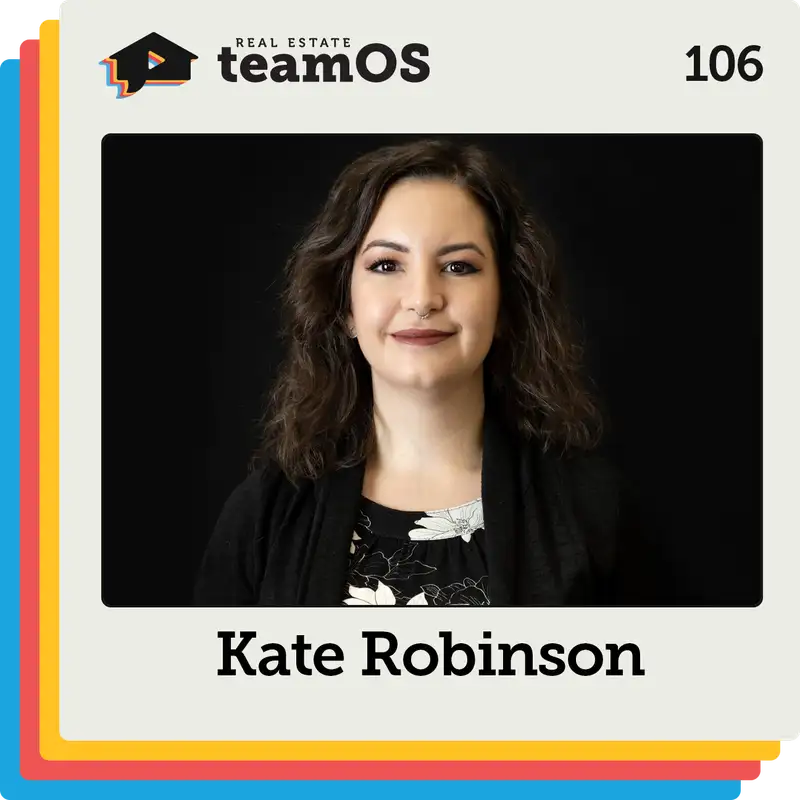
Going All In with One Builder to Grow Your Real Estate Team with Kate Robinson | Ep 106
Speaker 1 (00:00):
Wondering how you can sell more new construction or curious about how to partner more effectively with a home builder. You are about to learn how a deeply integrated relationship with one builder helped propel Mel Nchu real estate group to being the number one Century 21 real estate team in the world. Longtime team member and operations manager, Kate Robinson. Details for you here. The history, foundation, development and success of that partnership as well as how agents earn and keep a spot on the new Build team. What top performing agents do differently, which agents might make great staff members for you in the key metrics, systems and responsibilities of her role? Enjoy this time with Kate Robinson right now on Real Estate team os.
Speaker 2 (00:47):
No matter where your business is today or where you want to take it, you'll get there faster and more profitably with an operating system. Welcome to Team Os, your guide to starting, growing and optimizing real estate team. Here's your host, Ethan Butte.
Speaker 1 (01:02):
Kate, I am so glad that we followed up after we connected that unlocked several months ago. I'm really excited to dive into your role or roles I guess over the years with the number one Century 21 team in Alberta for many years running and the number one Century 21 team in the world in 2024 and maybe 2025. We'll find out before this episode releases. Welcome to Real estate team os.
Speaker 3 (01:25):
Yes, great being here. Thank you so much. Really glad to connect. Again,
Speaker 1 (01:29):
We start with the same question with everyone, so I'll ask it to you too, and that is what is a must have characteristic of a high performing team?
Speaker 3 (01:37):
I definitely have to say for me personally, it always comes back to self-motivation. High performing teams don't need to be micromanaged. They have a grind mentality, they take ownership, they push through the obstacles and they don't stop when it gets uncomfortable, they stop when the job is done and for us and our team, the job's never done.
Speaker 1 (01:59):
What are y'all driving toward that just keeps you moving
Speaker 3 (02:02):
Client and customer satisfaction? Honestly, how we can improve the customer experience in our service. That definitely drives everything that we do. How can we make it better for the people that we work with, the realtor relationships that we have and our builder client as well.
Speaker 1 (02:19):
Cool. I can't wait to get into the builder client piece of things because that's a really interesting and important part of your business, but I'd like to proceed with just your arc. How did you connect up with Mel Nchu and what's that journey been over the past seven, eight years? I think you've been with the organization.
Speaker 3 (02:36):
It's been a long time. So I joined up with Mike Mel Neuer team lead back way back when in 2012. I was an agent at the time and I joined up at the time there was only three agents, Mike, myself and another agent, and there was one admin. I worked with Mike for maybe about three years during that time and then I had children and just decided that, okay, well maybe I'll just stay at home and be a stay at home mom, but that definitely didn't suit. I wanted to get back into it. So after my second born was a year old, I joined back with the team in an admin role, more reliable hours, steadier pay, I'd still be able to be home and be with the family. That was kind of my focus at the time. So I was a transaction coordinator for from, I think it'd be 2018 to about 2020 and at that time I moved into an operations manager role.
Speaker 1 (03:41):
I think what you did is interesting and I think it's more common than most people understand and I know that there are a lot of team leaders looking for great people on the staff side of the business, and a great place to look is the Asian population. So I think what I heard from you is quality of life essentially like I'm still a mother, I'm still a parent. I still want to live a great life both personally and professionally and for me that means maybe going to the staff side of things. So I'd love for you to give advice or a word of encouragement to an agent who loves the business but not necessarily the lifestyle or to a team leader or ops leader who's got a sharp agent who's maybe just not in the right seat.
Speaker 3 (04:27):
Yeah, no, that's a really good point For us, especially finding admin staff is incredibly difficult and that's not to say I went in this being like, oh, I'm going to be a straight nine to five going into it. I work 16 hour days now seven days a week. It's very different, but admin is very varied and nuanced. So you can have a TC that only works nine to five. You can have a listing coordinator that maybe works a bit outside of business hours to be able to go to the listing appointments, meet up with sellers on weekends, et cetera. It's very varied, but what we have noticed is that you need to find the right people for the right fit. So you really need to look at the requirements for the role. What are the personality traits that are needed? Do they need to be detailed oriented?
Speaker 3 (05:20):
Do they need to be able to multitask? Do they need to be being able to handle a monkey wrench thrown into their daily and not have their day go off the rails? Being able to get back on track and focus on what you were doing. Our team is very high volume as you mentioned, so no day is the same. To find an agent that wants to transition to an admin role they need, there cannot be any me in it. It has to be a we. They need to focus on the whole, and for us, for our admin agent, success is our success. We're not doing something right if they're not feeling accomplished and supported.
Speaker 1 (06:01):
Really good. Have you found success outside the industry? I mean, you talked about personality traits, you talked about skill sets or ability to work in a particular type of environment that may or may not be an agent. Have you had success finding people in any other particular industry?
Speaker 3 (06:19):
For our history, we normally bring in people that are completely green, a hundred percent green. We found success in that it takes a long time to train, but at the same time there's no bad habits to correct and you don't necessarily have to have a history with real estate. In order to be successful in it, you need to have the grind mentality. You need to be able to just keep track of a lot of multiple things at the same time. Organization is really key. Also, communication. We have four full-time admin on staff. We talk throughout the day all day. We are everywhere, sometimes in different provinces, different cities. We really need to keep the lines of communication open as well as with our 17 agents that are on the team who are spread out all over the place. So we need to make sure that everybody's on the same page. Expectations are set and follow up is there to make sure everybody continues to be on the right path.
Speaker 1 (07:21):
I heard four admin, I heard 17 agents. We've already established Alberta, but there are multiple markets. I think before we kind of dive into some specific topics, I'd love for you to give just an overview or drive by on Mel, Chuck Real Estate group, anything that we haven't covered that you think you'd like to share, other markets that you serve, culture, structure, anything else?
Speaker 3 (07:44):
So we started in Edmonton in 2012. As I mentioned, three agents. We grew with intention. We weren't looking just to add agents in just to bulk up our numbers. We wanted to make sure it was sustainable and intentional. We expanded into Calgary in 2021. We now have seven designated agents in Calgary alone to support that area. And then just this past summer actually, we expanded into Winnipeg, Manitoba, which is two full provinces away from us, and we have an agent out there and we're looking to expand this. Last year we added a new agent in, I guess it was the summer for Winnipeg when we expanded and we added one in Calgary and one in Edmonton in around November. So they are all still actively in training, but they are definitely amazing assets to the team. As I mentioned, we're Edmonton, Calgary, Winnipeg, and area, so there's a lot of different suburbs and stuff around the cities that we also serve.
Speaker 3 (08:44):
We are not just city Central, but it's been a long road. We've been doing this for a while. Our support staff, as I mentioned, we have four full-time admin, both my sales manager and myself, the operations manager. We've been doing this for at least 18 years each. We have the experience. I have the experience of also being an agent as well as admin as well as more like senior leadership. My sales manager has worked with brokerages nationwide on a social media scale. She's worked with various builders. She's worked with agents as an assistant as well as on a team. She's very educated. She's been on the, she's actually was part of the conversation for the condominium laws that got brought in a couple of years ago. She was tagged in by some lawyers, so she's very well versed, she's very knowledgeable. We have a really good set of admin on our team. We have a designated listing coordinator, a designated transaction coordinator, and something really exciting that we just did a couple weeks ago is we added a marketing director. So full-time they're going to be going through all of our branding, all of our marketing, really dialing in the client experience and our systems just to make sure everybody's on the same page, especially as we cover a lot of areas. So we want to make sure we stay consistent, we put the right foot forward.
Speaker 1 (10:14):
So can I assume correctly that some of that market expansion is driven by a key builder relationship?
Speaker 3 (10:20):
It is. It definitely is. Especially when it comes to Winnipeg and actually our expansion to Calgary as well was driven by our builder client picking up lots and land in Calgary and we're like, we're going with you and we're going to be working together. And that really started our expansion into Calgary, which has been tremendously successful, and this past summer we expanded to Winnipeg and we are looking at even picking up more lots. So we're doing really well out there for being a brand new builder that no one is familiar with in a completely new province.
Speaker 1 (10:54):
We're going to dive into it after we cover a couple other topics, but I love a partnership where both organizations grow together and I think that's the story that we'll get. But I'd love to stay here a little bit in, you did a great job breaking down some of the roles and the structure of the organization. I'd love for you to talk about your role. What is your role today? What's included, what's not included? Is it a net new role or were you filling in shoes that existed before? Just talk a little bit about what your day-to-day, week to week looks like and what your role is shaped up to be.
Speaker 3 (11:26):
Yeah, my role is very, it's all over the place. I wear a lot of hats, so I still am involved in transactions with our builder client. I process new deals. I'm mostly involved when it comes time to when we receive a waiver and we send paperwork to the builder so we make sure all the details are included, any changes to the contract, any repairs that are needed, possession, stuff like that to make sure everybody's on the same page. I send it to all the departments that are required. So I'm still involved in transactions that way. For the team sphere, I do all of our systems or operations. I train our new agents. I work on all of our systems, our automations or anything with follow-up boss, I'm your person, that's my baby. I coincide with our sales manager and I'm kind of her number two. So anything to do with our builder client, I'm the backup, so I receive the same information as well. So if she has any time off, I'm able to fill in. But it's a lot of training, just adapting every day, kind of brainstorming, being innovative, really the market changes so quickly, so we need to keep on top of it. But yeah, I wear quite a few hats. I still deal with leads that come in reviewing paperwork. It's a lot. Yeah,
Speaker 1 (12:59):
Yeah, it sounds like a 16 hour commitment. What is your title? What do we call this?
Speaker 3 (13:05):
Operations manager.
Speaker 1 (13:07):
Okay.
Speaker 3 (13:08):
So it's kind all encompassing, just kind of little of this, little of that. But yeah, my real passion is the systems, the operations, running the day to day and supporting our agents and what can we do together to build their business to the next step.
Speaker 1 (13:28):
Cool. Talk a little bit about the tech stack that you've built. I mean, you already mentioned follow up Boss, but I assume that a lot of the agent training that you're doing is on the systems and processes that you've designed to help them be productive. Talk a little bit about that relationship and what you've built to support
Speaker 3 (13:44):
Agents. So when we first joined with Follow-Up Boss, again, we're going on year six, we joined with them 2020. Our client success manager, Jeremy, was instrumental in setting everything up because we have such a unique kind of workflow where our primary client is this builder and we weren't really sure how to incorporate that compared to normal resale together, we brainstormed a lot of meetings over a lot of time, figured out our action plans or automations, our general workflow, how are we saving people in the database, how do we make it streamless and stress free, and being able to pull the data out because in order to really reflect on our successes, we don't know what's going on unless we can pull the data out and take a really good look at it. So our sources, where's our business coming from? How many deals are we doing in which neighborhood, in which city, in which province?
Speaker 3 (14:51):
Are we working a lot with one particular agent like Realtor? For an outside agent, should we maybe consider bringing them onto the team if we've had a positive experience with 'em? We are very realtor friendly. We don't really find ourselves competing outside. It's more of a collaboration once all work together for the greater good. But follow-Up Boss has been instrumental in our success. It's been extremely helpful from tracking from when we first get the lead right through to going through writing an offer and talking in the part of working with our builder where it's at post offer, waiver, warranty, period, everything we can see everything. We keep track of working with multiple agents where it's like, okay, well we're working with them resale here, we're working with them. New Build here.
Speaker 3 (15:43):
Oh, this Edmonton agent is also interested in our Calgary inventory. Let's connect them that way. Also supporting our different city teams and having things set up differently for that way. So Followup Boss was definitely instrumental in helping us kind of customize and tweak what we need for our team. I could go on about followup boss all day. Honestly, I feel there's such an untapped market for when it comes time to working with developers or builders. I would love if someone mentioned, oh, we're going to do a special team to brainstorm and help more builders, I would be your person. I would be all over that. I'm really passionate about having the systems and support for the agents. I feel that their job should be boots on the ground talking to clients, meeting clients, and there should be a system in place to support them along the way, especially in busy markets so that you keep your pipeline full while still maintaining that human connection. That's very important.
Speaker 1 (16:50):
Yeah, I really like the divide that you made there. I mean, I think that is in the face of all the technology that's emerged over the past decade and certainly over the past five years in particular, putting agents in that position to be real people in service of other real people is probably the top priority, at least philosophically. One of the things you shared in there that I thought was super interesting is tracking very specifically who's on the other side of your transactions and perhaps identifying really good fits for the team. Did that just occur to you naturally in doing some of your reviews of things?
Speaker 3 (17:24):
Yeah, we always like talking to our agents and being like, and even for admin staff, we're going through, we can see the conversations that are happening. We can see the texts that come through, we can see the emails and we could see, okay, well which agents are giving us a hard time, which ones aren't so good to work with? So that other agents on our team, we get an offer from this person, or maybe we receive an offer from them for a resale and we're like, this is our past experience with this agent. Keep an eye out for this. We also track dead deals as well, so if we have an agent that comes in and they just keep feeding us offers that continuously die, we'll be like, Hey, do you have a pre-approval to make sure that we're not wasting time here? We also, like I mentioned before, keep track of really positive experiences, which we'd like to focus on more. If we know that for our builder client, we can go to them being like, you know what? This is a lower offer, but this agent has brought us five deals this year. Maybe we can make some movement and we want to foster that relationship so that they continue bringing us leads.
Speaker 1 (18:32):
Can I assume correctly that again, your training function is around tech and systems and processes primarily? Yes,
Speaker 2 (18:40):
Yes.
Speaker 1 (18:40):
What does that cadence look like? How often are you training? Are you training virtually? Are you training in person? Share a little bit about what that looks like and kind of how you settled on that cadence as the one that works for you and your group.
Speaker 3 (18:53):
Yeah, so we've gone through a couple changes with with the team being so large and being kind of geographically apart. I do a mixture of Google Meet. I do in person if they're in Edmonton. I've also traveled down to Calgary to do training. I've been up to Winnipeg as well. That was fun. But what started was we, on our teams meeting, we used to do a team meeting every week and our team just grew so large and so geographically diverse. We're like, you know what? This isn't going to really work. People have appointments, whatever. We got really busy and we found that people just couldn't make it. So then we're like, okay, we're going to do it digitally. We're going to do, because we used to rent out the boardroom at our board, the real estate board and have everybody come there, and then it was just traveling from all over the place.
Speaker 3 (19:50):
Okay, we're going to do it virtually. Alright, well people seem to zone out or I can't make it because I have an appointment. They weren't very connected. So then we're like, okay, we're going to do maybe quarterly meetings, and I was like, we're going to dive in and we're going to set goals. And for me, I was like, okay, well let's track consistent actions. So every December, November, I like doing business planning with our agents. Okay, well how was your year? What do you think you could do differently? Where do you think you shine? Where do you think you struggled? What can we position ourselves for in the next year? And based on the previous tracking habits, thanks to follow up Boss, we know how many appointments I had, how many calls, average attempt contacts, who they have in their pipeline in terms of lead stages, A, B, C, what's on, where can we position that?
Speaker 3 (20:48):
So it's like, okay, well if you want to reach so many units, so much sales volume, break that down, but also keep that human connection to what are your personal goals and how is that going to affect your day-to-day business. I'm a big supporter of time blocking, but as you know with real estate, anything can happen day to day. So I'm like 15 minutes, give me 15 minutes, do your smart list in the morning or whenever you can, and we'll go ahead and we'll do that. Currently I do training on demand, so I'm working with two of our agents. One definitely more intensive. I meet with her weekly. Every Wednesday morning I meet with her and she's struggling organizationally. She's so busy, she doesn't really have the systems in place. So first thing was let's get your email on track. Okay, let's get that filtered out.
Speaker 3 (21:43):
Okay, let's go through your follow-up box. Let's clear out all the overdue, kind of unneeded tasks that are there so that you can focus on the important ones that come up every day. If we assign 'em, we go over calls, okay, well who can you call today? Who are the 10 people you need to focus on today? Take eating an elephant, one bite at a time, right? Making it really not overwhelming and they feel accomplished, right? So small wins add up and give that sense of confidence and instills that they can actually do it and then it's not impossible. So I meet with her every week and already I've seen leaps and bounds. She's great getting a lot better with paperwork organization, definitely have a lot more to go. Our office and our team's completely paperless as well, so online organization is very key. So passing on those, I guess, tips, tidbits, structure to the team really helps. We're all on Google Workplace, so they all have access to Google Drive to store all of their information, but right now I do mostly one-on-one training on demand, especially with our new agents that we brought on. We're doing paperwork training, objection handling, role playing, that sort of thing.
Speaker 1 (23:03):
Again, this sounds like a 16, 16 hour commitment for sure, and I love the devotion to one-on-one training. I think it probably lands better and connects better, and it's obviously much more custom to that person. High level question here that's directly related in terms of your most productive agents and some of these folks that really need or want more direct one-on-one training, which I assume are not necessarily the most productive folks on the team. Any other key observations if you were to just draw a line and say Our most performant people do some of these things differently with regard to either activities as you were talking about or even about adapting tools, tech or processes?
Speaker 3 (23:49):
Yeah, no, that's a fantastic question. We've seen a direct correlation with the agents who use F to its full extent. They're tracking their appointments, they're making notes, they're relying on fub to do their calls and they're doing them consistently. I will take someone who is hungry and consistent over someone who has talent any day. If they have talent and they're inconsistent. I would rather take somebody who's willing to learn and is consistent are agents. Definitely the more success they have, the more that they do use follow-up boss. I find that if they're not using the systems that we have laid out for them, they struggle a bit more. They're not, all of our agents are good performers for sure, but I find that it's less of a hassle and a struggle for them. They get that success easier if they use the systems that we have in place and even the one that I'm doing one-on-one time with, she's one of our top performers, but she's so busy, she's overwhelmed. She doesn't really, her systems have gotten away from her, so we need to bring her back to basics.
Speaker 1 (24:57):
Love that, and happy to hear. Okay. In terms of where all of your deals are coming from, I assume that there's some sphere activity. I know that there's a great builder relationship that we're about to dive into. Any other main sources of opportunities before we dive into the Builder partnership?
Speaker 3 (25:15):
Well, we do use YO. So the agents, if they aren't working or if they're done going through their spear calls, their past client calls, all of that. If they're, because not all of our agents are on the new home sales team, they have full access to Y LO O and to use those leads, we've seen some success with it, but most of our agents would prefer to work their sphere. Our team motto is to nurture your network. So we place a really strong value in building and maintaining the relationships that we create.
Speaker 1 (25:51):
Okay, so now that leads to a bridge question, which is who is on the new build team and who isn't and why
Speaker 3 (25:57):
Not everybody, I think all but two of our agents are on the new build team and joining our team doesn't automatically give you a spot on the new home sales team. Our training regimen is extremely intense. It takes about a year to be fully trained to do new home sales. The first 90 days are very intense. You have weekly quizzes and you have to pass with at least 80% grade. If you fail three, you're done. You don't get another chance. We really want to see passion for what we do. They learn everything from, there's a very distinct difference between an A SMA normal builder representative, and what we do, we act as educators. So our sales team knows everything about our spec, knows everything about what's used to construct the homes. We train in role playing, in objection handling, everything that comes down the pipe. So even they're very familiar with the permitting process for the home and if we have a delay here, how that affects us here. The training is extremely intensive and even still, once you're fully trained, we still have biweekly meetings to go over everything to make sure that they're kept on top. We do pop quizzes, our sales manager and our senior trainer on the team, they travel between Edmonton, Calgary and Winnipeg to make sure everybody's on the same page and everyone is held to the same level of expectations.
Speaker 1 (27:40):
Man, I understand why you've been invited in to grow with this builder. I mean, that level of commitment is incredible. I'd love for you to go back a little bit. I think you've been part of this relationship probably from the beginning. I'd love for you just to kind of characterize how this came together, the opportunity as a leadership team, as you saw this opportunity, when did you really fully commit to it, and then just talk a little bit about what else you do for the builder that they couldn't maybe get with other teams or organizations.
Speaker 3 (28:12):
Oh yeah. So this builder, it kind of came at a pivotal time. So in 2017 they used to be a custom home builder and they made the decision to go to a spec home, which means everything is preselected, everything's good, no customizations. So that was back in 2017 and I believe we only sold 10 units with them that year, and there was no guarantee of scale. We were also working with other builders in the city at the time too, so it was just kind of our attention was spread out along there. Now we operate as an extension of their team. Right now we're not really like an external sales arm. They're a strategic partner of ours, and we are not like, okay, we're going to sell homes for 'em. We're building quality homes, affordable prices, and for every stage of life we want to be there for them.
Speaker 3 (29:08):
But the partnership didn't start with the volume. It was about the shared values, about what they wanted to do, what our team represented, and we grew from there and they made a lot of decisions early on and they continuously to grow. They've tripled their staff. So what started as 10 homes we're now doing roughly 550 and more a year. They expanded to, I think it's 14 cities and 30, 34 communities around there. So they're all over the place, but what really mattered was the trust that we built. We were there from the ground floor and their evolution, our evolution as a team to really help them. Currently there, they're our only builder client and our sales manager, that really is her baby. She doesn't really do any resale work. She just works hand in hand with them. She works with all departments of the cash construction manager, senior leadership team, estimating, drafting, everything.
Speaker 3 (30:16):
So we have input on the new communities that they're entering in, what models should be introduced, the actual models. Maybe this floor plan isn't really working. Do we need to make any changes? The spec that they use, we just brought in a new light package finally, we've been fighting for that for a while and we're like, we need to update this. I think this would really make a difference. And they listen to us. We're constantly in communication with them night and day. It's not like a normal builder where senior leadership is like, oh, it's five o'clock, I'm done and it's Friday night and we have an offer and we've got to wait until Monday to talk about it. He's available 24 7. The entire senior leadership team of the builder is available all the time. So we are in constant communication with them. We're always updating them on market statistics, what's going on where we need to position.
Speaker 3 (31:11):
We do lots of reporting, pricing reports, what other builders are doing, what the resale market is doing in competition with us, it's very extensive, especially because we're spread so far out. The biggest thing is trust for the builder and building on the same values. They don't just want to pump out houses. It's all about the client and the customer experience. How can we make this better for them? How can we construct a home and their SPAC is considered upgrades compared to other builders. So when buyers come in to our show homes, they're like, oh, I really like this, and it's like, that's great. All of it's included. You don't have to pay anything extra for any of this. It's all very clear, very concise, and that makes the process a lot easier. The other thing is, what makes us a bit different too is our sales agents and the site staff, the construction managers, the site supervisors, the site assistants, they all have close relationships and they know, oh, hey, I found a problem.
Speaker 3 (32:12):
They know that they can call that person and be like, Hey, I found this. Can we work on this? Or, oh, hey, we need more salt or sand on the ground here because it's super icy. Or Oh, hey, dumpsters need to be emptied or I noticed this in the home. They know that we can connect and make sure that any problems can get fixed as soon as possible before it becomes a problem. But the builder that we work for, I'm just going to name drop their name as a cash and it means to the sky, and that's exactly how we've grown with them. So we've built on trust, communication, respect, and never losing sight of the people behind the process.
Speaker 1 (32:55):
I love the depth of the integration of your two companies. I love that you've really grown in parallel. For agents that are working these opportunities, for some of them, is it most of their business or is it like 50 50? How does that balance work out for those who have made it through the gauntlet and made it onto the new home sales team?
Speaker 3 (33:18):
So some of the agents only want to work at cash. They're like, this is my passion. This is what I want to do, this is what I'm interested in. Other agents are like, I would like to work just my sphere and a cash, and they keep it balanced that way. The level of activity that is required on the new home sales team is very intense. So we do weekly site photos, we do biweekly meetings. They're constantly, we don't keep normal show home hours. We are available 24 7 if you want to look at a property at eight o'clock at night, nine o'clock in the morning. Most show homes are closed Fridays, which I think is insane. So we're available all the time and by not keeping show home hours, we're able to show tons of different properties in the area or multiple areas instead of just sitting in the one show home and waiting for people to walk in.
Speaker 3 (34:13):
It's very intense. So sometimes if you're working a site that has a lot of action and a lot of volume, you don't really have a lot of time to work your resale. Conversely to that, we have agents on our team where they're like, new home sales doesn't interest me. I would like to focus more on resale. I find a better feeling, more accomplished that way, and for us, that's no problem at all. For me personally, I find that I feel that we need to build our resale team a bit more because everybody wants to work for cash because it's so active and so fulfilling and they sell so many homes. So most of our cash sales team sells roughly 50 units a year at least, and they feel really supported. They're meeting more, they're being trained more instead of being resale and being like, here you go. If you need help, you can come to me and do it that way.
Speaker 1 (35:17):
I would assume that some of those buyers are coming out of your agent's existing databases too. I mean, it's not just net new. I'm sure some of that is fulfilling the needs and interests of past clients.
Speaker 3 (35:28):
Yeah, for sure. So we do have some of our sphere and even some just regular leads that are working with our I'll it our resale team, and they're like, oh, I'm really interested in this. We're like, no problem. That's great because we are realtor friendly, right? There are some builders out there that don't want to work with realtors and don't want to foster that relationship. For us, it's the exact opposite. And of course, all of our team is educated on a cash, what we have available because we have access to the entire inventory, not just what's on MLS, so we can bring them in. So we have one agent right now that's showing her second set and I think two weeks to a cash, and not only that, but it's maintaining those relationships. So maybe they bought a townhouse or a duplex a couple years later, Hey, I would love to sell this home and move up into a single family detached home or a triple car garage or something like that. So it's really maintaining those relationships so that we can stay with them and assist them through all their ages and stages.
Speaker 1 (36:31):
So this balance between supporting your agents, supporting your clients, and the spheres of influence supporting the builder, it seems like a relatively unique model when you're trying to grow in your own role. I assume you have your own professional network. Do you know anyone else that's trying to balance these pieces the way that you are?
Speaker 3 (36:56):
None. We talk with a lot of teams. We talk with a lot of agents. I don't know any other team that has a setup like we do, which has made it a bit of a struggle when we come up against a roadblock, so what my sales manager and I do every November through December, we sit down and we're like, what worked, what didn't? And we really were always curious. We stay curious and we always try to come up with new things and then piecing together what might've worked, even if it's a little breadcrumb, what might've worked with another team, oh, we can maybe incorporate that and extrapolate and that would work here and here and here, but we don't know anybody else that has a relationship with the builder like we do that has majority of their team working for the builder instead of just straight doing resale. So it's made it a bit difficult.
Speaker 1 (37:49):
It obviously worked out, but I'd love for you to go back to the beginning of that relationship when you were working with several builders and as a leadership team, you made a commitment to say, we're going to taper down or even just eliminate these relationships and focus on what we think is a promising opportunity. Do you recall anything from that period of time? Because the way that I would generically describe it is you placed a bet on a cash, it obviously worked out, but you stopped focusing on other things in order to go all in here, which is obviously a winning play. I think focus is the key to all economic success, but making that decision isn't always the easiest thing to do, especially in an uncertain future.
Speaker 3 (38:38):
In a sense, it was fairly easy. It came down to trust and similar values. Other builders that we were working for, they just wanted to treat us as ASMs. There was no, we weren't able to provide any input and receive it back. There was no mutual respect and trust there. It was just like, sell our stuff and this is what we're doing. We don't want any input from you, just sell it. But the cash, it was way more collaborative and because we've been with them for so long, that trust has really grown and fostered and now we're integrated in all of their departments and we have input that way and they really value their people, and they're not all about just pumping out homes, the client experience. What can we do better
Speaker 1 (39:30):
For you personally, what's ahead in the year ahead as we record this in Q1?
Speaker 3 (39:35):
Oh, goodness.
Speaker 1 (39:37):
What are two or three things that are like, I either want to implement this or I want to fix this, or I want to research this. What are a couple things that you're really excited about?
Speaker 3 (39:47):
So a massive goal of mine is actually to integrate a cash into our follow-up boss. I've been working on them and trying to be like, you know what? I really think this would matter and be great. So we're in talks right now to get their client and homeowner centered departments onboarded in. So not only can they see the progression from a lead all the way through, but both sales and let's say warranty are on the same page about who was saying what, who connected when, and the progress that is happening that way. So I'm really excited. That's a big passion project of mine. It's going to be a real heavy lift, but for me, I geek out for all things systems, so I'm definitely there for it. Other than that, we're probably going to be looking at bringing on some more staff, so more training.
Speaker 3 (40:45):
Whenever we bring on somebody new, we look at it as an opportunity, how to tighten up our training, tighten up our offerings for our agents, maybe our systems, maybe something doesn't work for them. New people always bring new ideas and I'm a hundred percent on board for all feedback. I always tell my team, tell my admin, even for the systems that we're using, if you can think of a better way or think that something's redundant and we don't need it, let's cut the fat, let's pull this in new. Let's do something. I'm here for the progress and to innovate.
Speaker 1 (41:18):
If someone is not working with a new builder, obviously you've shared a number of tips and some of them have come on the show before. I'm thinking of episodes with Treasure Davis and Jonathan Campbell and Mike Hines. I'll link some of those up below if anyone likes this, kind of working with folks that are building new homes and being a sales partner to them for additional tips, but I assume that you've had conversations with folks that aren't working this way. You've already covered some of the basic stuff, which is go beyond just selling the house and being a strategic partner, doing some of the research shared values. Any other tips that you've shared with folks who are curious about either how to get started or how to be a really good partner for a builder that we haven't covered yet?
Speaker 3 (42:03):
It's a bit of a difficult question because there are so many builders out there. First off, you need to make sure that your values are aligned. What do you see yourself doing for yourself personally? If you're an individual agent or your team? Where do you want to go or do you want to focus on what do you want to be passionate about? Find a builder that has those same values and don't just go into it because like, oh, it's a builder. They're looking for an agent. We're going to connect. Not a good way of going about it. You need to make sure that you have a strong foundation. You can't build anything on a weak foundation or it will crack going out and finding a builder that you can have really good communication with. Keep the lines open, that they're open to constructive feedback and that they're willing to take your advice and have that mutual respect and accountability where you guys can build off of each other.
Speaker 3 (43:02):
Because if you're not building the homes that are good and client-centered and focused and use good products, building in good neighborhoods, good floor plans, et cetera, you can't sell 'em. You're going to have difficulty selling 'em, and if you have difficulty selling them, they're not making any money. So it's really hard. There's so many different builders out there. So it's basically just talking to them as people first, finding out what their values are, what their goals are, where do they want to see their company grow to? Do they want to expand? Are they only focused on small custom only doing this particular type of home? I'm only building bungalows. That's all I'm doing. This is what my passion project. I'm only going to do this, or I'm only doing apartment style condos and I'm building this way. Try to align your values and your growth. That's the biggest recommendation I can give.
Speaker 1 (44:00):
Really good. I think it's good advice too for anyone working in sales and marketing, which is if you don't believe in the product and you don't believe in the people that you're doing it with, it's probably going to be difficult to do high quality work. I think that shared belief is so fundamental to success in so many different ways. Kate, this has been awesome. I have three pairs of closing questions. You can answer one or the other or both. And the first one is what is your very favorite team to root for besides Mel Na Chuck, or what's the best team you've ever been a member of besides Mel Na Chuck, and it does not have to be a real estate team. Okay,
Speaker 3 (44:31):
Estate. Okay. Well, I want to give a shout out to a really awesome couple I met at Unlock. They're from Alabama, part of the Cinder group. I believe Their energy was just so contagious, and they're currently building their team, or I think they do already have a team, but they're looking at hiring an ops manager. So we had a really good conversation about they were struggling a bit with trying to find the right fit. So we were talking about personality types, characteristics that this person should have because you need to find somebody that's not wanting to be the hero. They want to boost everybody up. So I definitely am rooting for them. I follow them on social media and I'm looking at their growth and it's awesome. They're great people.
Speaker 1 (45:16):
Cool. I look forward to meeting them if I didn't already meeting them at Unlock. I think it's going to be in October this year. I'm not certain, but if you watch it and listen to this show, you won't miss it. Of course, you can also subscribe@realestateteamos.com slash subscribe, and you can hear about it there too. What is one of your most frivolous purchases or what's a cheapskate habit that you hold onto even though you don't need to anymore?
Speaker 3 (45:39):
Oh, okay. Frivolous purchase plants for sure. Indoor outdoor. Yeah, I have floral sleeve tattoos. It just kind of fits and yeah, I just always plants and recently, because we just moved to 30 acres in the forest bird seed, I'm buying Costco pallets of bird seeded. I just love feeding the birds and just looking at the wildlife, it brings me such peace.
Speaker 1 (46:08):
That's awesome. I knew you had moved into a new home. I didn't realize you had got 30 acres. That's outstanding. Was just a personal lifestyle, we really want to do this, or was it just like this property, just this home happens to be at 30 acres, so let's figure it out?
Speaker 3 (46:26):
No, we were looking for an acreage for years probably since we bought our first home in the city about 15 years ago, but it wasn't the time and CMHC, which is our mortgage insurance for the country, they kept changing the rules and even just, okay, well are we buying a house on land or are we just buying land and then working it and building. So a lot went into it and the time just worked out. So they constructed last year. We were in before Christmas and we just stumbled across this piece of land very randomly and it worked out. It was on the market for less than a month, and yeah, it was just serendipity.
Speaker 1 (47:08):
Awesome. Congratulations. Last one. How do you invest your time in resting and relaxing and recharging, or how do you invest your time in learning, growing and developing? What are you doing in either of those directions?
Speaker 3 (47:21):
I don't do a whole lot of relaxing other than just maybe being out in the forest, but that's very recent. I'm very much the grind and hustle mindset, so I love growing my knowledge base and I mentioned every October to December we do a deep dive in the business with my sales manager and I, so that's really, anytime we're seasonally kind of slower, take a dip. I work on the business, not so much in the business. I do regular webinars for coaches. I saw you had Check Black on here, that was great. Tech partners, so anytime that follow-up boss puts something on any of our other tech stack, put something on, definitely look at it. I go to conferences, go to unlock workshops, that sort of thing. I always want to remain curious and open-minded. Any little tidbit. If I'm watching a full hour and if I can pull one little thing that I can use, I definitely find that it's time worth or well earned or well spent. And I always view challenges as opportunities. That's really where we grow. Where did we have friction in the year? Where did we do that? Okay, well that's an opportunity to change something and create something better.
Speaker 1 (48:37):
Well done. Well said. If someone has enjoyed this time, they want to learn more about you, maybe they have an ops manager question, where would you send people who've enjoyed this
Speaker 3 (48:45):
Conversation? Well, for ops stuff, they can definitely email me personally at operations@melekgroup.com. They can view what our team is doing on Instagram. As I mentioned, we have a new marketing director, so all of our stuff is getting overhauled. But yeah, it was really amazing to speak with you
Speaker 1 (49:04):
Really enjoyed it. Thanks so much. Those things are linked down below For folks watching and listening in YouTube, apple podcast, spotify@realestateteam.com or any other platform. The description includes links to some of the stuff we covered. Kate, I appreciate you so much and I wish you continued success.
Speaker 3 (49:20):
Thank you so much, Ethan.
Speaker 1 (49:22):
Thanks for checking
Speaker 2 (49:22):
Out this episode of Team Os. Get quick insights all the time by checking out real estate team Os on Instagram and on TikTok.