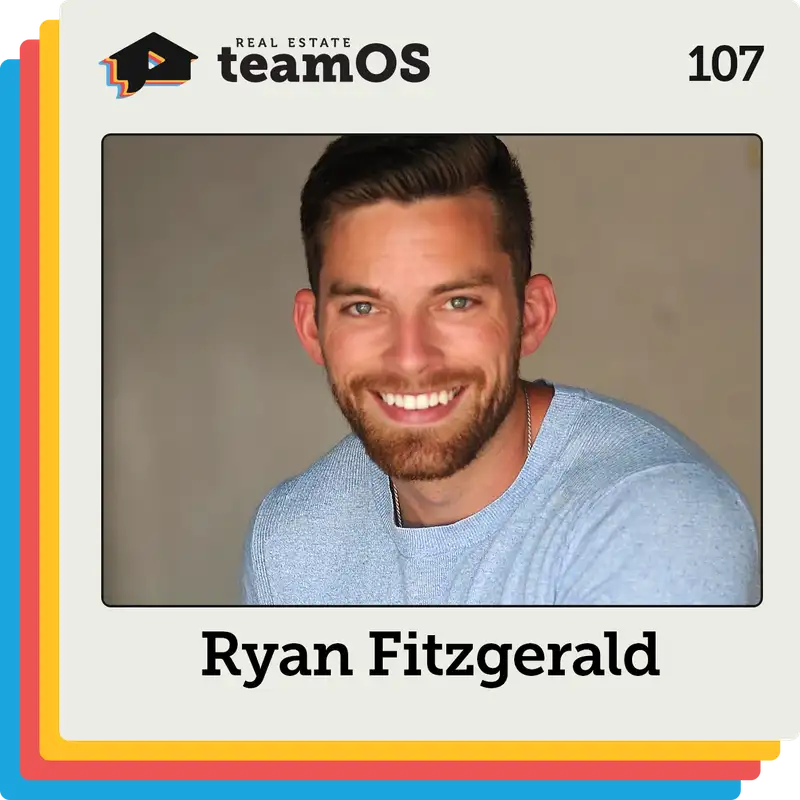
Growing a Profitable Indie Brokerage Powered by Inbound Leads with Ryan Fitzgerald | Ep 107
Speaker 1 (00:00):
After starting his career in real estate making 300 cold calls a day, Ryan Fitzgerald realized that he could stop chasing and selling and start attracting, attracting enough people, agents, and clients alike to grow a 40 agent business selling about a house a day. In this conversation, Ryan shares with you how and why they run a Lean operations team by design, who one of the best hires he's ever made is and how that role came together. Why he built an indie brokerage rather than a real estate team. Why it made sense for him to turn down teams of more than a dozen agents who wanted to join his brokerage and what makes a website effective in 2026. Get all that and much more with Ryan Fitzgerald right now on real estate team os
Speaker 2 (00:49):
No matter where your business is today or where you want to take it, you'll get there faster and more profitably with an operating system. Welcome to Team Os, your guide to starting, growing and optimizing Real estate team. Here's your host, Ethan Butte.
Speaker 1 (01:04):
Ryan, we got connected via your longtime friend and my guest back on episode 86, Eric Bramlett. I'm really excited to dive in, learn what you guys do similarly and differently and go into some other spaces as well. Welcome to Real Estate Team os.
Speaker 3 (01:16):
Awesome. Thank you for having me, Ethan.
Speaker 1 (01:19):
Yeah, super glad we connected. We always start with the same question on this show, which is what is a must have characteristic of a high performing team?
Speaker 3 (01:26):
A must have characteristic of a high performing team, I would say is trust, right? You need to make sure your team has bought into what you're doing, what you stand for, making sure everybody's aligned, making sure there's clarity around the mission, and just having trust in one another and trust in leadership as well.
Speaker 1 (01:47):
Trust is one of those things where over time through consistency in Word indeed that you are who you say you are, and people can trust that obviously over time we can build trust in a pretty predictable way. Is there anything that you've picked up in your career in the various ways that you've worked that have allowed you to accelerate that process?
Speaker 3 (02:11):
Yeah, I think trust is more than just saying, Hey, trust me, right? Of course, right, right. It's like what are your behaviors? What are your values? Are you keeping your word? Are you holding the standard you said you were going to hold? And it's all about really creating those behaviors and those habits that align with what you say you're going to do and actually doing those things. That's how trust is really built.
Speaker 1 (02:39):
And repeat and repeat what was going on for you. Go back, I don't know how long this is actually, but go back to the moment that team or brokerage first occurred to you. What was going on in your real estate career where you're like, I need to bring some people around me, or was it people said, I want to come around you? What was going on at that point in your business?
Speaker 3 (03:00):
Yeah, that's a great question. I think where it started for me was I became obsessed with generating leads, right? And I didn't realize that that was the most difficult part of real estate, but I just got so good at it that I had too many leads. I didn't know what to do with them all. So many people were asking to work with me. I just didn't have the capacity to work with everyone. And eventually those same people that I was generating leads from my website, I ended up starting to generate realtors as recruits from my website as well, asking if they could join me because their clients were already using my website and having such a great experience. So eventually I was like, yeah, sure, come on board, I could use the help. I have too many leads as it is already. And that's really ultimately I kind of fell into it
Speaker 1 (03:46):
Wild. Did you start by referring out those opportunities to these folks before bringing them into the business?
Speaker 3 (03:54):
That's actually a great question. It did start that way. I had a client that was looking for about, I dunno, 35, 40 minutes away from me. I didn't have the capacity to get to it. I had already begun that conversation of somebody coming on to join me. They actually lived very close to the home. I said, why don't you take this lead, run with it. You can send me a referral. They ended up going under contract within the next two or three weeks and he goes, I want to join. So he ended up joining. You
Speaker 1 (04:22):
Were like, join what I
Speaker 3 (04:24):
Mean, join what? We'll figure that as we go.
Speaker 1 (04:27):
So what was going on then? Did you start as a team initially?
Speaker 3 (04:30):
So it was just me. I started at Keller Williams 2000 15, 10, 11 years ago. Started by making all the cold calls, dialing 300 people a day, just trying to get listing appointments, get those listing conversations started, had some good success there. Realized I didn't like the cold calls. I liked generating the opportunities online because rather than chase people, I wanted to attract people. So just that mindset shift. I sort of created an inbound business model where people were wanting to work with me because I was providing value upfront. So sort of got away from the cold calls, joined a paper transaction company in year two. Those leads still kept coming in. And then after year two, I went out and started Raleigh Realty building my own indie brokerage.
Speaker 1 (05:20):
Okay, cool. So we're going to go into both of those categories pretty deeply here over the next half hour or so. And those two categories are Raleigh realty structure, business model agents that really work well there. And then the other side, which is kind of like the guts of online marketing, especially here as we get deeper into 2026. But I guess what we'll do next is for folks just level set Raleigh Realty as it is today, as we're having this conversation, like markets you serve, size, structure, culture, whatever you want to share about Raleigh Realty, I'd love to hear.
Speaker 3 (05:53):
Yeah, absolutely. So we're in the Raleigh, North Carolina market, also referred to as the triangle. We serve Raleigh Durham, chapel Hill, all the way down to Fayetteville actually. We have some folks out there who help serve that area. A team of 40 agents do about 200 million this year, probably a little bit more, probably sell a little bit over one house a day. But yeah, it's been great building it here. And I think based on Raleigh Realty and who we're trying to be is really just a company where we attract the top end talent. We're not looking to hire new agents, we're not looking to hire agents who don't want to take the career seriously, or maybe they're just doing it. We're not bringing those types of agents on board. We probably only bring on five to 10% of the agents we interview and we do. We get a lot of inbound folks filling out our careers page, asking to work here, and we've gotten really, really particular about who we will bring on. And so really just being authentic in who we are, knowing that we only want the top tier agent, people who have already proven production, people who are culturally aligned, and that's really where Raleigh Realty is.
Speaker 1 (07:17):
Cool. Talk a little bit about staff. What's the ops side of the business? And I'm using this as kind of a bridge into understanding the model a little bit. What do you provide agents? Have you decided not to provide agents, et cetera? But talk a bit about the staff and how that's come together over the years.
Speaker 3 (07:37):
Yeah, that's a great question. I think it's also a benefit as to what I was just referring to as well, where when you're only hiring those veteran, top tier, high performing agents, they can typically take ownership of a lot more than somebody who's just entering the business or somebody who really hasn't done that many transactions. And by taking ownership, it allows us to run a little bit leaner than probably most teams because we don't have to provide as much support. We're not offering like, Hey, let us show you how to write a contract, and all of those things that the newer agent, they need those handholding items. And so with the model, we're able to actually run a little bit leaner. We have transaction coordinators obviously that serve our agents so that once they do go under contract, they can sort of hand it off, not completely leave the deal, still doing the negotiations during the process there, but obviously being supportive of them and knowing that they're functioning around creating new business while the transaction coordinators, closing coordinators, they're all functioning around making sure the deal is going as smoothly as possible while providing the ultimate customer experience while under contract.
Speaker 3 (08:51):
And then after that, we have director growth and strategy. We have a broker in charge and some compliance people as well.
Speaker 1 (09:01):
Cool. What falls into growth and strategy?
Speaker 3 (09:04):
Coaching agents, coaching behaviors, coaching habits, strategically helping us bring in more of what we're looking for, whether it's new recruits or just top end talent to add to the admin staff and really just figuring out, okay, where are we going next? How are we going to better support our agents? How are we going to create a better experience for the end consumer? And that's really what goes into the director of strategy position.
Speaker 1 (09:34):
Is that someone who was a successful agent that was maybe with you for a good part of the ride and they're like, this just made sense out of your need or their interest or both?
Speaker 3 (09:43):
It actually came as a recommendation from someone who had previously worked with her. And I have to say it is one of the best hires I've ever made because since she's been on the team, it started to take off a rocket ship. It's sort of like a fresh perspective, came into the business, said, Hey, there's an accountability aspect that's missing here. We need agents to take a little bit more ownership around working the inbound leads that we're already generating. And actually it's going to create more opportunity for the agents who are actually already doing the work. And the next thing you know, we're up 42% year over year in the fourth quarter now here in January, February. It's looking like we're going to blow past last year's numbers as well. So it's that one little thing that fresh perspective comes in, adds a layer of accountability, also adds additional opportunity for the agents who are already in there working hard. And next thing you know, it's just more deals are starting to come together.
Speaker 1 (10:41):
I love that. Tell me as much of the story as you want to. How did this recommendation come to you and how did it get shaped into a, I'm going to make a role that didn't exist before. Did the recommendation come prepackaged as this person can take your business to the next level and in a role like this? Or was the recommendation, an introduction, a conversation and together you worked it out? And what I'm obviously asking on behalf of a team leader or a brokerage owner that's like, oh, that sounds really good to me. How do I do that?
Speaker 3 (11:14):
Yeah, I would say this. I would say, look, if it's a person where you say, Hey, I can tell this individual is talented, I can tell they want to work hard, I can tell they have grit and I can tell that they are aligned with me both culturally and from a values perspective. So when somebody came to me and said, Hey, this is somebody you should really look into, I said, huh, let me look them up. I viewed them on Facebook or Instagram, I can't remember which one. I think it was Facebook. And they were doing these motivational videos, just sitting there talking to the camera, doing motivational videos. And those resonate with me really well. I just love that stuff. Talking about growth, talking about accountability, talking about just becoming better as an individual. So when I started seeing these videos, I messaged her and I just said, Hey, so-and-so mentioned you're a great person in the industry.
Speaker 3 (12:05):
I'm not jumping to conclusions here or assumptions or anything, but if ever you were to look for another place to work, I'd love the opportunity to be considered. And then so we met for coffee and I said, okay, tell me what would you bring to the company? How would you do it? And just tell me a little bit about that. So she told me and I was like, wow, that's actually perfect. That's just what we need right now. Let's progress this forward if you, and sure enough, we ended up hiring her probably about a week after that.
Speaker 1 (12:33):
There's something really powerful, especially I think AI SLAP is what we generally call it, but in this day and age of you read someone's post and you're like, I've been connected with this person for several years and I know they don't talk this way. They've never written this way. And I know that they're using AI to generate these posts versus someone sitting, whether with a webcam or an iPhone or something just sitting, speaking from their heart. Maybe it's structured, maybe they're working off little cue cards that are off screen. Maybe they're using AI to keep eye contact and they're actually maybe paying more attention to their screen than we're led onto. But there's something about someone being able to just speak about the things that they think, believe, feel, experienced, do, recommend, et cetera. That's really, really powerful. And I assume you're basically half sold going into the conversation just based on that alone? No faking that. I mean, there is kind of, we're getting there with ai, but in general there's something really real and useful about that. I
Speaker 3 (13:40):
Totally agree. And I think you can learn a lot about somebody by their tone of voice and then the way that they sort of behave or the way that they move. And then just the video overall, it was just like, okay, that resonated with me. That's something I want to show to other people because it makes sense and it will help them. And so she definitely joined us. She could make way more money just selling houses, but her true passion, her true, just what makes her tick is helping other people reach their goals. So she needs to fill her cup that way, and we're very thankful that she does a great job of that.
Speaker 1 (14:22):
That's great. The last thing I'll add here, and then we'll move on to a new idea is if her videos resonated with you, it seems like not too far a step to say, if it resonates with me, it's going to resonate with the types of folks who believe in my vision and our operating here at Raleigh Realty.
Speaker 3 (14:39):
Absolutely. And that's exactly what happened. People get bought in, they're like, I love the message. I love the clarity around what she's delivering. And she's a very hard worker. So Saturday night, 7:00 PM she'll be texting me, what do you think about this, this or this? And I'm like, wow, you're still working, huh? So it's been great.
Speaker 1 (14:55):
We're just still thinking.
Speaker 3 (14:57):
Yeah, still thinking. Yeah, so it's
Speaker 1 (14:59):
Awesome. Honestly, to me, just I'm way off track now, but when I think about my own career, when I'm thinking about something at seven o'clock on a Saturday night, it's because I actually care about it. I didn't say, I need to get some more hours in. It's like, I can't not think about this stuff.
Speaker 3 (15:16):
And that's something I would recommend to team leaders as well, is if you find somebody for a position like that, make sure they're passionate about it. Make sure they're not Thursday, Friday, Saturday, Sunday at the golf course, and then Monday, Tuesday they're showing up to the office. It's somebody who's texting you at
Speaker 1 (15:31):
7:00 PM give, it's a training off the
Speaker 3 (15:32):
Cuff, right, exactly. 7:00 PM Saturday night if they're texting you about work. That's a good sign. Yeah.
Speaker 1 (15:39):
Something I mentioned, I think just to get this thing kicked off several minutes ago, indie brokerage versus team inside another brokerage. How did that decision go for you? I mean, I assume that when you looked up and realized I have a skill for generating leads, it has brought other people around me. I can build a much bigger business with these people around me than I could just on my own from that moment. There are so many directions you could go. Why did indie brokerage make sense to you and where did you look to make that decision and start taking those initial steps?
Speaker 3 (16:16):
That's a fantastic question. I think it's a question. A lot of team leaders that I talk to, they wrestle with that. They do wrestle with that. Do I stay at the brokerage of I'm at, do I open my own? And I'll tell you what, for me, it's all about authenticity, right? It's about being able to be who I am, who I want my company to be, what I want us to stand for, versus, hey, I have to confine who I am within these guidelines, within these rules. Obviously we're not going out here and just totally disregarding rules and laws and legalities, but being able to culturally be who we want to be, make our own decisions, that type of independence, that was really important to me because that would allow me to build something real, something authentic.
Speaker 1 (17:03):
I want to double back into this idea of top producers. I think it's something that a lot of people would want for themselves, whether they're running a team or a brokerage. A, why do you think that you're able to do it overall? B, you don't need to take all these in one sweep. I'll remind you, I'm just listing them out as I have the top of mind. Why do you think you're able to bring these folks in? How is onboarding and training different? You already touched this a little bit. How is onboarding different than if you were taking people that were maybe 18 months or 24 months in the business who've only closed six transactions in that time and they're looking to level up? How does that affect onboarding? And then we'll move a little bit into retention. I think that's something that everyone struggles with, no matter the structure, their business, and no matter where agents start, it's like, what do I do to keep someone who could literally be welcomed into any shop in the triangle?
Speaker 3 (17:59):
Yeah, absolutely. I think a lot of it is about less about selling them and more about branding. You want to brand who you are as a company because you want to make sure that these recruits are aligned with what you're building, what your mission is, what you stand for before they even interview. Otherwise, you're just going to be wasting everybody's time. We're not for everybody, and that's okay. And we also grow, we don't stay stagnant. So it's very often that a realtor on our team might say, Hey, this isn't for me anymore. And that's totally okay too because we want to make sure that everybody who's bought in, everybody who's aligned, everybody who's here is able to meet the standard of what we're building because certain behaviors will be tolerated. And then certain behaviors we're like, well, we can't work with that. We either need to coach you through that, or we need to figure out a way that you can work within the confines of what we're trying to build here.
Speaker 3 (18:56):
But basically those new recruits, they'll see us on social media, they'll see us obviously via the website. I think that's where it all starts, is we do about two and a half million people on our website every year. So their clients are already using our website. They are already using our website. Everybody's sharing links to our website. So that's really one of the places where those recruits will start. And then they'll follow us on social media. They'll see the messages that we create a lot of video content around coaching realtors on our Instagram and Facebook pages. So we produce that content, we share that content, and a lot of people are like, Ooh, I really like what this firm is about. I like this message here. It's really resonating with me. And that's typically the type of person we want on our team because we're delivering a message about growth and strategy and not being afraid to pick up the phone and make the calls. So typically somebody who that resonates with is somebody we want on our team. And then to jump into that onboarding aspect, we have an onboarding program, but it's less about, Hey, let me hold your hand and show you how to write an offer and more about, let me show you how we can create more structure, more systems, and better processes around your business where a 25% increase is going to add three, four, 5 million in additional volume each year just by doing these little tiny daily behaviors that you weren't doing before.
Speaker 1 (20:27):
Retention. Thoughts on retention? Anything you've maybe changed or implemented as maybe someone you wanted to keep opted not to stay? What have you learned about retention? Anything you're doing actively or proactively around
Speaker 3 (20:44):
That? Yeah, I would say it's very rare that it happens, but it does happen. So I think for me, where somebody may leave who I wanted to stay, it's typically because I've invested so much time, money and effort into that person that I'm like, oh, geez, I don't want this person to leave. And whether or not they do leave or not, it doesn't really matter at the end of the day because as long as you're doing the right things, as long as you're holding that standard, if that person is unable to grow with you, if that person doesn't have the capacity to see where the company is headed, that's just a misalignment. So at that point, it's like it would be better off for us both to part ways regardless of how much time, money and effort we've spent on that person because there's no longer an alignment there.
Speaker 3 (21:36):
And it's going to lead to resentment, right? Because I'm asking for more of you and you're saying you don't want to do more. You're saying, I don't want to behave in this way even if I think it would take me to the next level where I want to be. So at that point, I say to myself, okay, I've spent time trying to coach this person. It's clear to me that they don't want to raise the standard, they don't want to grow, and that's on them. That's not something that I can control. So it's probably best for them to go and find somewhere else to work, but certainly it hurts because a lot of those people you're like, just because we're working together doesn't mean we're not friends because we are friends. So certainly wish them the best. Certainly we'll be rooting for them from the sideline. And you always wish it was different, but you can't live in a fantasy world. You need to work within reality here.
Speaker 1 (22:32):
How are standards and accountability different today than they were say three or four years ago?
Speaker 3 (22:38):
Yeah, I would say with the COVID market three or four years ago, it was a different type of accountability. It was like, just make sure you're waking up and getting out of bed because there's so much business to go close. As long as you're doing that, we're golden.
Speaker 3 (22:55):
And nowadays it's like, Hey, we need to get back to the fundamentals. We need to get back to the basics here. Because while that was a lot of fun and chaotic, we need to go back to structure and develop these systems, these processes, these consistent behaviors and habits that we need to do every day regardless of how many homes we have under contract. Because what's going to happen is if we're not doing them, we're just not going to have a pipeline. We're going to run out of business. And those are the behaviors that you need to have in order to have success anyway. So while the COVID market three or four years ago was amazing, it is a new world today, and helping agents reach that daily habit, that daily consistent growth and just making sure they're knocking out those tasks, it is basically everything in this market.
Speaker 1 (23:48):
Yeah, it's interesting the way, obviously the market's ebb and flow over time, and so a lot of training or coaching is retraining or coaching like, Hey, you remember back when we had to do this, we got to do this again. Hey, remember back when we had to do this? We're about to have to start doing that again. So I'm raising it again, teams within the brokerage. Is this a conversation that's come up? Do you have any thoughts about it? Have any agents pressed you on it or have you thought about it proactively? Or do you even have teams within the brokerage already?
Speaker 3 (24:19):
Yeah, so we've actually had probably two or three agents within the brokerage actually approach us about starting a team and support them any way we can. And then we've had teams from outside Raleigh Realty reach out about joining Raleigh Realty. We just haven't really had that team where it's been the right fit. So we had, I think it was a 13, 14 person team and obviously would go from 40 agents to 53, 54 agents overnight. However, it just seemed like where's the profitability in this? Because if they're coming on board and they are going to take up all these resources with 14 people, I need to make sure that at the end of the day, my ROI is going to be there because it's not about agent count, it's about, Hey, how are we supporting the agents have, do we have the resources we need to support them? And are we profitable? Right? Because I could bring on a 14, 15 person team and be like, they're costing me 30 to $35,000 a year in the red just by having them on my team. So it's definitely important to look at that type of stuff too. I think for team leaders who sometimes get out over their skis and just recruit, recruit, recruit, recruit, and it's like you don't necessarily want to recruit everyone. In fact, you definitely don't want to recruit everyone.
Speaker 1 (25:43):
I love what you just shared for so many reasons, but the main one is you're aware enough of what you, I mean, what I heard from you 10, 15 minutes ago was I hire more experienced agents specifically so that I don't have to build this monstrous process to get someone to figure out how to do the business and to grow them into the type of person I'm actually recruiting in. And so when you bring in that team of 13 or 14 people, not only do you have to figure out the cultural aspect of it, I mean the team leader may check the box, but the variability across a population of 14 agents is like not all these are Raleigh realty material, even though the team leader is and we're aligned and we see everything the same way. But in addition, then your backend isn't built to take on 13 people at a time, no matter whether they come one at a time or whether they come as a group. Definitely not designed to take 'em as a group probably.
Speaker 3 (26:36):
And
Speaker 1 (26:36):
So it's a whole new direction. Do I want to change the way my business is structured in order to accommodate these opportunities? And you said, no, I like what I got going.
Speaker 3 (26:46):
And that's exactly right. And I think too often a team leader will say, oh, I just want a bigger team. I want to sell more houses. I want bigger volume, more numbers, higher statistics, and move me up. I want to be the number one realtor. And it's like, okay, that's awesome and I'm all for it. As long as you're also looking at profitability ROI, are you supporting? What about your current team? How are they going to feel when you hire these people? So there's a lot that goes into it. And at the end of the day, I think just knowing that we are able to support our current agents and that we are highly profitable helps me sleep at night.
Speaker 1 (27:23):
Yeah, really good. I appreciate that discipline so much. And I think more people would be farther ahead if they had more clarity about what they were doing and more discipline to stick to it, at least for some period of time. And you can always change in the future, but that groundedness today is a benefit for sure. Transitioning a little bit into online marketing, I want to pick up on something that you shared a few minutes ago, which was we're doing these videos on our social media and it's attracting agents. I'm going to ask a question before leading into really the guts of where are we with digital marketing and websites in 2026 and beyond, but how did you think about doing social media for consumer versus for agent? And one of the ways that I often see it is the team or the brokerage social is all consumer facing and the team leader and maybe a director of growth and strategy, their personal social media is more agent oriented. But you also mentioned the website was obviously attracting a lot of local folks or people looking to move to the area, but it was also attracting a lot of agents. And so it's kind of a two in one, but I'd love for you to start on the social side for a team leader who's thinking about how do I attract more agents with social when our social is maybe more consumer oriented or we're trying to do both and it's not great by trying to do both at the same time. How did you think about that?
Speaker 3 (28:53):
Yeah, absolutely. And I actually think that first of all, great question. And I noticed a lot of the team leaders around my area have sort of taken what we're already doing, what we've already built, and they're trying to incorporate it into what they're doing. And it's sort of flattering in a way to watch your competition start to mimic and copy what you're already doing. And what we do is we really just say, Hey, look, let's talk about the message. Let's talk about coaching. Let's talk about behaviors that we want in our agents. Maybe an agent comes to us and they're just like, Hey, this is where I'm at in my business. How do I fix it? So then we'll say, okay, perfect. This is a great video that we can create because they're not the only agent that's experiencing this right now. There's plenty of agents all over the triangle who are experiencing this all over the world, and we will create videos around that. We'll create videos around maybe some current topics as well, if there's anything pressing in the real estate world. I remember when the NAR lawsuit was going on, I think a lot of people were looking for comfort and relief from their anxiety. So just remaining grounded in that scenario and spreading that message. I think that resonated with a lot of agents, and we did see our competition copy a lot of that. So we do monthly market updates as well via email that people love and always click on and respond to. So that's another one too.
Speaker 1 (30:24):
Cool. Are you doing this on a calendar? You're like Tuesday afternoon throughout the week, I'm just going to take notes of things I could talk about, and then every Tuesday afternoon I'm going to record five videos and someone is going to post 'em throughout the week. Do you have a structure around it or is it kind of ad hoc?
Speaker 3 (30:39):
Basically, we schedule two hours once a month. We create, I think eight videos and we try to do two a week. So try to get Tuesday and Friday, I believe it is, and we try to get those videos out there, and it only takes two hours once a month to shoot the videos. We use a tripod, we use a teleprompter, we have a camera guy. We create the scripts ahead of time, and it's been awesome.
Speaker 1 (31:04):
Take us through an amazing website. So you and I probably wouldn't have connected if you were not Great. I'm going to go, I think this is going to work.
Speaker 1 (31:14):
You and I would not have connected if you had not been fascinated by and become really good at building a website that attracted a ton of organic traffic because you wouldn't have had this abundance of leads necessarily, and that was years ago. And over time, you've obviously continued to optimize that. You're now doing it for other people. I would love for you to talk about the basics of a great website that haven't changed in the time that you've been doing it. What are the elements of a great website that have allowed you to build an entire business off of it?
Speaker 3 (31:52):
Yeah, absolutely. I think it all starts with the user, right? You have to understand, what is this person on my website for? What are they doing here? Why did they come to my website? How can I create an experience that they just absolutely fall in love with? So they never want to go anywhere else. It's sort of like when you go to your favorite restaurant, you just have such a great experience every time that you just keep going back, that's your favorite restaurant. So that's really what we've tried to create with our website and Agent Loft and other websites for other people is, Hey, let's just create an incredible user experience. The websites fast, it delivers what you want. It helps you get that hyper-local search criteria. Then there's the blog. So that's where we provide a lot of the value upfront where people might be searching for things on Raleigh.
Speaker 3 (32:40):
So we're able to provide a ton of value upfront. We answer a lot of questions. Again, that goes right into the AI tidbit of this, and those people are very thankful, right? They're very thankful that, Hey, this company, this brand just answered my question. So I'm going to work with Raleigh Realty. When it comes time to buy a house and we don't force registration, we just leave the website wide open because again, our user is the most important person of our website. We want to provide as much value as we possibly can. We do not want to force them to register unless they want to give us their information.
Speaker 1 (33:17):
I really appreciate that so much. So I built a career in marketing, and I think of it as selling by teaching. I think that's one of the gaps that marketing
Speaker 3 (33:26):
Covers,
Speaker 1 (33:27):
And I've always been of the mind and of the heart, even though it's a leap of faith for a lot of people, that if you do the right things, the right way, that you'll get the business out of it in the end. So this idea of building something that's going to attract people and you serve them related things to whatever brought them there in the first place so that they hang around and that they choose to come back, it's a leap of faith for you to do that all wide open, assuming that they're going to come back when they're ready to actually engage and that they're going to engage with you versus someone else. Talk about that kind of leap of faith that says, we don't bother force registration
Speaker 3 (34:07):
When building it. I just knew that, hey, if I'm the end consumer, what do I want? I'm just putting myself in their shoes and I'm thinking to myself, oh, I don't want to be bothered until I'm ready. When I walk into a store and somebody wants to help me find something, I say, no, thanks. I'm good. But then I can't find it. So I say, Hey, remember me? Can you help me find that thing? You know what I'm saying? So it's like that's when I want them to approach me. I'd love to be out the door just saying, Hey, can I help you find anything? But sometimes that's going to scare people off. I want them to find me when they need help finding something. So that's really what we've tried to build, and I think we've done a great job of that. We ended up with, we do have some paid traffic and some forced registration as well, but we're getting twenty three, twenty five phone numbers a day and 50 plus leads. So we definitely have the traffic that converts at this point.
Speaker 1 (34:59):
To use your restaurant analogy, to go back to that what's on the menu, I heard blog, which I assume is a lot of local market information. Obviously, IDX people can look at properties and they can probably choose based on criteria. Are we doing things like town and neighborhood standalone pages that aren't quite blog posts? They're like Standal, what's on the menu in this restaurant that brings people back, even though they first came for this particular item that their friend raved about or that they were searching for? What else is on the menu that's going to bring 'em back?
Speaker 3 (35:34):
The menu's large. The menu is very, very large. We have automatic dynamic page creation. So once we plug into the MLS, we're able to create pages based on cities, neighborhoods, new construction neighborhoods that many realtors don't even know about yet, but they're already a page on your website because we dynamically create it for you. And then that new neighborhood has no competition online because nobody's built a page for it yet. So we do all of that for you. We do it on our website. Certainly those long tail keyword searches are so important, and I think that's one of the things that many people they don't really think about is like, Hey, this consumer who's looking for, let's say, a basement home in this community, that person is very specific on what they're looking for. That means they're very far down the funnel versus somebody who might be searching Raleigh Homes for sale. That person's probably just browsing or maybe just considering Raleigh, one of 10 other cities they're considering moving to and just wants to get a feel for what's out there. So that's a fantastic question, but certainly the menu is big. We have the blog, we have the communities, we have a bunch of popular searches, zip codes, school districts, anything you can think of that somebody might be looking for as it relates to their house, we try to create a page around that.
Speaker 1 (37:03):
How has SEO changed in the time that you've been doing this?
Speaker 3 (37:07):
It's been getting crazy. I would say chaotic almost, because just recently, Google launched the AI overview feature for things like best neighborhoods in Raleigh. So they try to answer your questions without you clicking on a blog post. So what's happening is a lot of those people that were clicking on the blog posts before are just getting their questions answered right then and there. And what that's doing is it's creating a, Hey, you're no longer just writing for the end consumer. You're no longer writing for just Google. You're now writing for AI because you need to be the expert so that when AI is crawling your website, they know, Hey, I'm putting this data, this information in front of my user because this is the stuff that they want. And we've had, I think AI's only got a 4% click-through rate or something. Most questions just get answered right then and there, and they jump off. But we've had a ton of AI leads coming in, and I'm like, I can't believe this is already happening. This is awesome. So definitely interesting. What's going to happen there? My guess is that chat, GPT and all the other AI platforms are going to take that Google pay-per-click approach where, Hey, we now offer advertisements on the side here. If you click on it, we get a little chunk of change, and then we'll send you leads to your website.
Speaker 1 (38:33):
Yeah. Oh man. There's a lot there. There's a lot of speculation as we record this, not super far removed from the launch of the Claude ads that are taking shots at chat GPT for ad placement. It's a whole new level. I mean, ad placement around Google searches was a thing, but ad placements around, I've been talking to you for months about all kinds of things. It's like, that's a whole new level. That'll be really interesting. Then I hope that this trust in other people is raised up a little bit and that we wind up going back to the people that we were referred to or that provided us some help or whatever. I assume. So you mentioned we're getting a couple dozen phone numbers a day.
Speaker 1 (39:20):
I assume that your folks are calling out to those people, and some of them respond and some of them don't. And there's a whole series of activities that follow on the initial phone call and the text message, but some of those land and some of those land, and they need to be nurtured over time. And my hope is that in this period where I am getting okay advice from ai, but I'm also getting advertising that that I'll remember that three minute conversation I had five months ago when I was a little bit top of funnel, so to speak. No one thinks of themselves that way, but except marketers, they might see themselves as someone else's funnel. But in any case, I'm hoping that that human to human connection really starts to resonate when all of this gets blurrier and someone who is still slightly media literate has appropriate skepticism for what the bot is saying.
Speaker 3 (40:11):
Yeah, I think the human to human interaction is just so important. And at the end of the day, when it does come time to buy or sell a house, I think that that's ultimately what's going to end up happening. And while ai, I love ai, I talk to AI probably more than I talk to humans at this point, but I don't necessarily trust it as much as I do. Like, Hey, let me trust myself and my own decisions because I'll be talking to ai, looking for advice, looking for guidance, and then next thing I know, AI has given me the exact opposite of what it just gave me. And I'm like, I'm asking questions. Why did you do that? Oh, you're right to call me out. Here's why I did it. And I'm like, the explanation just doesn't even make sense. Yeah,
Speaker 1 (40:54):
Yeah. It's funny. And then of course, then we don't need to go down this road. So then you think about the consequences of that when pre-adolescent and teenagers and folks are doing this, they don't have that same, they haven't made a decision like this hundreds of times throughout their personal life and their career you have. So just again, that literacy around what is actually happening here is pretty tricky.
Speaker 3 (41:20):
That's a great point. Yeah. Wow. Didn't even think about it like that, but certainly nerve wracking.
Speaker 1 (41:27):
It's, I listen to a lot of different types of podcasts, and there's one in particular that is in this topic all the time. It's been really interesting, and not just frightening, but important to think about how this is going to affect human behavior. So anyway, I appreciate you speaking on the topic from your own perspective as well, what do you think is the future of the team model? Yeah,
Speaker 3 (41:52):
I don't think the fundamentals are going to change at all. Just to quote Eric and Mike Del Breed here, I think it's mostly the boring stuff that's going to continue to win because it's so easy to get distracted by all this flashiness. Like, Ooh, look at this new tech. Ooh, look at this new model. Ooh, look at this new structure. And it's like, well, hey, at the end of the day, are your agents supported? Are your agents culturally aligned? Are they clear on what your expectations are so that they know they're doing a good job? And when you get your team bought in that it makes everything so much easier for them, for you, for everyone. So I'm not sure that that's going away anytime soon, but just sticking to those boring basics, those boring fundamentals, yeah, that's where be spending our time there.
Speaker 1 (42:42):
Really good. Before I let you go, Ryan, first, thank you. Second, I've got three pairs of closing questions, and the first one is this. You can answer one or the other or both if you would prefer. What is your very favorite team to root for besides Raleigh Realty or Agent Loft, or what is the best team you've ever been a member of besides those teams? And it doesn't have to be a real estate team.
Speaker 3 (43:03):
I actually coached my little brother's basketball team for three, four or five years. I think that was my favorite team, right? Because Oh, there he is. Let's speak to the devil. Yeah, I think that was my favorite because really what it allowed me to do, and it's very similar to real estate as well, because it is coaching behaviorally. Again, going back to those boring fundamentals that end up winning games, working on our layups, working on our left hand layups, working on our free throws, working on the fundamentals, like creating easy, open shots. So I just think something like that, that would be my favorite team, is when I was actually the coach of the team.
Speaker 1 (43:44):
Makes sense that you're running a brokerage, what is one of your most frivolous purchases or what is a cheapskate habit you hold onto even though you don't need to anymore?
Speaker 3 (43:53):
I like reading books, so I mean, books aren't that expensive, I guess, so it's a kind a cheapskate habit, but just diving into books, passing time that way, that's probably the cheapest skate habit that I have.
Speaker 1 (44:09):
You're reading physical books or digital books?
Speaker 3 (44:12):
Physical. So the way my brain works, if I'm listening to something, I'll go 20 minutes and be like, I didn't hear one thing this person just said. You know what I mean? So I have to sit down and read it physically, otherwise I won't comprehend anything that I just listened to.
Speaker 1 (44:29):
By the way, there's some science that supports reading on a page versus reading off of a screen. Even if you're reading a digital book, not even listening to an audio book. Retention and comprehension and retention are both enhanced by reading off a physical page and there's something there and you just kind of spoke to it. I don't know what it is exactly, but I do the same thing. I prefer reading a physical book for a variety of reasons, and I buy a lot of used books so that I'm cheap in that zone.
Speaker 3 (44:55):
I love that. That's a great move.
Speaker 1 (44:57):
Yeah, thrift books is my current favorite site for that, although they're like local bookstores. Anytime I go to a new city, if I have time, local bookstores. What does it look like for you? You already kind of touched on this a little bit, but what are you doing? What does it look like for you to invest time in learning, growing and developing, or what does it look like? What are you doing when you're investing time in resting, relaxing, and recharging?
Speaker 3 (45:19):
Yeah. I think resting, relaxing and recharging is probably difficult for me because I always feel like I have so much to do, and if I'm not doing it, I start to get a little anxious, and then you have to remind yourself like, Hey, taking this time to rest, recharge, and relax will actually help you spring forward. So in those moments, if it's nice weather, I'm taking a walk outside, I'm going to take a hike somewhere, there's a couple trails by my house 15 minutes away, and you'll end up leaving your phone behind. I do bring my watch, but just walking with yourself, your own thoughts, just trying to figure out, okay, working through anything that you might not have been able to think about because you were so involved with work and what was on your plate, that there's a lot outside of work you likely need to work through as well. And I also like traveling. I also like exploring the world, meeting new people and just learning more about planet Earth as it is.
Speaker 1 (46:20):
Love that. And there is, there's great science behind walking with your own thoughts, no earbuds, your own thoughts, and it's tested through history as well. There are a number of great thinkers and leaders who that was a critical part of their daily routine, walking with their own thoughts. This has been awesome, Ryan. I appreciate you so much. If someone wants to follow up on this conversation, connect with you, learn more about the different stuff that you're up to, where would you send them?
Speaker 3 (46:46):
Yeah, I would just say, Hey, can check me out on Facebook, Instagram, raleigh realty.com, agent loft.com. Definitely plenty of ways to get ahold of me.
Speaker 1 (46:56):
Cool. Those things are linked up, down below. I appreciate you so much and I hope you have a great rest of your day, Ryan.
Speaker 3 (47:01):
Awesome. Thanks Ethan.
Speaker 2 (47:02):
Thanks for checking out this episode of Team Os. For email exclusive insights every week, sign up@realestateteamos.com.