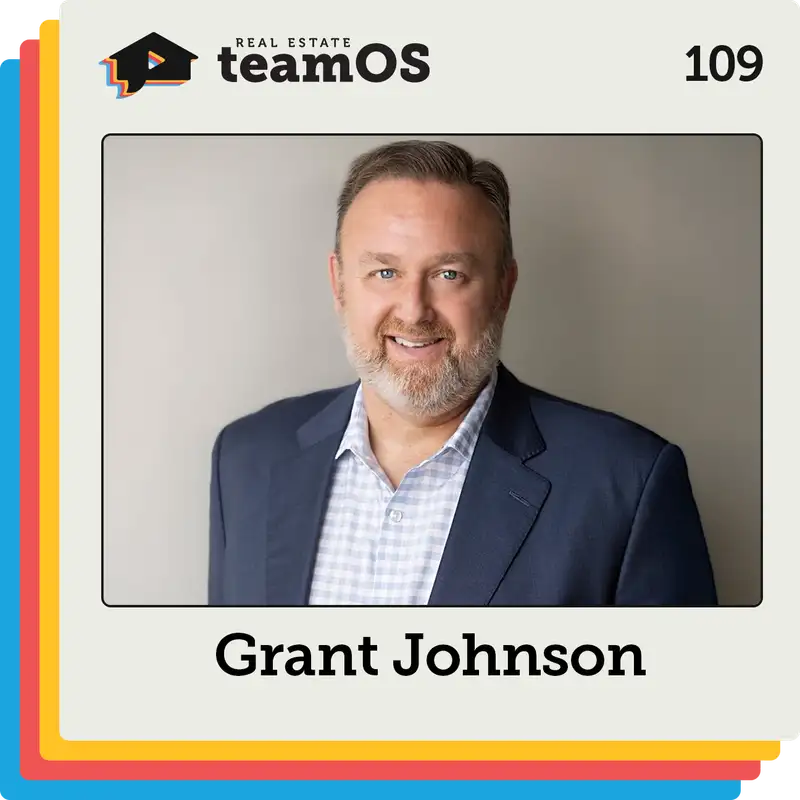
How Commercial Agents Boost Team Revenue and Referrals with Grant Johnson | Ep 109
Speaker 1 (00:00):
Commercial real estate agents within your residential real estate team? Yep. Grant Johnson turned what might have been a passing thought into immediate action and now has 11 commercial agents with a hundred million dollars in listings that just closed 25 million last week alone. For about a decade, Grant ran a smaller real estate team that was producing between 100 and 150 closings per year, but he's recently stepped on the gas and he's here to share with you how they've tripled production over the past few years. Why a five staff 120 agent ratio works for them, why he's never pushed the team brand and has always been agent brand first. What they learned in their first two market expansions and what they're doing differently on their third and why building a real estate team isn't the right choice for the majority of people. Enjoy your time with Grant Johnson right now on Real Estate Team OS.
Speaker 2 (00:52):
No matter where your business is today or where you want to take it, you'll get there faster and more profitably with an operating system. Welcome to Team OS, your guide to starting, growing and optimizing real estate team. Here's your host, Ethan Butte.
Speaker 1 (01:06):
Grant, it has been an absolute pleasure to connect with you in person several times over the past year or so. This conversation is totally overdue. I love some of the ground that we're going to get into. Welcome to Real Estate Team OS.
Speaker 3 (01:18):
Thank you. I'm excited to be here.
Speaker 1 (01:20):
You're doing some very interesting things, including a commercial alongside residential, so we'll get there, but I like to set this up a little bit with some context for you and some of your perspective, and we'll start with a must-have characteristic of a high-performing team. What comes to mind for you?
Speaker 3 (01:35):
Number one is drive. You have to have a drive that nobody else has, in my opinion, because running a team ... I post on this last week, I think. It's not easy. It's not for everybody. I was speaking on a panel last week and they asked, when should somebody start a team? And my answer was 75% of you never should. And it's truthfully because you don't start a team to make more money usually. You don't start a team because your life's going to get easier. You start a team because you want to change other people's lives. And so if you're doing it for more money, just sell homes. So I hope that answered your question, but it's got to be drive, but it's also got to be the willingness to help change other people's lives and change the direction of their life.
Speaker 1 (02:28):
Yeah. So that drive, you had it before when you were selling 70, 80, 100 homes. You have it now as the leader of a 120 plus agent organization. The drive just probably looks and feels different. So what are a couple of ways that you're driving yourself and maybe some of the people around you differently than you were driving when you were trying to handle all the spinning plates of working with multiple buyers and sellers at one time?
Speaker 3 (02:56):
I think the most important part hasn't actually changed. And it's a schedule. So I still get up at the same time every day. I do the same thing every morning. Now, what I do maybe changed. I mean, I don't spend all my time prospecting now like I used to, but I tend to be one of the first ones at the office in the morning and sometimes one of the last ones to leave. So to me, it's just internal. And for me, my whole life, that's just how I've been. I mean, before I got into real estate, I had a job nobody probably would ever do. And it just comes from inside you. And when I watch agents, I would tell you few have a true drive to push through things. And so me, it's the schedule and just doing the same stuff every day, the same boring thing.
Speaker 1 (03:48):
Yeah. I know you've got people working with you on recruiting now, but you've recruited a ton of agents yourself. When you're thinking about who you've brought on and who you have, and I'm sure Drive has been part of that evaluation, but is drive inherent? Because I've been the same as you throughout my career, which is like, it's not about time in the seat, although it kind of is about time in the seat. And by that, I just mean first in, last out because we've also, you and I have, I'm sure, both worked with people that are like, they put in a lot of hours in a superficial way, but they're not getting anything done. But let's just assume it's a combination of those two things. I'm working hard on about the right stuff, in about the right order, and I'm doing it for longer than a lot of the people around me.
Speaker 1 (04:32):
Is that drive to do that inherent in someone or have you seen it coached up in someone or unlocked in someone? Does someone have it or not and you're kind of looking to evaluate that when you're looking on who to bring around you?
Speaker 3 (04:44):
I think they have to actually have a why. The old what is your why? You have to have something that is going to take you to the next level. So I don't think anybody inherently has a drive probably above anybody else. Maybe they have a goal they want to reach. Maybe it's changing generational wealth for their family. Maybe it's getting out of debt. Maybe it's the fact that you've never owned a home and you get into real estate and now you want to own a home, or nobody in your family's ever made $100,000 a year and you want to be the first. There has to be something there inside of you that's going to take you from A to B to C.
Speaker 1 (05:25):
Yep. I see that. And it makes me wonder what's driving me, honestly.
Speaker 3 (05:30):
Honestly, some days I don't know if I always know. Yeah. I mean, when my daughter was younger, it was that. It's providing for your family. Now my daughter's out of college. What's driving now? And for me, I think what's driving me is now changing other people's lives. Being able to take an agent who says was in the business ... We have one agent that joined us last year. She was in the business at a different company for over a year, sold two homes. She joined us her second year in the business and she sold 15. So did that change her life? Yes. And now will she continue to grow? Hopefully. But that's what I like to see now is the reward of helping others.
Speaker 1 (06:10):
Yeah. Deeply satisfying. What was going on in your business grant when team occurred to you? What was going on? Set the scene. When did you think, "Team, this is maybe something I should be doing."
Speaker 3 (06:22):
I think for me, you always heard that's the next step. Oh, you sold X number of homes yourself. Well, then here's your next step. You better start a team. So you start with an admin, sell a few more. You just keep adding. I did it backwards. I've failed so many times. I've done it backwards so many times, including the fact that I hired agents before I had an admin at one time. Well, then who's going to help? And that's not my strength. So when do you start a team? How do you start a team? I don't know if there's an answer that you can answer for everyone. And again, I'm going to go back to saying most people shouldn't start a team. And then when you asked about recruiting and how do you find drive in people? I just don't think it's something you can see.
Speaker 3 (07:14):
I really don't. And we tell every agent that joins us, we'll give them every tool, every training, all the help, but we can't teach them to actually do the work.
Speaker 1 (07:23):
Who are among the 25%? Things I've heard from you that would fit the 25% of people who should start a team. Wanting to invest in other people, obviously a willingness and ability to give up some amount of control and trust other people to do some of the stuff. What are some other things like when you're thinking about the folks that maybe did it and shouldn't have, or people that you think this person might be able to do this really successfully or better than I have or whatever. What are some of the characteristics that you've learned within yourself? Because I will say you're successful at a minimum in relative terms. So let's just say you've successfully laid the foundation for something that can be wonderful and long-lasting. What have you either learned about yourself or what have you seen in other people, either for success or unsuccess that put someone on the 75 side or the 25 side?
Speaker 3 (08:19):
The hardest thing I think for most people is the willingness to give up control. You mentioned that a second ago, and that is a struggle. And it took me years to realize that people are going to do things differently than you, and it doesn't mean it's wrong. Most of the time they're better than you at it, is what I've learned. In so many years, I tried to control everything. So I think the people that should actually start a team versus the ones that don't are probably the ones that have a true entrepreneurial mindset that 100% know what it's like to run a business because running a real estate team at a level of a hundred plus agents, it's not running a real estate team, it's you're truly running a business. I mean, I spend time on P&Ls. I spend time in balance sheets. I spend time recruiting.
Speaker 3 (09:12):
You got to go in a lot of different directions. So you have to be the person that can actually lead others down the path and change their career. So like Amber runs all the sales on our team. She runs all the day-to-day operations. Is she better at it than me? Hell yeah, a lot better. And there's a reason that there's a reason she's doing it. She's been with us 10 years. She went into leadership three years ago. So we've, I don't want to say groomed her, but we've kind of taken along the path from good agents selling 40, 50 homes a year to somebody that moves towards leadership. So if you're going to start a team, you better be willing to change people's lives. One, I've mentioned that a couple times, I think. Two, you better understand business. That is the hardest part. So many people get into real estate, run a team, and they don't truly understand how you run a business.
Speaker 3 (10:05):
And it's different. It is so much different than just go sell more homes.
Speaker 1 (10:08):
When you were referring to all of your early failures, how long ago was that ballpark?
Speaker 3 (10:13):
We've had a team in some capacity for about 15 years, and we have some agents that have been on our team for 15 years.
Speaker 1 (10:20):
There are so few reasons that someone should be going medium to far down the road, like in the start phase and not recognize that this thing needs to be designed like a business. I feel like there are enough people, enough voices now that didn't exist 15 years ago. I mean, at that time, it was a lot of the leading voices with regard to building a successful business where the ones wondering, "What the heck do I do with this group of people that are calling themselves a team?" But now we're so much farther along. I know that you're coaching team leaders associated with Chet Black's organization. What are you seeing now among earlier stage team leaders that you wish you knew back then?
Speaker 3 (11:03):
I wish I would've known how to recruit, how to add the right people. So many times we've added people that probably weren't the right culture fit or didn't have the right stuff to be really good at real estate. And I wish I would've held to standards at a higher level early on. We didn't. We kind of let people do whatever they wanted and we've learned that you can't. You have to have standards in place.
Speaker 1 (11:28):
What do you think that was about for you? Was it conflict avoidance? Was it, I'll deal with that later? Was that, I'm so busy doing these other things, including maybe still producing closed transactions myself? Or is it a mix of all those things?
Speaker 3 (11:43):
I had to learn to like accountability myself. I am the type of person that ... Well, let's be honest, I was a C student or lower. So you know I don't necessarily like to do things the way that it's supposed to be done always. And so when somebody told me you should do it this way, maybe I thought I could do it smarter and better. And I had to learn that isn't always true. I listen so much better now than I did 10 years ago. And I'm probably a lot calmer than I was 10 years ago.
Speaker 1 (12:19):
Describe for me your team as it is today, like market, size, structure, culture. Give us the basics for someone who isn't familiar with what you're doing there in the Twin Cities and beyond.
Speaker 3 (12:31):
Yeah. Well, we're in Minneapolis, St. Paul and Wisconsin. Soon to be more that we'll be announcing, which is pretty exciting. We're our team of 120-ish agents today, kind of goes up and down every day. We kind of learn with 11 of them being commercial, full-time commercial agents. We run very lean on staff. So on our payroll, there's only five people. And I talked to a lot of team leaders that have 15, 20 people on payroll and we don't have that. We run with five people. I've talked to our staff and they're all like, "I'd rather work harder and make more than have more people. " So it's kind of the philosophy we've taken.
Speaker 1 (13:22):
On behalf of people listening that are like, "Okay, I heard 120 plus agents. I heard five staff." So one of two things must be true probably. One, you have agents who are doing some of the functions.You hear about, for example, pod structures like, "I can't manage them all. My full-time sales manager left." And so now we have some of our best agents for a small cut of their agents in their pod are going to be the leadership, the guidance, the deal fixers, the et cetera, et cetera, or there's not a lot of leverage behind the agents and that's just a model that we've chosen. And so we don't need a lot of staff because we're not doing a thousand things for each transaction. So is it some of both of those or is it something else?
Speaker 3 (14:11):
It's neither.
Speaker 1 (14:12):
Okay.
Speaker 3 (14:14):
We are extremely blessed to have incredibly talented people on this team, on the staff roles. And I'll break it down for you. Yeah, please. Amber runs all the sales functions for the residential side. I run the sales functions for the commercial side. Katie runs our operations. Megan does our marketing. Sean is our listing coordinator and kind of does a lot of stuff around here. We outsource our transaction coordinators. So we have two- Outsourcing,
Speaker 1 (14:48):
Good one. Yeah, yeah. I should have checked that box too.
Speaker 3 (14:50):
So we have two outsource transaction coordinators, and then we have three recruiters that are all paid on commission. They're paid on commission based on how many people they recruit. And that's our staff, but we do everything for our agents. I mean, everything. They really don't do anything themselves, hopefully besides go list and sell homes.
Speaker 1 (15:14):
For example, like writing contracts, are they writing their own contracts?
Speaker 3 (15:16):
We use AI, which helps, right?
Speaker 1 (15:20):
Yeah.
Speaker 3 (15:21):
So they do write it, but it takes them about five minutes on an app on their phone and it writes it
Speaker 1 (15:26):
For them. When did you know that this structure was going to hold this way and that it could support the ... I mean, because you've dramatically increased production each of the last three to five years you've, I don't know, maybe quadrupled or quintupled production from five years ago to today or something. And I'm asking for multiple things here, but when did you know that this core group of people could support even more than was already happening a couple years ago?
Speaker 3 (15:56):
First of all, you're right. Our production skyrocketed. For years, we were a team that sold 100, 150 homes a year, which is still a good producing team.
Speaker 3 (16:05):
We did that probably for eight or more straight years, just kind of hovered in there. My daughter graduated high school just over four years ago. When she graduated high school, I decided to go all in on growing a team. So for years, we were 10, 12, 15, 20 agents doing 100, 200 homes a year. So three years ago, we sold 270 some odd homes. The next year we jumped to five, I think it was 539. And last year we jumped to like 830 some. Over that time, we've actually only added two staff members. So I don't know. I've just been blessed with having great people. They don't ask for more help. I mean, we wouldn't be against hiring another person if we needed it, but it's not like it's a crazy system that we have that these people do so much more. It's that we've been blessed to hire the right people.
Speaker 3 (17:11):
So again, Amber came promoted from within. Katie joined us doing marketing and now she runs our full operations. And Megan joined us about a year and a half ago to do marketing when Katie started running operations and now Megan's doing more and more. It just comes down to hiring the right people.
Speaker 3 (17:32):
And if you ask me what the formula is to hire them, I can't tell you 100% that. I really feel like somehow I've been blessed. And I know it's kind of an not a direct answer. I'm sorry about that.
Speaker 1 (17:43):
I don't have- No problem. Yeah, that's great. So Amber is fielding the goda minutes across the board, like across-
Speaker 3 (17:55):
Most of them.
Speaker 1 (17:56):
Yeah.
Speaker 3 (17:56):
Yeah. I mean, I get a few here and there too, but most of them is insane. I mean, Amber's work ethic is second to none, and so is Katie's. And they both are partners in the team now. So they have some skin in the game. They participate in the profit. But I really don't know how to say it. I know I sound like an idiot that I don't have a direct answer for you, but it really is that we are just blessed having such great people
Speaker 1 (18:30):
Here. For what it's worth. And for the record, for folks watching this idiot is a word that literally never occurred to me in this conversation.
Speaker 3 (18:37):
But it's just, I don't have a direct answer to tell you, "Oh, we have this system. We follow this and this and this. " Now, do we have systems for everything? Of course we do, but we just have people that can maybe do more than the average person or are willing
Speaker 1 (18:52):
To. And really good systems and the commission-based recruiting helps as well. And so is Amber's doing onboarding, ongoing training and coaching and ...
Speaker 3 (19:03):
Yes. So Katie does the onboarding. Amber does the coaching and training. We don't do one-on-one of that though. We do groups. So we group them based on production or on goals. Because we found when you have 120 some agents, how do you actually do 120 one-on-ones? It's too hard.
Speaker 1 (19:26):
Well, and then also too, like this, at a certain point, if you're building systems and running them, for folks who have maybe two, three, four, five years out of production, this idea of your top producers kind of having facilitated coaching and training between each other probably makes as much sense as someone else being the person on high in the ivory tower suggesting that this is how this should go.
Speaker 3 (19:50):
Yeah. I mean, it happens every day, right? Shayna's one of our top producers. And if Amber can't do accountability, Shayna will be the one doing it. Tammy is one of our recruiters. Tammy was the top manager for the largest real estate company in Minneapolis, St. Paul for 15 years. So you don't think people go to her with questions? Of course.
Speaker 1 (20:13):
Right.
Speaker 3 (20:14):
So what is the old concept? It takes a village.
Speaker 1 (20:17):
Yeah,
Speaker 3 (20:18):
Totally. We kind of have that village thing going on where everybody's willing to step up and help each other. Last weekend, the Real Producers Award show here in the Twin Cities, we won the Team Excellence Award, which is really cool. Truthfully, the only award I cared about because it was about the whole team. And everybody does step up and help each other. I can walk through the common areas of our office and hear an agent that's been doing it 15 years, helping a new agent answering their questions. So not everything falls back on leadership. Everybody's a leader here in their own way.
Speaker 1 (20:52):
Yeah. I love that. And once that becomes the norm and people get entered into, I mean, just generally speaking, a culture that is characterized by that formally or informally, it just rubs off and that's just how we do it around here.
Speaker 3 (21:06):
And we're not like a dictatorship. We're not top down. I'd say we're more bottom up and our agents will come to us with suggestions and if they're good, we'll do everything we can to implement them.
Speaker 1 (21:18):
Yeah. Okay. I want to go to the commercial division because you have a dozen or so commercial agents with, I don't know, something close to a hundred million dollars in listings right now working within the context of your residential real estate team. And there must be someone else doing it. If you've met them, let me know. But it seems pretty unique to me. And I would love to hear you out on when and why did this occur to you and where does it fit within the context of the broader team?
Speaker 3 (21:53):
Well, the truth, 100%. And I'm going to sound goofy. One morning I was showering and I thought, damn, we should do commercial real estate. It's got to be a smart thing. One of our agents named Kashore was really good friends with Chris Missling who runs, he's like the head of our commercial, right? They were really good friends. Kashore introduced me to Chris. Chris was looking to do something bigger. He wanted to grow something. So he joined us, it was actually a year ago, the end of February, so just a month or so ago. He joined us. It was just him. And we put a plan in place, how do we grow commercial real estate? And all of a sudden we started recruiting commercial agents because we were willing to do things that the commercial brokerages wouldn't do for them, like having staff to help with things.
Speaker 3 (22:52):
We're trying to run it significantly different than how commercial brokerage runs. So all of a sudden we're up to 11 agents on the team. They're sitting at about a hundred million dollars in listings today. Oh, I think it was last week, they sold $25 million in a portfolio. And it's just such a different game. And truthfully, I just thought about it one day and I thought, well, it's real estate. What's the difference? We can do this too. Why do we take the principles if you look at commercial real estate, they don't market like residential real estate.
Speaker 3 (23:28):
Nobody's doing, well, some are, but like high level videos and things like that. Why don't we take our marketing principles of residential and put it into commercial and give them all the features because residential agents are spoiled with everything, right? I mean, their staff does everything for them. So why can't we do the same thing? And that's kind of the way we basically have growing that is that a commercial agent joins here and we're going to do Matterport type tours on their homes. We're going to do video walkthroughs, I mean, on their commercial listings. They have a 111,000 square foot building for lease. We did video walkthroughs of every suite. People aren't doing that type of stuff. Let's do something different. And all of a sudden people started noticing it and other agents wanted to join. And in the end, I'll be shocked if it's not our most profitable part of our team.
Speaker 1 (24:22):
Wild. Okay. Close this gap for me. Hey, this seems like a good idea. Why couldn't we do this to we're doing this?
Speaker 3 (24:33):
Well, that was one minute. When I thought of it, I said, "We're just going to do it. "
Speaker 1 (24:36):
Okay. We're
Speaker 3 (24:37):
Going to ...
Speaker 1 (24:37):
Yeah. Okay.
Speaker 3 (24:41):
You talk about drive earlier?
Speaker 1 (24:42):
Yeah.
Speaker 3 (24:43):
See now, if you talk to anybody around here, they're going to say, Grant has too many ideas, too many things he wants to do, which is probably very common. Well, this was one that I just said, "I don't care what anybody says, we're just going to do it. " Because it seemed like a good enough idea. It seemed like something we could truly do at a high level.
Speaker 1 (25:02):
And a key part of that idea was we're going to apply what we've been doing for residential to this space.That was foundational to the idea.
Speaker 3 (25:11):
Look at commercial real estate, right? Commercial real estate is very old school still. I mean, residential agent is what? 75% women, probably 25% men. Commercial is probably 90% men, 10% women, and I'm going to get in trouble. Women are better than men at so many things when it comes to marketing and social stuff. So why can't we take what we're doing here and apply it to here? And that's basically what we did. And honestly, from the day we thought of it, about a week later we were launched. We didn't mess around on that at all.
Speaker 1 (25:56):
Was there anything like legal or technical or like little roadblocks that you had to get out of the way?
Speaker 3 (26:02):
Well, we're with Real Broker. So Real doesn't have a commercial division. So I did reach out to people at Real and said, "We want to do commercial." And they said, "I'd go for it. " I said, "Okay." So I talked to our broker and he said, "That's a great idea. Let's do it. "
Speaker 1 (26:20):
And it was just that easy. Gosh, I feel like you get a year or two under your belt and you have a whole system that you could be teaching and a whole nother line of revenue against the commercial division besides the revenue that it's producing on its own simply because, I mean, I don't know what I don't know. I've literally never been in your seat. I've never been a real estate agent. I've certainly never been a commercial agent, but the premise of what you're doing in the early signs of success say, more of the types of teams that I've been hosting on the show will be doing this in five years is my assumption.
Speaker 3 (26:59):
We want to take it to where we're doing events centered around commercial real estate, right? We're working on that right now. Who can we bring in as a speaker, senator? How many teams have an event around residential? A lot do. How can we take that to the commercial realm? That's really where we want to head to with it. I think the most exciting thing for the commercial agents is they get probably two to five referrals a week from the residential agents.
Speaker 1 (27:28):
Oh yeah. Talk about that dynamic a little bit. Yeah.
Speaker 3 (27:31):
It's incredible. So Ethan, you're a residential agent. Your friend owns a business that they want to sell their building. You're going to be like, "I don't really do that, or I don't want to try to do it. " It's a big industrial building. All of a sudden, one of our agents referred a $5 million office building over to the commercial guys. Well, it's $5 million. The commercial guys got, I think they got five or 6% commission on that, and the agent's getting a 25% referral fee.
Speaker 1 (28:03):
That's a pretty good incentive to do more of that because I'm going to assume, I mean, there are obviously $5 million listings in the Twin Cities, but there are probably a lot more $5 million commercial properties than residential properties.
Speaker 3 (28:17):
A lot more. And I've been doing this for almost 30 years. I've never sold a $5 million home in the Twin Cities. So I mean, this is just such a different world. And for the residential agent, what a great way to continue to use your sphere, your influence, and still get paid by having experts handle the deal for you.
Speaker 1 (28:41):
Yeah. Do they co-office? Do you have a space that agents use physically in person?
Speaker 3 (28:48):
Yeah, we have two. One on either Minneapolis, St. Paul, so one on either side of the river because the Misippi River splits the Twin Cities. The commercial guys tend to be in our one office most of the time, but this morning, there's one of our commercial guys in our office where I'm at and he's been talking to the residential people. They hang out all the time together.
Speaker 1 (29:10):
Yeah. And I'm sure not just listings, but I'm sure also potential buyers are in the kind of commingling of these people.
Speaker 3 (29:17):
100%. 100%. And it's been great for the commercial guys because commercial guys are like, "How do I get residential referrals? How do I get them from the residential agents?" Well, you're part of the same team. It's bound to happen. It's a win for everybody.
Speaker 1 (29:32):
Yeah. My guess too is that the folks that the commercial people are working with, people looking at buying and selling commercial buildings probably are on the middle to higher end of residential and those referrals could go that way too.
Speaker 3 (29:47):
I would agree with that, yes, because if you're going to own a $5 million office building, more than likely, you have a pretty nice house too.
Speaker 1 (29:55):
Yeah. Yeah. So you built this team over 12, 15 years time in the Twin Cities, you're opening up Madison and Milwaukee. How did that come to be and why was that? Was that another like, "You know what? I think we need to go into a neighboring state. What was the spark for this? " Just talk a little bit about that process. It's come up a bit on the show, but one of the reasons we do this show is to hear we went from here to here. They went from here to here, she went from here to here, he went from here to here, but the stories are all very, very different. So we've talked market expansion a bit on the show, but I would love to know how it occurred to you and what you've learned along the way so far.
Speaker 3 (30:39):
I was gutsy enough just to ask. So we're a Zillow preferred team, formerly Flex, right? And we were at Unlock and I just went up to our advisor's boss, manager, whatever you call them, and said, "Hey, we'd like to expand. How do we do it? " I honestly just asked and they're like, "Well, our numbers are good and we have an opportunity in these two cities. Would you be interested?" Now, getting the opportunity was that easy. It hasn't been a hundred percent easy getting agents in those markets compared to here because people don't know us like they do here. So that has been more of a struggle, that part. We actually launch in, I don't know, 15 days or so, and we have agents, but it's been work. We've never expanded like that. And if I did it again, I might do it a little differently than we did.
Speaker 1 (31:42):
Once you got the head nod and then eventually, I assume there's a contract to sign or something, once it's like this is happening, what are some of the first handful of steps you took? And then to what you just said, which ones would you maybe change the order of or eliminate or reprioritize?
Speaker 3 (31:59):
We looked up in broker metrics or whatever system we were using, who the agents are we wanted to target, and we just started calling old school boots on the ground. If I had to do it over again, what I would do differently is I would find a team in that market, a smaller team that I could partner with or purchase.
Speaker 3 (32:22):
So I already know where our next expansion will be, and I am basically in negotiations to purchase a team in that market. That's how I would do it differently because the way we did it was intense and time intensive. I mean, Wyatt, who's one of our recruiters, has been the one leading the push there. And if he spent one hour, he spent a hundred hours on the phone with people in those markets. And again, I would do it a little different knowing what I know, but that's how you learn. That's how you fix things. I failed my way forward all the way through life, and so you might as well just keep doing it. And that's what we did. It's going to work because we refuse not to let it work. I mean, just mentally, it will work, but I would do it 100% different next time, and we are.
Speaker 1 (33:12):
Yeah. Why do you think calling agents that fit whatever avatar you defined didn't work the way you wanted it to?
Speaker 3 (33:20):
I think it was more labor intensive than we anticipated. We honestly thought we'd call people and they'd be like, "Yeah, I want to do that. " And we just thought, "Yeah, this should be easy." It wasn't. It's just that you got to keep ... It's amazing. You get somebody to say yes, and then a week later they're a no. And so I just think finding the right person to partner with in a market is the way to do it. And so that's the next time we do this, it will be we'll have the right leader in place long before we do
Speaker 1 (33:55):
Anything. Grant, bear with me on a quick promotional announcement. For anyone that wants to dive deeper into this process of growing into new markets by acquiring teams of people, it's probably four or five episodes back. I had Jason Mitchell on, who's based out of Phoenix or Scottsdale, and I think he's in 43 of the United States at this point. And this idea of partnering or acquiring groups of people has been his MO, I don't know for how long. And I don't know if he had people working the phones in the earlier days of their organization doing that. But again, it's like episodes 104 and 105 back to back. We did like two episodes and we kind of dive into this topic a bit. And I want to stay in the zone with you too, Grant, which is, how did you know that this leader was the right person and that their agents are the right agents?
Speaker 1 (34:47):
What does due diligence look like in this type of experience?
Speaker 3 (34:51):
I was blessed on this one that I already knew them. I've known them for years. I knew what their strengths were, the weaknesses of their group and what we could add to it. And so knowing that, we just started conversations and it was really about creating something that was a win for them and a win for us. And so really, I probably should have called Jason before we even tried to do this he was doing. But like the next one we're doing, we don't have a flex or preferred contract in that market. We're just going and hope to get one in the future. So it's already an established team that has agents and does production.
Speaker 1 (35:39):
What is the value prop? How do you open up that conversation and say like, "I've got an idea for you. " What is in it for them?
Speaker 3 (35:47):
For them specifically, they needed leverage, systems and leverage that we have. And I think for them, that was what they needed to make it happen. I guess in my head I go, it could be different for everybody. Some people might need lead flow. Some people might need a system. Some people maybe lack leadership. It could be a lot of different things, but specifically for them, it was systems and we can leverage what we have.
Speaker 1 (36:19):
Talk about brand considerations, like brand considerations in your new markets in Wisconsin and brand considerations with somebody you know who's already running a team like Grant Johnson Group that plays in the Twin Cities. You've got a reputation, you've got a network, et cetera, et cetera. Is it just the systems and they get to kind of do their own thing? How are you opening up or what are the implications here?
Speaker 3 (36:42):
Well, my ego isn't so big anymore that I need to have my name on stuff. So I would love to take it off, first of all. Yeah. They won't let me around here, but I would do it instantly. In other markets, if we partner with- Because
Speaker 1 (36:56):
There's so much value in it in the local market, just because of the duration and tenure.
Speaker 3 (37:00):
I hate to say that, but maybe. What we're going to do is let them brand themselves. But we run our team like that here in the local market. Our agents all brand themselves. It's not branded as a team. I mean, the team's on everything, but our for sales signs have the team's name at the top, the brokerage at the bottom and the middle is all about the agent, including their photo, their phone numbers. We are not about all branding the team.
Speaker 3 (37:28):
It's just not how I've ever wanted to be. I had a coach years ago tell me you have to brand the team. It's got to be all about the team. My head goes different. If I want to recruit great producers and great agents, they want to brand themselves. So if I'm a great agent and I'm going to go list this million dollar home, do you want my name in front of it or your own? Well, we just had an agent join us and she sells 40 plus homes a year. So she's a really good producer, right? Do you think she wants Grant Johnson in front of her listings? I wouldn't.
Speaker 2 (37:59):
No.
Speaker 3 (38:00):
So it's not about me. If you're going to be good at leadership, you can't make it all about you. It has to be about the people that you're leading. And that was one of the simplest things we could ever do was take the importance of the team name away and make it about the agent.
Speaker 1 (38:18):
I heard you off the top say that you're kind of leading the charge on commercial, although I'm sure it's getting its legs under itself. How has this market expansion affected your day-to-day? Who's driving this? How are you involved in it? What do you think that will look like for you as we get deeper into the year?
Speaker 3 (38:37):
I did the vision on it. Amber and Wyatt implemented it. They've 100% handled it. They went to Milwaukee and Madison last week. They met with the agents. They didn't even invite me, which was fine. But they truly are the ones handling that whole expansion part. Probably as we grow, if we continue to do this, we probably need to hire somebody. Whether Amber takes the role of doing that and somebody else steps in and helps with training and accountability or whatever it may be, we're probably getting to the point where we need to add somebody for that if we're going to continue to do
Speaker 1 (39:21):
It. Yeah, agree. That makes a lot of sense. How do you all stay on the same page so that people can pick up on the groundwork that you've laid and fulfill the vision?
Speaker 3 (39:29):
Obviously, we know EOS and we probably run a real loose system of it is what we do. But every Monday at 9:00 AM we meet as a group, the leadership of the team and all the staff, it's one meeting. I share an office with Amber. I don't have my ... In 25 plus years of real estate, I've never had my own office. If Amber and Katie and I speak probably three, four times a day, so it's constant communication and we'd meet every Monday at 9:00 AM. Amber, Katie and I sit down once a month to basically go over things like books and different systems. And I go through the P&L and the balance sheet every month and say, "Do we want to keep this or do we want to cut it? " And we do that as a group. So it's just constant communication. And I tell you, probably the hardest lesson and the lesson everybody who wants to grow needs to learn is to get out of their own way.
Speaker 3 (40:28):
So by that, I mean, I don't make all the decisions anymore. Not all the decisions are ran by me. And by letting people make the decisions and run with something, it has changed the direction of everything we do. So Amber and Wyatt go to Milwaukee and Madison, they meet with agents, they get everything set up. Did I need to make all those decisions? No, I didn't. And if I would've, it probably would've been screwed up. So I think the biggest lesson in leadership for me was learning to trust others.
Speaker 1 (41:00):
Yeah. What does the rest of this year look like for you? What are you most excited about?
Speaker 3 (41:04):
Besides the basics, excited about growth, excited by seeing people grow. From the business standpoint, growing the bottom line is really what I'm concentrating on this year, is taking our profit. Last year we were up compared to the previous years, but I want to continue to grow that. And it really is through a few things. Expense control is probably the number one thing, right? You can either make more or spend less, and I don't know if there's another theory behind it. So I'm real excited to dig more into that type of stuff, but some of that will come from growth of sales. So if commercial, if we sold 331 million last year about the number at residential, what if commercial adds another 100 or 150 million to that? What does that do to the bottom line? Hopefully it helps it a lot, or we did something really wrong.
Speaker 3 (41:55):
And so for me now, it's really come down to running a business. And I get more excited about those meetings and different opportunities that come because we're growing than I do necessarily about talking about how to go list a house. And don't get me wrong, I'll still sell probably 10 homes this year from people I know.
Speaker 1 (42:15):
Okay.
Speaker 3 (42:16):
Yeah. First of all, if you're not going to ... I think you still need to know what's going on in the market.
Speaker 1 (42:21):
Yeah.
Speaker 3 (42:22):
And that's how I learn is, say my uncle calls and wants to sell his house, am I going to send somebody else? That'd be weird. So I still do about 10, maybe 15 homes a year, but let me run a business. That's really what I enjoy.
Speaker 1 (42:39):
Yeah. I love that, man. It also keeps you familiar with the way that you're handling the backend on behalf of an agent. It's not just staying in touch with the market and what's going on and what the conversations are and these types of things. It's also like staying in touch with your own business in a different way too.
Speaker 3 (42:57):
Actually, I'm going to go on a listing appointment tonight.
Speaker 1 (42:59):
Okay.
Speaker 3 (43:01):
I had to go into what we call our hub and fill out the pre-listing paperwork. The agent's got to do some work when they fill that out. I didn't know all that stuff. So I had to do that to get my paperwork put together by our staff. So I learned what we do. And that's what I say. I don't know every system we have or every process because I don't need to, but I learned one today because I had to do it.
Speaker 1 (43:25):
So you've essentially run two different types of businesses and you're a few years into this kind of like second phase of the team where you're growing, you're pushing in new directions, you're pushing into new markets, you've dramatically grown agent count versus that first phase, which was a collection of folks selling 100 to 150 homes a year or something. So two dramatically different lines. I know we kind of hit this a little bit off the top, but between your own experience, the people that you talk with in the industry, maybe the types of folks that you're coaching, like if someone is in that six, seven, eight, 10 agent range, they're still producing, they have a small staff that's sufficient to deliver a great level of experience and to provide agents leverage, who should stay there? So they are into pouring into people. They have kind of successfully launched a team and they've been doing it for five, six, seven, eight years as you had.
Speaker 1 (44:22):
Who should push into this next phase, whatever that looks like for them, but let's just say it is pushing to a hundred agents. What's the difference there? Because in the beginning we talked a little bit about who should keep producing and get a really good assistant and maybe hand off some referrals and get paid on the referrals versus actually starting a team. Your early team versus your team today, what's the difference there in terms of leadership? Is it anything we haven't covered, I guess?
Speaker 3 (44:49):
I think we covered a lot of it, but the early team, if we sold 150 homes, I probably sold 50 or 70 of them. So that's really not a team, right? As a group of people working together, I really go back to most people shouldn't do this. If I was back at that stage, I may look at joining a team that's larger, leverage what they're doing to cut some of my expenses to grow a team that way, almost grow a team within the team. We do quite a bit of that. So we'll have people with a team of five or 10 agents that say, "Hey, we like what you're doing here. What would it look like if we were part of your team?" And I think I would go that route. I don't think people necessarily know what they're getting into when they're growing a team.
Speaker 3 (45:43):
And I know that because I didn't know. And I'll tell you the one thing, I would never grow a team without a rock solid coach, 100%. I mean, if it wasn't for Shep Black, we wouldn't be where we are today. And what I've learned there, and whoever you choose, whoever you click with, choose somebody that's going to take you to that level that's willing to actually work with you because we would never be there without John.
Speaker 1 (46:10):
Yeah. And he's worked with people that have been a ... I mean, you're on your own unique journey, but he's coached many people who've been to some of the places you want to go. I
Speaker 3 (46:21):
Think he coaches the biggest teams in America, if I'm wrong.
Speaker 1 (46:23):
For sure. Yeah.
Speaker 3 (46:25):
So I've watched so many people try to do it on their own, get help, be willing to pay for help.
Speaker 1 (46:32):
Yeah. Really good. Okay. Another quick promotional plug. John was my guest on the second episode of this year. I think it was episode 95. And in that, he mentions that about 90% of team leaders shouldn't be team leaders. So if you want to go deeper to some of the themes that Grant and I have covered here, John and I do that maybe 10, 15 episodes back. Three pairs of closing questions. First one is, what is your favorite team to root for besides your own team and your own staff? Or what is the best team you've ever been a member of besides your own team? And it doesn't have to be a real estate team.
Speaker 3 (47:07):
If you go to real estate, actually, I root for everybody to be successful because there's more than enough for everyone. I hate when other people ... There's some huge teams in our market, huge. And there's enough for all of us. And by the way, we're all friends. We get along, we talk. And if one of my agents leaves and goes to one of their teams, it's fine. It's back and forth. What's best for the agent? I am going to root for everybody to be the best they can be. But I mean, if you want to talk like sports, I mean, we're a Vikings town, a Twinstown, Timberwolves, wild. So I'm going to root for all that too.
Speaker 1 (47:49):
Yeah. It's one of the things that I love as someone, again, who has kind of served into the real estate community, but never been a direct member. I'm the side door in the vendor category or something, I don't know, is how my relationship to real estate has been. But one of the things I love about it so much is what you just described, which is the cooperative nature of all of it from the level of strategy and philosophy and approach and support, just like emotional support and mindset support, all the way down to the tactical level, the amount of cooperation among people who are competing not just for listings, but for agents, it's just wonderful. I love it. And I love to hear it from you too. What is one of your most frivolous purchases grant or what is a cheapskate habit you hold onto even though you don't need to?
Speaker 3 (48:37):
I do pick up coffee at the coffee shop for the staff every morning, which probably is frivolous. I don't need to do it. I mean, we have coffee here. I am relatively ... I mean, I don't spend a lot of money on stuff. I mean, it's just not who I am. I mean, crap. I just need a small two bedroom house and I'm happy. I love vacations, so I'll spend money on vacations, but frivolous, probably spending $60 a day on coffee for our team.
Speaker 1 (49:10):
I love it. It has multiple benefits. Same. I've lived for almost 20 years now in a two bed, one bath house, and it's more than enough. And I think a lot of that is mindset as well. How do you invest your time in learning, growing, and developing? What does it look like? What are you doing? Or what does it look like? What are you doing when you're investing time in resting, relaxing, and recharging?
Speaker 3 (49:33):
Learning, go against a lot of people. I'm not a huge reader. I am not a guy that sits down and reads a book. I learn best by listening to other people. Truthfully, things like we're doing right now, a podcast or something like that, that's how I'm going to learn. Our going to events, we go to a lot of events. I always thought they were stupid for years to go to events, right? And I thought, why would I spend money to go to Vegas, to go to this or that? And once we started doing that, it's amazing how much our business changed and how many people we met that are willing to share. I mean, friends in other parts of the country that are doing things, they're like, "Oh, I did it this way." You learn so much. So I learned through people. You're talking to a guy that was two colleges, asked him not to come back because his grades weren't that good.
Speaker 3 (50:23):
The third one gave me a degree. But I mean, true story, University of Minnesota, when they decide your grades aren't good, they take you into a room with white walls and there's four people across the table from you and they say, "Hey, you probably shouldn't come back here next year." And I'm like, "Well, we could have done this over the phone." That's
Speaker 1 (50:43):
Exactly what my thought was like,
Speaker 3 (50:45):
Why
Speaker 1 (50:45):
Are we all here? Yeah.
Speaker 3 (50:46):
Yeah. So I mean, my way of learning is probably different than most people, but I learned by watching others. I'm really good at observing what others are doing. And that's probably one of my biggest strengths.
Speaker 1 (50:59):
Yeah. And it has been a joy to get to know you a little bit in person rather than virtually. I personally benefited from your commitment of being on the road. Grant, if someone wants to connect with you, learn more about your team or you, or where should someone go if they want to follow up on this conversation? What are a couple links I should make sure to include in the description down below?
Speaker 3 (51:21):
They can all have my cell number.
Speaker 1 (51:22):
Okay.
Speaker 3 (51:23):
It's 651-324-3787, or they can always email me grant@grantjohnson.com.
Speaker 1 (51:31):
Awesome. Grant is who he presents himself to be. He's insanely approachable. He's incredibly humble. He's incredibly accomplished. Grant, I appreciate you spending this time with me. I look forward to what is ahead for you and your crew throughout 2026 and beyond. Thanks for doing this.
Speaker 3 (51:47):
Thank you. I had fun.
Speaker 2 (51:49):
Thanks for checking out this episode of Team OS. For email exclusive insights every week, sign up at realestateteamos.com.