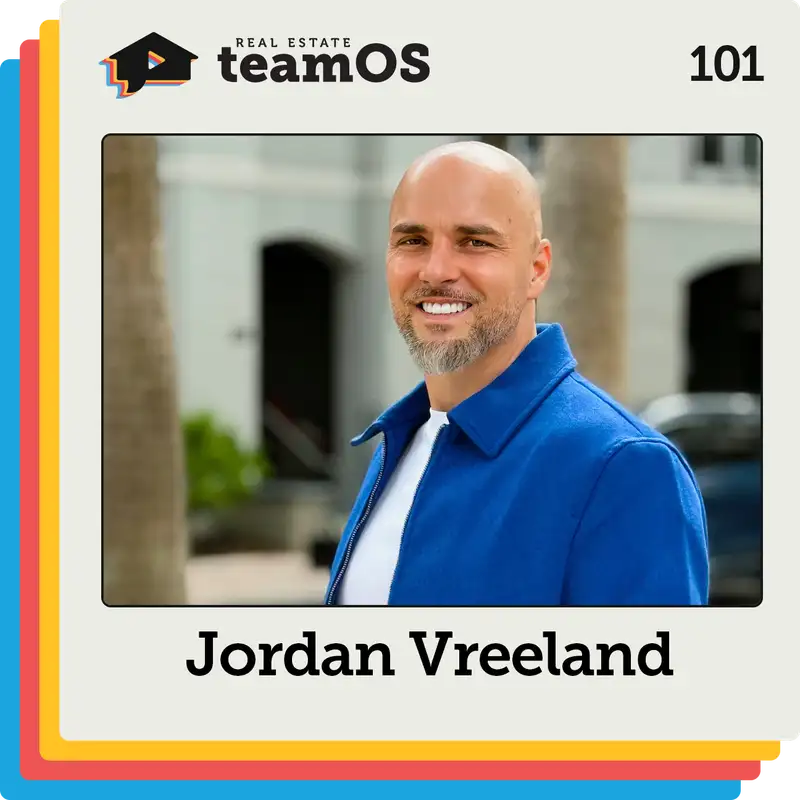
Running Real Estate, Mortgage, and ISAs from a Single Playbook with Jordan Vreeland | Ep 101
Speaker 1 (00:00):
The Falcon system to deliver guidance and success. The tech hub to unify multiple lines of business, the merged calls to save deals. Jordan Vreeland has turned mortgage success into a 100 plus person organization delivering integrated real estate services, and he's sharing his playbook, How Real Estate Mortgage and ISAs Work Together, how they're building and running a unified tech stack, how they're getting agents three deals in their first 90 days, how they're merging calls from real estate to mortgage and mortgage to real estate, and how they've built their ISA team that's their defense system and the lifeblood of their business. Get all that and more right now with Jordan Freeland on Real Estate Team OS. No matter where your
Speaker 2 (00:44):
Business is today or where you want to take it, you'll get there faster and more profitably with an operating system. Welcome to Team OS, your guide to starting, growing, and optimizing real estate team. Here's your host, Ethan Butte.
Speaker 1 (00:58):
Jordan, we got to connect in person late last year. I'm really thankful that we did. I'm impressed by and curious about what you're building. Real estate mortgage title, ISAs, private equity, probably something else that is even on my radar, so I'm excited to jump into it. Welcome to Real Estate Team OS.
Speaker 3 (01:15):
Oh, thank you, man. It was great talking with you before and looking forward to this.
Speaker 1 (01:20):
Yeah, me too. So we always start with the same question, and this one's really interesting. I already have follow-ups for you no matter what direction you take it, but it's what's a must-have characteristic of a high-performing team?
Speaker 3 (01:32):
I've been saying it all week. Attitude and effort. Those are the two crucial things, even with the team. We have a great team in general, but there's times where people slip and the one thing that keeps saying is, "Hey, when you cross, if you get online or if you crumb through the doors, whatever personal stuff you're going on, just change attitude and effort." I used to play in sports, like when you cross the court, when you go on the court, these are the things you have to do. You forget everything else, but you have to do these two things. And that actually, that works really well if we're all doing that together.
Speaker 1 (02:10):
To me, when I think about it, of course, I've never been in your seat and you have a very unique seat that we'll kind of unpack over the next 45 minutes or something. But to me, when I think about it, it's obviously, yeah, we want to screen for some of that on the way in so that we have potential winners or proven winners joining the organization. And then of course, it's this ongoing kind of coaching process to make sure that people can stay in the right head space, especially picking people up when they fall down, especially if they're younger in their career or their journey. But is there anything else about making sure that attitude and effort are present within the organization across everyone participating?
Speaker 3 (02:47):
I mean, it's a challenge, right? Because everybody's going through something personally and you don't know until you ... And you can't ... I mean, if you have 80, 100 plus people, you can't talk to everybody every day. So I think it's hard because you get caught up in doing the deals and how many units did you close and what did you do last year? What are you going to do this year? And try to unplug yourself, which is really difficult and just have a conversation. You got to be careful of the goda minutes where you know that's going to be a complaining conversation, but you got to try to look to spot behaviors of people that it's not really like them to do this or be late continuing like, "Is everything okay? Can I help you? " That's the challenge of spotting the people that really need the most help.
Speaker 3 (03:34):
Then you have individuals that are there for a reason or basically just a season that they're coming for and you can get caught up in the wrong conversation. So I've struggled and just trying to pick my spots in helping the ones that need to be helped.
Speaker 1 (03:51):
Yeah. It's a super difficult line. I saw a quote of yours online, or I'm going to attribute it to you. It's my job isn't to win games, it's to build winners. When and how did that shift happen for you? Because I kind of heard it a little bit in your response there. You can't build everyone into a winner. You're obviously not about winning games because if you build winners, the games win themselves, kind of. But I'm sure that was a shift for you. When did that occur to you?
Speaker 3 (04:18):
Through athletics early on in life. I mean, and then that stops, right? So then it's getting into the work world and just saying, "Wow, this is interesting." Now your best friend is Larry or Ralph that's 49 years old and you're 22 and you're in the workspace and you're like, "We go to lunch with Ralph and he's 49, he's got three divorces and you're a young kid." You're like, "What the hell?" So it'd be hard for somebody young coming in. And I always took athletics and that's all I knew. And coming into work is like, man, if we took these things like winning aspects of sports into the work world, I've seen it over the years where just because you're 42 or 61 or 29, it's not over. So a lot of people just work and they go and they clock out and see you later, "My lunch pale and I'm blue collar." You don't have to do that though.
Speaker 3 (05:11):
You can actually still win every day and you could achieve, you're not done at 39, even if you're new to the career, like mortgage real estate, title, whatever it is, I just see it so many times where they're just doing the thing instead of like ... But when you were 15, you wanted to be really good at football, basketball, baseball, whatever it was, you practiced, you trained, you wanted to win the tournaments. Why at 30, 40, 50, 60, why do we all give up? It's over. So I think just raising winners, constantly letting them know like, "Hey, you're still in the game, the game of life. Your kids are looking at you when you go home, your wife, your husband, your parents are still looking like, don't you want to keep achieving by trying to keep that mindset because it is tough. It's like Groundhog Day every day you go into work and do the same thing.
Speaker 3 (06:00):
And sometimes this business is seven days a week." So you got to break it out and just say, "Guys, let's constantly have minor victories."
Speaker 1 (06:07):
Gosh, it seems like as tough as a seven day week is, those are the best markets, obviously, because it's demanding that of you.
Speaker 1 (06:15):
Not that you couldn't find something to do twenty four seven, especially all the entrepreneurs that comprise the organization. It's never over and there is no finish line. So you could go twenty four seven, if you want to. Okay, you came up on the mortgage side, you built a really successful mortgage business. I'd love for you to kind of ... We're not going to dwell exclusively in real estate, but obviously this is real estate team OS. So we are going to talk real and real estate quite a bit, but you came up on the mortgage side. When did real estate occur to you and was that the start of this kind of integrated set of companies you've built?
Speaker 3 (06:49):
Yeah, it started mortgage long ago. My older brother, he was in real estate. And so we were always doing deals and trying to figure out things together. But after a while, he was a top ranked realtor and I would have joint ventures with different real estate companies or we'd have marketing arrangements. And with great different portal players, they'd connect me to, "Hey, this company in Colorado needs a lender.This one in LA needs a lender." So I was going all over trying to figure it out, going to events and seminars and speaking. And I saw too much of the real estate side and we were doing everything for them. We were in their CRMs. We had 34 CRMs at one time, 34, different CRMs that we'd have to log in, log out, figure out. And I had my team and I had my wonderful ISA team in the Philippines, our Eagle team.
Speaker 3 (07:39):
And we'd have to learn it. We'd have to recruit for them because hopefully one day we'd get that deal coming back. We'd have to troubleshoot it. We'd have to educate the agents like, "Hey, this deal, this loan, the client's lying to you. You can't do that. " No, and they're going after the hardest loans they could possibly do and they're not closing and they want to quit. And we're trying to tell the broker or the team lead like, "Hey, what are you doing that you're doing it wrong?" So after a while in 2017, I said, "Hey, time out, time out. " I'm in all these meetings. I'm not recruiting anybody, I'm not taking anybody. I know the market. I know the lead flow. I know this very well and I'm spending twenty four seven learning this and studying this and I'm going to all the events.
Speaker 3 (08:19):
I'm talking to everybody. And so in 17, I just said, "Hey, I told my other brother, let's do it. We can do this. " And we have everything. We got a couple agents together and then we put the marketing down, we have the systems going and we took off from there.
Speaker 1 (08:36):
Awesome. I would love for you to characterize Vreeland real estate as it is today, like markets you serve, size, structure, culture, whatever you want to share about it to characterize it for folks and then maybe pull out to include the other companies that are all kind of plugged in together.
Speaker 3 (08:53):
Yeah. So Vreeland Real Estate, we have about 70 agents right now. On mortgage, we're probably up to about 15 total with processing and loan advisors. And we have our team in the Philippines. We're up to nine and that's more of our ISA division. And within real estate, we have obviously transaction coordinators, we have team leads, we have a broker, agents, and some support staff in there too.
Speaker 1 (09:22):
You're Tampa, Miami, Jacksonville for real estate? Yeah.
Speaker 3 (09:26):
Yeah. We cover ... And I learned this and I probably made a million mistakes and will continue to do so. But when I was going around in mortgage, we had all these joint ventures and MSAs with different real estate groups. I was in New Jersey and California and Utah and places ... I've never even been to some of these places, but I was in these markets working with ... So now I've had a history of doing that. I know how to do it. I know how I spent a ton of money and got nothing back from it. I know good relationships, bad relationships. I know the signals. So now we scaled back and said, "Hey, there's more than enough right here in Florida." But now we're starting to say, "All right, well, we can pick our spots because we have the real estate built up." It was tough before because we didn't have agents.
Speaker 3 (10:10):
We were saying, "Hey, we got this cool thing and we can pre-qual leads and send them to you. " And we were known for that, but the agent wasn't ready. Sometimes we were the quarterback and throwing the pass and the agent was dropping the pass like, "No, that was 800,000 ready to go. They wanted to make an offer." "Yeah, I'll call them later. "Like," Oh my gosh, no.
Speaker 1 (10:31):
"So talk about that. I mean, it sounds like lead gen was a strength.
Speaker 3 (10:36):
Yeah. I mean, you could go off referral, and I did referral for a long time, but referrals are great if you have them and you have a solid source, but they could dry up. So we had to, earlier on, we got into the lead game and just said," Hey, let's figure this out. "Vendors go up and down, good and bad and different. So we figured out systems. And I went to, I'll never forget, I went to an event called LeadsCon and it was like 900 a ticket. And at the time, like $900 for ... I'm not going there. And I went and there were very successful people that were telling me about it. I was like, " Yeah, but I'm not. I'm good. "And I don't even a website, I'm okay. I have a sticky notes that I write stuff down. I'm good. I don't need that.
Speaker 3 (11:18):
And I go to work and I forget it on my dresser. So there's others that had websites and they're like, " Yeah, they're nerds, this will never check out. "This was long ago. And then a buddy of mine was very successful. He goes to LeadsCon. I'm like, " Okay, well, let me figure this out. "And I started to see the others with websites that I thought would never lift off. They started doing a lot of production and they're good and they're getting billboards. I'm like, " Holy cow, so I got to figure this thing out. "So I went and everybody had orange shoes and T-shirts and I'm like, " I'm used to mortgage vents, but everybody's got suits on. "It was totally different. And I started learning systems and processes and SOPs and like, " Oh man, I'm figuring, okay, you do this and this company makes ... Oh, you make it so much more easier for us.
Speaker 3 (12:02):
"So that was the moment long ago we got in and just half the stuff I didn't know what they were talking about and then I just started learning and making tons of mistakes and then learning. And now some that are in the business like, " Well, you're the lead guy. "No, this is not a lead guy, but they don't understand if you're still shaking hands, you got to move and you got to move with systems, like you adapt or die. And if you don't, it's going to be really tough. So I'm
Speaker 1 (12:29):
Going to go out on a limb and say that that $900 ticket paid for itself several times over?
Speaker 3 (12:35):
Yeah. I was totally out of place. Didn't understand anything, but after a while, then I kept going back, going back like, " Okay, I'm starting to understand this now.
Speaker 1 (12:45):
"Why independent brokerage?
Speaker 3 (12:48):
I don't know. Honestly, on mortgage, I've always been a part of a bigger company and I just didn't see the value at the time and not saying it's not there. I didn't see the value at the time. If I talk to people like, " Hey, we got leads. ""Okay, what do you have? PPC." I don't want those. I have much better stuff going. We're actually pre-qualing the client online, sending to the agent, "We have a proven process that we're winning awards for. " "Would you have this? ""No, that's pretty cool. Okay. Why would it go to you if you don't have what I have already?" So we sort of stayed in our own little bubble and just kept refining our processes and just expanding that way. And it's worked for us so far.
Speaker 1 (13:32):
It made sense just to keep doing your own thing.
Speaker 3 (13:35):
Yeah, I didn't see anything better. I mean, I saw the stuff and you go and we have seminars. I'm like, "Okay, cool. What's the next one about? Short sales. Got it. You're still talking about short sale negotiating and how to do Facebook leads and there's nothing wrong with that stuff, but we're moons past that. Who's teaching that? " Well, Bob, Bob hasn't been a producer since 1988. Why is Bob's like, "No, I don't want this. " So we're very tech forward, processes, thought. We want to be ahead of the curve on a lot of stuff. I like to be able to make changes if we need to really quick.
Speaker 1 (14:10):
Do you have one core tech stack that real estate, mortgage, ISA and title runoff of, or I mean, obviously different specialties have different tool sets, but is it all kind of connected at the center? Talk a little bit about your own kind of awareness or passion of tech over the years, like how that's evolved and how it works across the multiple divisions.
Speaker 3 (14:33):
Yeah. So everything ties into Follow Up Boss. So that's our hub and then we could have anything from third party and we'll test a third party, it's good and then it's not good because this other company's better now and then this other company will come in. So using the integrations and Follow Boss helps a lot. We're plug and play. We're constantly moving tech partners. We'd love to keep everybody, but the problem is it's just moving so fast. So to me, I love marketing and I love the technology part just because it's so intriguing that long ago we were, like the stuff we had to do 25 years ago or 15 years ago was insane. If you look back, you were doing paper applications, you were really FedExing stuff and you couldn't fax machine. So now you have, I don't want to name certain companies, but you have companies that are just going off role play and they're grading out your role play and companies are putting in notes for you and they're all the things that we have headaches with and they're very manual tasks that it's actually just happening.
Speaker 3 (15:39):
And the lead providers, they're doing a lot more than just giving you lead. They're assisting you in the process versus just giving you a lead and saying, "Figure it out.
Speaker 1 (15:47):
" What is your role in this organization today? I mean, I feel like you're probably, I don't know, the visionary and maybe kind of like the heart, soul, brain tone setter, but describe your own role.
Speaker 3 (16:04):
Puppet master for a little bit, and then that's not it. That's not a good thing. A coach says, John Sheplak, every level has its devils. So he's told me that for years, but it was running around and trying to pick this one up and you get this one set and you got to run a new title and you got to figure out ... I found that I'm most happy building. So building through tech, building through systems and obviously having the right people to do it with. So a visionary builder, because they'll ask like, "What do you like to do? " I'm like, "I don't know. I just do everything that needs to be done. I'm going to just go over here." When you're growing, it's tough because someone quits and they have this division. What are you going to do now? You got to fill a hole, so you got to do it.
Speaker 3 (16:49):
But now understanding it, it's probably my age and hopefully a little wisdom comes with it, is understanding to slow down and to really work with people that are in our organization and try to grow them into a position is what I've learned instead of just outsourcing and trying to figure it out on the fly, because that may not be the best. But if someone's been with you and loyal for years, why not spend the time with them to elevate them?
Speaker 1 (17:14):
And have you been doing that across all of the different divisions? For example, just go back into real and real estate and talk a little bit about that structure and any ... You don't have to name names unless you want to. Share an example of a team leader that you maybe invested in a little bit and what was that like for you? I mean, especially being a mortgage guy rather than a real estate guy.
Speaker 3 (17:37):
Yeah. Yeah. Interesting. We created a position called Falcon. My love for ChatGPT and having conversations about nothing and everything, it turned into something. So I was just going through and thinking about the ... I'm always thinking about the athlete and me thinking about weaknesses and where's the holes and how can we fill it and what could we do better? And I was thinking about a position. It's like, you could say team lead, but that's sort of played out. But what we really need is on the recruiting classes, we're averaging 12 to 20 a month coming in on agents and you got that first week and spring Benson, a hello week, and okay, we're going to do that. And we took pieces from others in the chat black community and saying, "Hey, you guys do this. " And they're all phenomenal and they got great ideas and we have some of the ideas we're putting together too, but week two, week three, we're not really great at that.
Speaker 3 (18:26):
And we're probably telling people like, push them, you're going to figure it out and make calls. And we're figuring out and followup boss, they're just making a bunch of calls and probably pissing off a lot of clients. And then they're texting and they're template texting everybody. They're just robotic. So we figured out and said, "Hey, we have top producers." So one of the top producers, we just said, "Hey, there's a Falcon position. I was going through and thinking the animal that's best and it swoops down in. So if you can swoop down in, see that this client needs to make an offer, the client doesn't know what to say, but they jump in a group text and do it, or they're going over, they're pulling them and coaching. And so they're really getting involved in the process from week two to maybe 60, 90 days.
Speaker 3 (19:04):
Let's get everybody the three deals. Let's find a way to get them three deals really fast because most times when agents see the first check or second check coming in, they close the deal and they see it, now they're like, okay, I believe you. Because I think we're putting a lot of tech and all these awards and everything we do, and this is great. But I was talking over the weekend about this is I think they ... Well, I know they hear this from every brokerage they tried. Sometimes it's not the brokerage. It's their personal habits that held them back, but they hear a lot and I don't know if what they're getting is the truth or if they're really getting a winning strategy of doing it because they bounce brokerage to brokerage and all ... I mean, it could be one of the two, but we have to do a really good job of illustrating and overseeing.
Speaker 3 (19:51):
And one said micromanaging. I'm like, not micromanaging, but if you've got three deals in the first month or two months, then you'd be really happy. And you'd actually, we say a lot of times, just run the play, man. Our plays work really well. Just listen to the Falcon, listen and run the play.
Speaker 1 (20:06):
And so that role is an agent and they're also doing this in addition?
Speaker 3 (20:12):
Yeah. So we did it. It worked really well. They're receptive. We're on Rome, which is similar to Zoom, but Rome is a little bit better. You can move back and forth. So they're in, they're at shift change, but they're constantly in the room sharing screens so it's interactive because we're not all in the same place. Some agents are out of their living room. They're at Starbucks, they're in their car, but they always can pop in for guidance. And it works so well on the real estate side that we did on mortgage. I said, "Hey, we're going to do a mortgage falcon." And now the two connect and it takes time away from me that I don't have to jump into firefight every single deal.
Speaker 1 (20:46):
Really good. I want to talk a little bit about mortgage and I want to talk a little bit about ISA. And I guess we'll start with mortgage just because you introduced the word and so it's top of mind for me in this moment. What do you wish more real estate professionals knew or understood about LOs, the loan process, or just the mortgage business in general?
Speaker 3 (21:07):
Picking out the right deal and not just listening to the client what they want to do. There's a lot of good loan officers or loan advisors out there. Welcoming them into your CRM and making them respond and some LOs will, some won't, but the more unified you can be, and you don't need to have seven different lending institutions to try to split the marketing. Pick one and work together really well in sync where you can finish each other's sentences, group text, but be careful on just doing any deal because the client told you there is some hard loan products that take 60, 90, 120 days and you're fighting for escrow money back. And if you can select conventional FHA VA, and there's some non-QM loans that are pretty good, but be careful on selecting the hardest deals out there like DPAs and HomePath Renovation, 203K.
Speaker 3 (22:07):
Not saying they don't go, but a lot of times agents pick that or they just do it, they will close and then they get so frustrated. Most of them leave the business because real estate's too hard. It's not too hard, but the two of you got together or you said yes to it and you gave it to a lender and they have a 400 credit score and you were showing them for three months, but get them involved earlier on and make a connection, but be inside follow-up boss together.
Speaker 1 (22:30):
For an agent or a team leader who's watching or listening that doesn't have the benefit of having a mortgage expert kind of at the head of their company, how far should a real estate professional go in understanding the nuances of different mortgage products? And if you feel like that is a responsibility or at least an opportunity, I think it probably is, where should they go? Where should they get studied up if they don't have someone who can kind of like answer questions and feed them and maybe even build some mortgage education into the onboarding experience?
Speaker 3 (23:05):
That's a good question. And I was thinking while you're saying, I'm thinking, if I was them when I didn't know, what would I do? I would look for the top producers, and you can find them. Look for the top producers in your market in lending and they should be contributing and they should be on YouTube and Instagram and Facebook. They should be giving information. Just listen to what they're saying, watch some videos on it. And it's not your job. We say this agents all the time, it's not your job to pick the loan product and talk about rate. It's not your job. What you want to do is once it gets out of bounds and you're like, "I don't know, " just say, "Hold on a second." Get the LO on the phone. Call them, "Hey, hurry up. Need you. " Cool. "Hey, I got Ethan on the line." Either they had a question about this loan, but always say, "Hold on one second, let me take care of you and then merge it.
Speaker 3 (23:58):
" And if you get that LO on the phone, just listen to what they're saying and how they're ... No, you don't want to do that. Okay, here's what we want to do, but the merge call and listening to them live, that's going to build your knowledge level instead of you just trying to look at the best loan products. Nobody's going to do it, first of all. You're not going to go in and research it and then remember, you got all this other stuff to do in tourism and LO shouldn't do that with real estate either, but just hold on one second, let them be on the phone with a client and hear them. And you're going to find out if someone's telling terrible voice, but if you're watching some of the top producers in your market in general, just listen to what they say when they're live with the client, because that's game time.
Speaker 1 (24:38):
Yeah. I assume that what you just described is something that's available to a client of your mortgage company or your real estate company. I'm sure that you have this kind of down a little bit. Talk at whatever depth you would like about the integration of a mortgage business with a real estate business in a way that stays fully compliant, but improves the client ... Because what I heard in your response there was an instant three way with an LO in the conversation. I feel like if I was a client and that happened like bang, bang, bang, like, "Oh wow, I'm talking with ... "That would be impressive to me. So I assume because your mind went there that it's something that you're doing. Talk about some of the steps to make that work.
Speaker 3 (25:27):
Well, think about what we do with clients and overall it's the client experience. If we can make the client experience better, they close, they're happy, maybe they get referrals, but altogether they're happy buying a place. That's why we're here. We had a rule is merge the phone call. So for years, agents would always say, "Hey, call them tomorrow." I know I did. They didn't answer. Call them the next day, did it again. I've called them four times. I triple dialed them and they didn't answer. I texted them, I emailed them and I talked them on social media. The thing is, if you have them live on the phone, merge the call, whether it's real estate to mortgage, mortgage real estate, merge the call, but be ready and be on the fly. So do I have to be ready? And what if I'm eating at six?
Speaker 3 (26:13):
I know, I'm sorry. But we're dealing with buying behavior. New lead client likes a place. Here's what really happens is it's eight o'clock at night. You don't have anybody to answer to answer those questions on payment or down payment. Okay. So wait till the morning. Okay. Now it's nine o'clock and finally, okay, are you ready to talk, Ethan? "Yeah, I'm finally ready, man." Or the property's gone, multiple offer. So you may have needed 3% seller concessions like, "Well, we got another offer. Why would I talk to you? " But if we got that locked in, call listing agent and fired the offer out, now it's game time. So we saw so many deals falling. They said, "Hey, if you have them live and they like the place and grandpa or someone else is not going to talk them out of the deal and they're both a husband and wife, they're agreeing on one place.
Speaker 3 (27:02):
They haven't agreed in a year. They've finally agreed on this place and it's nine days on the market. Why would I wait?" "Well, I'll do it tomorrow. Don't do it tomorrow. Merge them on the phone call right now and you have to make sure that you guys are in sync. Mortgage real estate, ISAs, you have to be in sync or pick up the phone. Save the number. "We tell this to everybody. Save dollar sign, dollar sign, emoji, emoji, emoji, save whoever's name and put that there. So if your phone lights up with that, you can put a graphic, whatever you want, pick up that phone call. No matter where you are, pick up that phone call. It's money.
Speaker 1 (27:34):
And that's being trained on both sides.
Speaker 3 (27:36):
Yep.
Speaker 1 (27:37):
Yeah. When did ISAs come into your world? When did you get turned onto the idea of ISAs and how did you decide to build out your own team, which if I remember correctly, you call them the defense system or the lie of defense or something else. I'd love for you to talk about the evolution of ISAs because I assume that they're supporting both real estate and mortgage.
Speaker 3 (27:59):
Yeah. I tripped upon it actually, I think 13 years ago. There's a real estate broker and he was using ISAs in the Philippines and he was going, but I was watching how he was working and how he was just interacting and treating. And I'm working like 17 hours a day. They were working off spreadsheets, no CRM. And I was like, " What the heck? "And they're working. They're like, " We haven't had a break. "I'm like, " Whoa, what are we doing? "And they were so nice. And then I was just a lender at the time. I was like, " This is crazy. I don't want to be a part of that. "And so I talked to one and they were in Facebook and I was like, " Hey, I don't have a knock. There's nothing there. I can help you. "And I loved it.
Speaker 3 (28:43):
I loved how you were and you were great. And so I just started working with them and just having them," Hey, I need backend support. I probably could be in CRM and we could be on Zoom together. You want to do Zoom or you want to do any ... Google me, anything like that. "So we just started working through processes and I'm like, " Man, but here's delegate and elevate. Here's the things that I don't want to do and then I need to be working on these things. "So I just started testing it and I was like, " Man, they were task oriented, knocking things out and it just saved so much time. I could do a lot more things up. It was a football game. My son played it at UF and we're at Florida Gator football game. I'm watching him and we're in the stands and pre-quals are coming in and I'm kicking it to them and they're handling everything in the systems and back and I'm like, thank God because I can't do all these things.
Speaker 3 (29:32):
"And then from there we just started growing it. So adding more ISAs and we just, like I would say they're the lifeblood of this business. And if anybody comes in, they're so nice and they're a huge part of the family that we have, but they save ... Even last night, I was looking at, I gave them a shout out this morning right before we came on, they looked in the system and they picked up probably like nine offers clients said," I want to send a link. The agent didn't even see it. Lending didn't even see it. They picked it over the way You can say, "Hey, they want to go offer." How the hell do they know that, but Agent and LO, you didn't see it? And then Clay, I don't know. I'm like, "Yeah, they were." And the client wouldn't offer that fast.
Speaker 1 (30:10):
I feel like one of the impressions that folks that aren't steeped in working effectively with ISAs is that it's these are people who will do tasks that you assign them as long as you give them a 12-step, step-by-step breakdown. And I'm sure it starts that way, but what you just described is someone who understands the nuance of the business and the communication. So how did this team get there? And can I assume correctly too, going back to where we were maybe 25 minutes ago, that you maybe have a leader of that team who is one of them who's been with you for most of that time? Yeah.
Speaker 3 (30:51):
Yeah. And I've seen, how does it work? It doesn't work. It doesn't work because you talk down to people. It doesn't work because you just sent them an email and expected them to come back and them being your teammates to come back and figure it out. That's like going to practice and coach is putting something there and saying, "Figure it out guys. I'm not coming to practice today." "All right, coach, we're on it. "Right. So we spent tons of time on live calls like this share screen and saying," Hey, do you havequestions? All right, let's role play it. Let's role play it again. "Actually, we wouldn't say it like that here. We would say this. And no, don't do that. Do it this way. So phonetically giving them, who's your favorite actor? And they'll say somebody," Who's your favorite artist? ""Okay, let's try to sound like them a little bit like tone, pitch, cadence." You have to work with them.
Speaker 3 (31:43):
And I mean, I can't tell you that a teammate we have wasn't college educated. All of them are. Their resumes are fantastic and they're great people. So taking the time to never say assistant, I don't like it. ISA is a word, but you have to spend time in training and coaching with them. And if you will, they will shock you and your business will blow up if you spend the time doing it.
Speaker 1 (32:15):
Did you find these folks yourself? Did you get an introduction from someone that they were also working with? How did you build this team? Did you use a third party company initially and then kind of build it out on your own? Or how did that go?
Speaker 3 (32:28):
So we didn't. And you can. There's third party companies that you can build relationships with and go through and do it. And I'm sure they're fantastic. And it doesn't have to be Philippines. I mean, there's several countries that I've seen over the years and been at seminars like, oh shoot, if I didn't have this already, I would probably try that. For us, it was just dumb luck. It was like they were getting treated horrible. She reached out to me through Facebook and I said, "Yeah, I'll spend time with you. " It was a gamble because did I need to do it? Should I have done it? Probably not, but I felt compelled. I was like, "Man, but you could be really good." And I saw things that like, man, but if you could help me, you're not going to go tour a property. You're not going to tell me to bring an offer.
Speaker 3 (33:09):
You're going to pre-qualify.You can't do any of those things, but you could see a lot of things that I can't because I'm in these meetings, but in the back end, if you saw a text come through or you could get the client on the phone and merge them to me live, that could save so much time. And that's what they're really fantastic at.
Speaker 1 (33:26):
So you have been kind enough to test something new inside follow-up boss. I don't normally talk products, but it's a new thing and you've been kind enough to test it for months. There's a new feature set in Fub via Zillow Pro, including kind of like that MyAgent connection. I'd love for you to talk a little bit about like, A, why'd you decide to test it months ago? And then B, what have you learned in the meantime and how's that been interesting to you?
Speaker 3 (33:56):
So we do all types of different leads, but there was leads in general that we were going and we would get them, we would pre-qualify them and then we'd get them to an agent, but they'd already be with another agent that was a Premier agent product. And so for years we were saying, "Guys, you could have Wylope with Sierra, you could have everything else that you want to get the client to go to, but they're going back to Zillow. We all know it. They may go to realtor.com and go back to Zillow." So if you just gave us vision, if you just gave us eyeballs and to know if they liked the place, then we wouldn't have to be pressing them and the client experience sucks. We're coming to us and we're saying, "Don't go back there. Only go here. Stay on this site." And then you're going back there, damn it.
Speaker 3 (34:41):
I want to say that for years of us saying that in several meetings, that may have sparked a little bit of that. Behind the scenes, we laugh and joke like, I think we may have been the cause of that because we kept on law, if you guys, it would be so much more powerful if you just gave everybody, not just us, but if you gave them vision. So the MyAgent is, I see it. We've made mistakes with it, but if I can get the client for a year, if I can send them, we call it Zbuddy, if I can send them a message and they say yes to it, it's for a year. If it's anybody else that we have, say it's a referral or a different lead source, if they can say, "Add me as agent," and I send it out and that's three years.
Speaker 3 (35:23):
So for three years, I can see everything they're looking at or help them. I don't have to say, "So did you see any properties you like? " Because we all have agents that do that all the time. "Let me know if you like a property. I'm here. We did our job. Thank you. "So now they like 123 Main Street and they hearted it, then you could have a better conversation like, " Hey, actually I showed that one. I closed the home. "There's more intentional conversation or text that you can have based off what they want and the client doesn't have to feel uncomfortable about you just having that weird text template or," How are you doing today? Is it cold over there? "Like," Holy cow. "So it takes the salesmanship or the advisory because you should be advising your client. It takes that to a new level where you have something to gain, but you have something to give the client as opposed to just trying to sell them something, which we can't stand when people do that here.
Speaker 1 (36:19):
Yeah. That visibility, I like your language around that too. I think I also heard you describe it as GPS or something. And this is the idea of sometimes we're nurturing people for months and months at a time. And you try to check in and not that you say," Hey, I'm checking in, "but we try to come up with means and opportunities. Sometimes it's automated, sometimes it's a reminder for the human to do the activity. We try to stay in touch. And so this idea of knowing where the client is when they're not on coastalproperties.net where you want them, they're on Zillow where they just want to go because that's what they know and that's what they do. And I don't think your team's been on it long enough to know for that person that you closed three months ago, what are they doing 18 or 24 months from now?
Speaker 1 (37:07):
Maybe they're not in the right place. Maybe they are starting to look again.
Speaker 3 (37:12):
And you think about it, you say five, 10 years ago, I'm like, we battled with it. You don't know what to say to the client and it's uncomfortable. Even as team lead," Hey, so your dog's all right. "You're trying to look up your old note and maybe you have it in background notes. If you put it in anyway, in background notes, it'd be there, but you're trying to just ... They said hello like, " Holy cow, I got to talk to them to something. "They don't care that you're going to ask them the same question if you're going to touch base every quarter. They know you call every quarter. They know you call every Wednesday at two o'clock because that's your call time. So this just gives something different. You want to talk about a property, they want to buy a property and you could see how long they've done it.
Speaker 3 (37:52):
To your question or to your response to what you had was interesting too because I say this could and should be our best post close product. You could put templates on, like a post close, email template, text template, go. That's great, but it doesn't make any sense. Now if they look and look and look, if they're looking at hard and like, " Hey, are you trying to sell? "Because a lot of times you can use Fellow, you can use everything else and that's when they already are doing it in the process. But if you see activity kicking up and you can do your smart list and follow up boss where you can say anything is last visit, you can see everybody going. So if I could have everything set up in there, then it'd make a heck of a lot of sense to get them right then and there.
Speaker 1 (38:34):
Thank you. That was really fun. And I agree, the post close piece is I think long term, one of the more interesting aspects of it because it's real behavior as opposed to the response to an email or the response to a text which may be sincere or earnest in nature, but it's not necessarily behavior. People don't always know what they need or want, but their real behavior says something very clear.
Speaker 3 (39:02):
And if you talk to them at that time, it doesn't have to be weird. They're going to be guarded anyway, but you could say something easy and get into the conversation, then you can talk about their dog or their cat or their kids at 10th grade now and you can soften the conversation up. It flows a lot better than what we've had before is nothing and we're trying to make something, make a conversation up. That sucks.
Speaker 1 (39:27):
Yeah. Yeah. I guess to kind of like bring this to a close and to kind of call back, you mentioned John Chet Black and the community that he's built, obviously a ton of amazing highly performant team leaders. As you got deeper into real estate and you got into communities where some of the best operators in the business on the real estate side are hanging out, what surprised you about real estate or the real estate business or team leadership? What was the same as you maybe expected and what was different than what you expected? How did you come to feel at home and what were some of the break in experiences that you started to connect with some of the best real estate team leaders around?
Speaker 3 (40:11):
I think for years you saw them and you didn't really talk. So mortgage and real estate is weird because mortgage are always begging the realtor for a deal and give me money and you're like, " I don't know, you're going to give me a deal. Give me money. "Okay, because they have leads and everything else, but for us it was different because we didn't need that. So we were coming in and I was coming in to the community years ago. It's just like, " Hey, now I'm on a level where I don't want deals. I want to communicate and I want to grow the real estate business, but it helps grow all businesses too because you're dealing with, you got some monsters in these rooms and I think getting in there and then growing it, but now being equals with them and having real solid conversations and friendships, that was a thing that I didn't think would happen.
Speaker 3 (40:58):
I thought it would just be conversations, it's superficial and nobody helping, but they're literally giving playbook. That's what we do. I'll give playbook, I'll help out anybody because there's really no competition. There's enough business to go around, but if everybody's nice and we help one another, you don't know what anybody ... Like I said before, even team leads and broker, you don't know what they're going through. You could help them fast track six months before because they didn't try this technology and they could have ... So in these rooms, that's what actually people do, which is amazing to me. I love it.
Speaker 1 (41:29):
Yeah. And it's a you get what you give type situation. I mean, I'm sure no matter what rooms you've been in, I'm sure there are some people that are more closed off, but they're only getting back what they're giving away.
Speaker 3 (41:40):
Yep. And you could tell, they're closed off, they won't talk. I'm like, okay, that's weird. But then the ones that are just giving everything away like, "You're in my mind." Yeah, it doesn't matter. And if you go to YouTube, everything's in there anyway because everybody's giving it away anyway.
Speaker 1 (41:56):
Yeah. It's one of the most fun things about like, I'm just thinking about Unlock just a few months back and I'm standing there talking with a high performing team leader in the hallway and another guy that I know who is in his exact same market comes up and they just straight up bear hug each other and now the three of us are hanging out and they're like, they're direct competitors. They're competing for the same buyers and sellers, they're competing for the same agents. But to your point, there is enough to go around and they're wise enough and open enough to know that or recognize it. And it's also like, it's not just there's enough, it's there's a right fit for each person. There's a right fit for a buyer, there's a right fit for a seller, there's a right fit for an agent at this stage of his or her career.
Speaker 1 (42:43):
And we may or may not be that, be it.
Speaker 3 (42:46):
And we see that too. You may go to another brokerage because, hey, that's a better fit. We may be a little too intense. And then someone else, very intense, like they're too laid back. I want to be here. Okay, that's fine. But there is a right fit for everybody.
Speaker 1 (42:59):
Yeah. Is mortgage that open in general culturally? Would you say that it's that open in terms
Speaker 3 (43:05):
... No. No. No. For years, no. You just made me think, thank you. Now, the communities that you go into, and there's been real estate where everybody's closed off and everybody's too cool. But the ones we've gone to embedded part of. And the funny thing is the more money I spend in coaching, which I don't want to do that, the higher I go, the bigger ticket price to go to certain events, it's the more they share and the more open they are, which everybody wants their ideas, right? But then when you go lower, then everybody's closed off, but you're closed off exactly what you said, what you give.
Speaker 1 (43:45):
As we record this early in 2026, what's ahead for you this year? Does the calendar year mean anything to you with regard to your own goal setting and planning?
Speaker 3 (43:56):
I think it's good, man. I think it's good for the units and volume and more so for everybody, what they want to hit and what they personally want to overcome. We do going to the board and like, "What do you personally want to come? What do you want to make? Everybody wants to make X, Y, Z." But more so, what do you want to overcome? And if that happened, what would that bring? Because if you did that, you'd make the money you want. I try not to chase others ever because it doesn't matter. And even going in, like now I'm 48. It's not so much about the, how many did you close this year? I don't know. I've closed billions of dollars in this business, billions. So now you close 400, they close 500. I don't know, man. Is everybody happy? Is everybody hitting their goals that are on the team?
Speaker 3 (44:40):
And then family-wise, is my family good? My wife, my kids, my sister, is everybody good? Are they hitting their goals? Are we traveling? So I think it's more so at this point, it was all that before, like, no, I'm going to do a thousand. And now it's a little bit different. And I'm finding that as long as we're growing and we're doing it the right way and everybody's taking care of each other, we have our number one core values in Buntu. I am because we are. If we keep that solid, I think we're just going to continue growing and hitting our goals, but more so just making sure that we care about one another as opposed to just, and the client in general, as opposed to just getting to that number, that number, because you chase that, man, that's a sickness. I've done it.
Speaker 1 (45:23):
Yeah. Beautiful. Such a healthy approach. Okay. Man, I felt like I just asked you one of my closing questions just in the spirit and nature of that response. That was great. And I don't know if you know Wemer Group Realty in Orlando, but Umbuntu is also very important to their structure and culture. Awesome people. You obviously share that approach. Okay. Jordan, three pairs of closing questions. You can answer one or the other or both, whatever you prefer. The first one is what's your very favorite team to root for besides Reland or what is the best team you've ever been a member of besides Reeland?
Speaker 3 (45:58):
Junior year of college basketball was a good team. Everybody played off each other. We had captains. We liked each other. We played hard, cheered. It was a good culture. And then if I think about ... Yeah, I love sports, but if I think of team ... I love Golden State Warriors, and they're sort of declining now. I'm sad about that. Probably Oklahoma City Thunder where if Shay Alexander, if he's up there giving ... Interviewed after the game, he makes the whole team come with them and joke around and do stuff. And they're playing at such a high level, but they're team chemistry. And I'm not there, but just seeing it and being on a lot of teams, you can just see that they're close. And I love watching that.
Speaker 1 (46:44):
Yeah. You made me think of the Pistons. I grew up a Pistons fan and they got that going on right now. And just you see these proposed trades come up in the news and you're like, "Do not blow this up."
Speaker 3 (46:55):
Don't rack it. Don't wreck it.
Speaker 1 (46:57):
The chemistry is all there. And that matters as much as just the raw talent on the court
Speaker 3 (47:02):
Because
Speaker 1 (47:03):
We've all seen tons of talent that just doesn't work well together for any of a variety of reasons. What is one of your most frivolous purchases or what's a cheap skate habit you hold onto even though you probably don't need to anymore?
Speaker 3 (47:17):
I've heard you ask this to others, and I was trying to think about this because I knew it was coming. I would say gum. Okay. So when I was younger, I didn't have a lot of money for gum, so I would rip it and just half the gum and save half it later. So I still do that. But I think if you chew the whole stick of gum, you're a psychopath. You're lawless, you have no boundaries, there's nothing there. So yeah, probably gum.
Speaker 1 (47:45):
Yeah, I love it. As soon as you said gum, I was like, all right, where's this going to go? I get it. I get the half piece. Totally. What does it look like for you, Jordan, when you're investing time in learning, growing and developing, or what does it look like? What are you doing when you're investing time and resting, relaxing, and recharging?
Speaker 3 (48:02):
Heavily into the community. I try to work out as much as I work in a sense, but I'll go to the sauna a lot and I'll just have YouTube. I'll just learn. Just podcasts, whatever I have going on, just learning. While I'm working, I'll try to play that again. Just constantly, it could be my coaching call, other coaching call podcast, but just feeding, feeding, feeding. Because that actually, I have friends that are great speakers and coaches that don't even know who I am, but they're my friends because I listen to them all the time and they got me out of the rut and I left Asana or I left work and I'm like, "I feel better now. Now I can go help people. " And personally, I try to push for a family trip. I'm better about this than I was because I was not good.
Speaker 3 (48:44):
I was working way too much, but pushing like we have to get away. So we have to do Airbnb, a place, a really cool place. And we talked about trail hiking and certain things. We're always doing trail hiking now, but just going to get a cool house, spending time cooking, caring, talking, joking around, playing games, talking about finances, just really getting away with the family is a big part of it now.
Speaker 1 (49:08):
Awesome. I love that. If someone has enjoyed this time, which if they're listening like 50 minutes into a conversation, I assume they enjoyed this time. Where would you send folks who want to follow up with you and maybe connect with you?
Speaker 3 (49:21):
Yeah. Just Vreeland Real Estate, Instagram, Facebook, anything like that, just Reeland Real Estate, just hit us up. If you have questions, comments, anything like that, you want to jump on a Rome or a Zoom just to have ideas? Yeah, for sure, man. We'll jump on anytime.
Speaker 1 (49:35):
Cool. Links are down below in the description, whether you're watching on YouTube, you're listening in Apple Podcasts, you're watching or listening in Spotify, or watching or listening on the website, links are all right down below to learn more about Jordan and his massive integrated business. I love what you've built. I wish you continued success in the year ahead, and thanks for spending this time with me.
Speaker 3 (49:54):
Awesome. Thanks, buddy.
Speaker 2 (49:56):
Thanks for checking out this episode of Team OS. Get quick insights all the time by checking out Real Estate Team OS on Instagram and on TikTok.