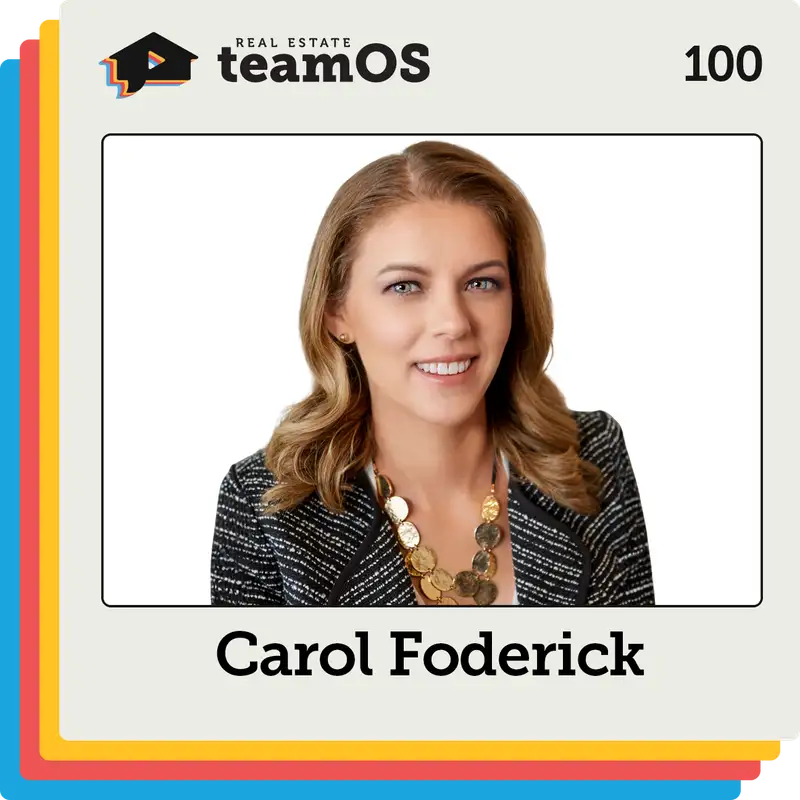
The Hidden Math Behind Referral-Only Real Estate Growth with Carol Foderick | Ep 100
Speaker 1 (00:00):
How many marketing activities does it take to produce a referral? How many referrals does it take to produce a closed transaction? What's the value of every outbound call or text? Carol Fodrick can tell you, and she does in this episode. Her 20 agent team closed more than 500 transactions last year, working 100% by referral. Get all the details, including roles, logistics, activities, agent retention, and more. Learn to work by referral with Carol Foderick right now on Real Estate Team OS.
Speaker 2 (00:32):
No matter where your business is today or where you want to take it, you'll get there faster and more profitably with an operating system. Welcome to Team OS, your guide to starting, growing, and optimizing real estate team. Here's your host, Ethan Butte.
Speaker 1 (00:46):
Carol, you and I connected in person not very long ago at a Buffini Coaching Live event. I was so glad we had that conversation. I'm really happy to welcome you back and have another conversation here. Welcome to Real Estate Team OS.
Speaker 3 (00:58):
Ethan, I am so excited to be here. We're going to talk about all the things. And I feel like in preparation for this, we've already had six podcast worth of material already, so can't wait to just distill it all and share some of my knowledge with your community.
Speaker 1 (01:11):
Yeah, I love it. The one thing we are definitely going to hit, and I'm just saying this for folks watching and listening, we're not going to do it right away, but a systematic approach to referrals is a thing. Doing it in a team context is a thing, and it's something that we haven't talked about enough on this show. So we're definitely going to get into that just as a teaser. But you know, Carol, where we start, which is, what is the must have characteristic of a high performing team?
Speaker 3 (01:34):
You know what's interesting? I'm going to say that there is a personality trait that's a must have, and then there's a logistical or a tactical part of it. So from a personality trait, I'm going to say it's grit. The reality is that whether your market where you are listening to this locally is good or it's bad, the reality is that it's hard. Wherever you are, whether or not you're in a place where you're receiving multiple offers on all of your listings or you've got multiple listings and no offers, it's hard. So Grit is that ability to really be able to pivot quickly, to be able to do the hard work, have the hard conversations, regardless of which side of the transaction you're on. And I'm going to say that that's probably the biggest skill that you need to have. On the logistical point of view, no team, whether it's a small team or a big team, can exist without lead generation.
Speaker 3 (02:21):
And so we live and we die by our weekly numbers. And I know I'm echoing the sentiment that a lot of people on this podcast have already shared, but without input, there can be no outcomes. And so you can have the best mindset in the world, you can have the best systems in the world, but you're not actually feeding fuel into the machine through lead generation. It doesn't exist. So that's my perspective on it.
Speaker 1 (02:42):
This is a very basic question and I don't mean anything in particular buy, but when you say lead generation, just toss off some of the ideas and activities that are in that category.
Speaker 3 (02:53):
Well, I would say it's not a basic question because for everybody that heard me say that, it's going to mean something different to that.
Speaker 1 (02:59):
That's exactly why I asked. I love
Speaker 3 (03:00):
It. Yeah. For some people, it's going to be the lead generation is going to be plowing through that list of online leads that they bought. For some people, it's going to be lacing up their shoes and knocking doors or getting the headset in an auto dialer out. Lead generation means something a little bit different for everybody. For some lead generation is a chaos. It's a mix of a little bit of all of those things. For us here at the Carol Fonda Real Estate Group, lead generation is a working by referral approach. So it's a systematic approach to our database and we track three things, CNP, calls, notes, pop buys. So calls to database. So that's an established sphere of influence, people that we are striving to be in community with on an ongoing basis. Some we know very well, some we are trying to get to know better, but calls to that database.
Speaker 3 (03:45):
Notes, just like it sounds, personal notes to those database contacts with the intention of forging not only community, but real connection with those people and Popeye's, which is the ... I mean, we could have a whole podcast just on that. Just probably the most perfectly generation tool ever built. It's the opportunity to get face-to-face with your clients, whether they are past transactions, people that you've had the honor of servicing before, or people that you want to be of service to, getting face-to-face with them. So we track those three things. That's lead generation for us. And that's what we look at every single week, week in and week out.
Speaker 1 (04:22):
Okay. We're going to dive deeper into that system after a few other topics that we have. I just want to save one personal thing here. Everyone knows this is a relationship business. Everyone knows that this is a human to human business. And the number of digitally mediated things that we put between us and our clients is shocking. And so I just found what you shared very refreshing. When did team occur to you? I assume if you're like 99% of the people who've been on the show, you're a very successful agent. And at some point you said, "I'm going to bring a few people around me. " What was that for you? Where were you in your business and how did it
Speaker 3 (04:58):
Start? Yeah. So super quickly, I'll give you the trajectory of where I started and where I'm at now. So I started like so many amazing agents do, which is on the front desk of a real estate company answering the phones and paging out lockboxes. If we ever wanted to take over the world as older agents, we could literally just page it out in the cryptic pager messages that we used to send RLS, LBX, release lockbox, lights off, leave shoes, all these things. So started on the front desk, very quickly moved to the back office of that real estate brokerage and then got picked up by a top producer in my office as an unlicensed assistant, moved to being a licensed assistant, moved to being a team leader. At the same time, I was having kids and I moved geographically within the greater Toronto area, which is where I live, decided to start my own team after being successfully running one of the biggest teams in the country.
Speaker 3 (05:45):
And so for me, that's what I thought I wanted to do next with my life. You're right, Ethan, that a lot of people kind of migrate through to being a team leader after being successful real estate agents. I don't think it's a natural migration. Not everybody who's a great salesperson should be a team leader. And by extension, not all great team leaders are tremendous salespeople. So if you're not a top producer, I don't want you to think you can't be a great team leader. But all of that happened for me at a time while it was also happening at an industry level. And I'm in a fairly big market, the greater Toronto area, the largest MLS in the world by agent count, 80,000 agents. And we see teamization happening all around us. And it's getting more and more pronounced. As our market has gotten harder, especially there's this sense of like smaller agents who are still very productive in their own right, tying their boats together and creating teams, not only for the client experience it is creating, but also for economies of scale and the efficiencies on the back end of a business that can be found by pooling resources that otherwise would be individually too expensive to be able to afford.
Speaker 3 (06:54):
So yeah, so my story kind of happened right at that beautiful moment that was also happening in the industry and that's where we're at. And then of course, practically, Ethan, you get into the, when does it actually happen for you? Because I didn't sit there and mastermind, well, I'm going to take this path and then this is going to happen in the industry and the wind is going to catch my sales. When do you start a team? I started like most people do, getting fired by a client and then realizing, "Man, I really need a buyer's agent." Getting fired by a seller client and being like, "Man, I really need a director of sales," being over my head in paperwork and saying, "I really need a better admin system." So a lot of it happens organically and it did for me, at least in the beginning.
Speaker 3 (07:34):
And now I've become a lot more strategic in terms of what growth is going to look like and building it out so that when the business is there, it'll be there, the systems would be there already to meet it.
Speaker 1 (07:44):
So you became a team leader before you even started your own team?
Speaker 3 (07:47):
I did. And it's really interesting because anybody who's been in the industry, it's been almost 25 years for me. Anybody who's been in the industry for a long time has the benefit of looking around and being motivated and inspired and mentored and guided, even for better or for worse, by so many people that they are in community with. When I was that 19-year-old sitting at the front desk of a Royal Page office, I got to see, I had the benefit of being able to see on the back end exactly what those top producing solo agents were doing and what was working and what wasn't working, not what they were telling everybody else that they were doing, what they were actually doing. And yeah, so was fortunate to be on a big part of one of the biggest teams in the country before I just decided that the team wasn't necessarily in alignment with where I was at from a season of life.
Speaker 3 (08:37):
When you have children, everything changes in a minute. They tell you it's going to change, but you can't appreciate it until you go through it yourself. And yeah, so was a team leader there. And so had a lot of the good foundational parts, not necessarily about how I wanted to grow my team to mimic it, but things that I knew I didn't want to do again because they weren't consistent with my vision for the growth of the team.
Speaker 1 (09:00):
Vision is another thing that we need. I want to go back to something that you offered a minute ago, which is not all top producing agents should consider a team and not all great team leaders have to have been great salespeople. Talk a little bit about that dynamic. What have you seen work that is against conventional wisdom, whether it's yourself or whether it's just other folks that you know in the business?
Speaker 3 (09:24):
Yeah. I'll boil it down to perhaps a scarcity mentality, Ethan, because I think that a lot of people who are great sales people are A, afraid to sort of open their hand and start the perception of giving away. Now, we could have a whole conversation about how when your hand is open to give, it's also wide open to receive as well. But I think there's a lot of people that just feel like if I start a team, I am giving up something of my own and I don't know if I'm going to be able to feed all these people. And that stops a lot of really great people who have a heart for leadership from doing that scarcity that if I split it, I don't know if I can still live on this.
Speaker 3 (10:04):
Looking back the other way from a financial point of view. And again, I will be the first to say that I have people on my team that are far better salespeople than I ever was. I mean, I was a top producing salesperson myself when I left my team to start another one. There are people now that when I'm selling one of my own properties, I will get their opinion of whether I'm doing the right thing just because I have such a high level of confidence. And I mean, ultimately, isn't that we all hope for, for team leaders that we're surrounded with people that can do parts of our job better than we can because if we're not building that, we don't really have scalability, right? And so if you don't have scalability, you don't have a business. And if you are integral to any part of your business, then you don't really have a business, you have a job.
Speaker 3 (10:48):
So your business has to be able to operate with you stepping back. So yeah, hire people around you that are better at different parts of this industry than you are and you'll never go wrong.
Speaker 1 (10:58):
Yeah. And one of the things I loved about the way that you communicated that I also heard, even though I don't think you said these words specifically, but I bet they're there all associated in your mind is like trust and respect as well. And so to build something with people you trust and respect enough to defer to them on decisions is not just necessary for scale. It also brings joy to the whole experience. Before we go too much farther, I would love for you to characterize Carol Foderick Real Estate Group however you prefer, whatever you want to share. I would love to share with people, although they already have a little bit of a flavor for it.
Speaker 3 (11:34):
Yeah, for sure. So the Carol Foder Real Estate Group is, of course, not just me. I have 35 people that work for me both in a sales, administrative and logistical role. So 20 licensed salespeople, a handful of those also hold administrative roles as well too, but 20 other real estate professionals that are licensed in our market, which is the greater Toronto area serving most of Southern and Central Ontario. We have a wonderful administrative staff that facilitates our agents being able to stay exclusively in dollar producing activities. So for us, that means working in their database, so those calls, notes, and Popeye's and actually being out on the road and writing deals for their clients. And then we also run a full staging and design division, which is something that in our marketplace is very necessary to compete with the top of the top. And it's an honor to be able to lead this team of people.
Speaker 3 (12:25):
We've been very successful, 507 transactions in 2025 alone, close to a billion dollars in sales in the last five years, and we are doing it 100% working by referral with not a single paid lead or bought referral. So it's proof that if you just show up in service to your people, they will take care of you.
Speaker 1 (12:47):
Structure the organization, like you mentioned administrative roles, you mentioned keeping agents in dollar productive activity by putting leverage behind them. What does that look like structurally or even financially? How did you put together what you have today in order to keep agents in a role that is very relational and very sales oriented?
Speaker 3 (13:10):
Yeah. And I think I'll take a step back because one of the biggest misconceptions that people have about starting a team is the idea that you as a team leader have to be the rainmaker that is going to feed all of these people. So if you're listening to this and you're thinking that Carol Foderick has a big enough business of our own, that I can share it with 20 people, you would be incorrect. What I do have is a wonderful system and I consider it like an umbrella that shades all of the agents that choose to be on my group and to do business with me. For us, our structure is that we are all independent agents that are growing our databases and our businesses, creating businesses that we each individually own. And we are doing it in parallel with one another under the umbrella of the services that our administrators provide.
Speaker 3 (13:55):
So we have a fairly complex administrative team that really handles every single part of the backend of the transaction on the agent's behalf. So at the beginning, an agent who signs a listing will go to our director of listing services who will then facilitate all the coordination of all of the services, communicate directly with the client, all of the things, then gets passed over to our director of sales who manages the listing while it is on the market. We have a director of marketing and a secondary director of brand who does all of our social media and all of our internal marketing on that. When the property sells, it moves to our director of closing services. And then of course they're also supported on the backend by our amazing brokerage staff. So we also own the brokerage that we work for. And so the brokerage staff is there to assist as well.
Speaker 3 (14:45):
So the whole idea is that the agents are showing up obviously for the offer negotiation. They're showing up for the tactical stuff that they need to be present for. But all of the other things like who picks up the lockbox and who booked the photographer and where the marketing materials that the house replenished and the sign fell over and all of the things that real estate agents busy their lives doing that don't actually contribute to the dollar that they're going to make, those are taken off of their plate and are handled by somebody else.
Speaker 1 (15:15):
Thank you for that detailed run through. I want to pull out kind of high level over top of this and just kind of get your philosophy on it because you were kind enough to share with me a beautiful piece, an agent facing piece that kind of positions your group. You triggered a memory of reading it as soon as you gave it to me, which is like, I don't know, a few weeks ago or something. So it's not like super crystal clear in my head, but I remember having a very distinct vision for this sense of agents having legacy and really building their own businesses, having enterprise value, teaching people to build enterprise value. And I feel like I heard that right off the top of that response, the way that you described that the agents work together around the system that supports them all, including I think something like your database is your own.
Speaker 1 (16:01):
It gets messy here. So I would love to hear you out either practically or just philosophically on-
Speaker 3 (16:05):
Well, both I think is important, right? So I think that there was a time ... I mean, again, let's take a step back, Ethan. When we started in this industry years ago, the definition of a team was like maybe a husband and wife or like a mother, son. Maybe you had a couple of agents that were kind of working together alongside each other. But teams like we know them now where you might have 30 or 50 or 100 agents working under the same umbrella, the same brand under the brokerage, this was unheard of, right? We could have a whole discussion. In fact, you've had podcasts about this already about how and why that happened, but it's really migrated away from that. And so this idea that there's one rainmaker at the top and everybody sort of feeds off of that person. And when that person's business gets a cold, everybody else down the line gets pneumonia or gets laid off.
Speaker 3 (16:50):
So I wanted to really take away from that. If I could give you an analogy or a mental illustration of what this might look like, I kind of encourage people to think about it like apple farming. And I say, "Okay, listen, I'm a successful apple farmer. Look, I have all of these trees. There's lots of apples on my trees." You come alongside me, here's some apples or here's some apple seed, here's a shovel, here's some fertilizer. You're going to plant your apples right next to mine. I'm going to teach you what I know about apple farming. From time to time when I have an excess of apples, I'm going to share some of my apples with you, but in the meantime, you're also going to be growing your own apples so that I don't have to worry about feeding you. We're going to share our apples and be able to pay for the fertilizer and the apple seeds and all the inputs into our business.
Speaker 3 (17:34):
But when the time comes that this is now no longer a fit for you, it's okay. You're going to be able to put up a little fence and those are going to be your apples and these are going to be mine. And why I think that runs so counterintuitive to a lot of teams in our industry is because we have different approaches towards lead generation. So if I had bought all of my leads that were being provided to the agents, it might be reasonable to say, "Hey, I own your database or anybody that was accumulated during the time that you worked here, they belong to me. " On a side note, I would question the legality and the morality of all of that, but it's common in our industry. When you work by referral and everything is relationship based, those people have no value to me.
Speaker 3 (18:14):
They've never heard from me before. They only know the person that's been marketing to them. So it makes sense that if they were to ever leave the team, that those people go with them. Now, my job as the leader of this team is to create an ever increasing umbrella so that our top producers can continue to feel supported by it. So for us, there's some ways we do that graduated commission structure. So the more that they make, the more that they keep. And even at our top producing agents, which is this year, just under $500,000 GCI independent for one of our subagents, they would not be able to go out and replicate the services that they received here even if they were out to go out on their own. So it's a win-win for both of us. I retained some of their earnings and it goes into the pool, which pays for the administrative support, but they're also getting great value because they get the benefit of like nine full-time admins in highly specialized trained jobs that they didn't independently have to go out and retain.
Speaker 3 (19:13):
So that's kind of our approach, high level and that's what it looks like. But I think yes, it's a big misconception, or I shouldn't say misconception, but I think for a lot of agents, whether you're joining a team or whether you are running a team, you really need to rethink that idea of the ownership of the database. You are going to lose some great people just because you've got this fist closed scarcity mentality around that.
Speaker 1 (19:37):
I love the analogy in part because I love-
Speaker 3 (19:40):
The farming. Sometimes I go down a weird rabbit hole
Speaker 1 (19:42):
To that. I love apples and I was wondering how you were going to button it up, but like with the fence, I was like, "Oh, I see it. Yep. And those are yours and these are mine and we're not sharing anymore."
Speaker 3 (19:51):
Some people sit across my desk and I've clearly lost it or I say anyways, it's thank you. I appreciate that you understood it.
Speaker 1 (19:57):
Yeah. Question for you on what you just shared, did that graduated scale based on production, was that a learning that you took from the previous team or is that something that you implemented because you had a hard conversation at some point in building your own team?
Speaker 3 (20:12):
Probably a little bit of both, right? You have to ask yourself, why would a top producer stay? And it's interesting because years ago I had a conversation with starting my team, I had a conversation with a broker of record and I said, "Well, what happens when they start making like 100 or $200,000 a year?" They still, because average splits you might say fifty fifty, we're on a 60 / 40 on the first 100,000. And I said, "Well, what happens when they start making a lot of money?" I mean, I had been on a team, remember, and that was one of the reasons why I left. The splits just didn't make sense for me anymore. I was having to pay for my own administrator in addition to the splits. It just didn't make sense. And he said to me, "Well, that's what will happen. You'll raise these bright shining stars and like a star, they'll just sort of shoot away into the sky and then you'll have to find someone else." I said, "Well, is that true?" To me, I do so much hard work in terms of not only pouring into these people to mentor them and to support them in their business, but also we've built this amazing community and this awesome office culture together.
Speaker 3 (21:12):
Why can't we continue to figure out a win-win? And so yeah, I would say that it kind of bucked the trend a little bit, but that's ... So that graduated commission structure, I would say is, I questioned the industry norm on that and so far so good. We've never lost a top producer. I have the people that started with my team, they are all still here, which is amazing. The one thing I will say though, that there is great room for improvement in almost all teams that I see is around the splits under different scenarios. So we talk about the graduated commission structure. Where it really starts to get kind of gray and dicey is around, well, if it's my buyer, where did the lead come from? Was it an open house you were sitting for me? My listing, my contract with my sales agents is 18 pages long.
Speaker 3 (21:57):
And that may seem really onerous, but I have seen the opposite where it's like one pagers and nevermind not being legally enforceable. They don't even make sense. You need to approach this like a business relationship. It's in like a minute to get into like a bad deal with somebody and it can take a year to get out of it. So I would encourage every team leader that's thinking about scaling or adding salespeople to A, consult with an employment lawyer to make sure that you're not crossing those boundaries between is this an employee or is this a salesperson because that happens a lot. And then also just a lot of clarity. And if it means that your contract is six pages long and you've outlined all of these scenarios and everybody's agreed to it, then don't be afraid of that. Clarity, I think then you can both come back to it and say, "Well, we agree that under the scenario where if it was a referral from somebody in my database that you worked with that that was going to be your client, then there's clear understanding and you're in alignment right out of the gate." So if there's room for improvement anywhere in our industry, I'd say that that's a big one.
Speaker 1 (22:57):
Okay. You gave me so many doors like I want to go through.
Speaker 3 (23:00):
Right. I know.
Speaker 1 (23:00):
Yeah. No, it's good. It's good. I'll just share something back to you and then you can keep feedback on it. So one of the things I observed in probably the first 40 or 50 episodes of creating and hosting this show was that the way to retain top performers in a team environment is financial or cultural or both. Some people, the numbers ... And you know the personality types are going to bias one toward the other. The culturally oriented person is going to really enjoy some of those characteristics that you described about what it's like to be part of this group up to a certain number. The money ... I'm not going to leave for an extra 12 grand. It's just not worth it because this is such a wonderful place and the people around me and Carol and all these other people have done so much for me.
Speaker 1 (23:48):
I wouldn't be who I am today as a professional without them. And it's just wonderful to be a part of this experience. I'm not going to nickel and dime anyone because they're not nickel and diming me either. This doesn't feel transactional. I'm not going to trade it transactionally. On the other hand, the financial aspect needs to make sense as well, even for someone that isn't very financially oriented. The numbers still need to make sense, but that you can retain people with one or the other, or really it's some combination of the two depending on how they are. And I feel like you're going to attract the right types of people out of the gate anyway, certainly at this point of your group building.
Speaker 3 (24:28):
Yeah. It's interesting, Ethan, because I think you have to back up and figure out why some people are attracted to teams. There was this misconception that teams were a place where if you were a brand new agent, you could go and get training and mentorship. But after a certain point, first of all, that's not who we recruit. I sort of let the market beat them up for a couple of years and then see who's left because brand new agents are trying to figure out, am I an entrepreneur? What do you mean I don't have to be here every day? There's a lot to figure out with becoming a commission only salesperson. So I'll let the market kind of tumble them around in the rock tumbler for a little bit. What comes out I can work with. I think that you have to ask yourself then, if they're not coming for training and they're not coming to figure out where this initial goes on this contract, then you have to ask, "Well, what are they coming for?
Speaker 3 (25:11):
" Well, about 60% of the population, whether it's in the greater world or in the real estate community, are aesthetic in nature. So it's the feels people, right? It's that to liken it to the buyer, it's the buyer that walks into a house and they're not asking the square footage or the age of the construction or any of the pragmatic questions. They want to just sit there and be like, "I don't know, this room feels nice to me, or what's the natural like? " Now, I'm not an aesthetic person, so that feels like, "Oh, who cares? It's $75,000 under the last sale." I'm a much more numbers driven person, but the feels people will ... And that's what 60% of the population as a whole in an industry like real estate, it could be higher than that. You need to be able to create an environment that compels them to stay.
Speaker 3 (25:55):
So when they come in, is there a warm hello? Do they feel part of something? Do you have the cultural and the social events that keeps them tied to the community or the team? And then on the flip side, you've got the other 40% of the population that is like me that is all numbers driven and the numbers have to make sense. And I don't need the warm hello. I want a dark office where I don't have to talk to people and I can just answer my emails and be very productive, but it makes sense for me to be there from a numbers perspective. So you've got to balance the two, I think, but just ... And I would say more team leaders than I have met have not tend to be pragmatic and they miss the fact that 60% of the people are there, not because there's a financial benefit, they are looking for community.
Speaker 3 (26:38):
This is a lonely business to be in, and we need to be mindful of the fact that teams provide a wonderful opportunity to just hold space for people in wherever they're at, especially in a market like the one that we're experiencing here in Canada. It's hard. Your family doesn't understand when you come home and you're upset about something that happened at work. They can give you well-intentioned advice, but they're not in the industry. You need a place to be able to laugh with people about real estate memes that nobody else understands. You need a place to be able to break bread with people, and sometimes you need a place to cry with people when there's nobody else that understands. So all of those things are important.
Speaker 1 (27:17):
Something that you're doing somewhat unconventionally, and by that I just mean like it's not the norm. Again, is teaching people and helping people and designing a back end to support growing your own business by referral. Just this weekend, we're recording this on a Monday. Just this weekend, I read another comment thread where referrals were referred to as like the gravy or the cherry on top or like some bonus to doing the business. Whereas obviously you can be more systematic, more thoughtful, and you can build a thriving business on referral alone. And the crazy thing to me about reading comments like that is like, well, those are just the good things that happen if you do a pretty good job, is that I think everyone wants to work by referral. If you could, you would.
Speaker 3 (28:14):
It sounds really attractive, right? It's like working by referral. It just sounds like the business is going to come to you, like someone's going to refer in business and it's great, but it's not waiting by working by referral, right? And yes, you need to take ... Yes, it does sound warm and fuzzy. Is it any different than a lead generation model that would require you to knock 200 doors to be able to have 10 conversations and 10 conversations will turn into one listing appointment? No, if systematically approached, a working by referral model still requires clear understanding of the inputs in and the expected outputs. Now, I will tell you, because for context, we're recording in early January. Last week we had an all hands meeting where we sat down with all of our sales people and we tracked out exactly what we did last year and what we're going to do this year.
Speaker 3 (28:59):
And our goal this year is going to be $5.6 million in GCI. So in the last five years, even though the Canadian market has come down like a meteor, we have not seen a year of less than 20% growth in those last five. And we do it because we are responding to the market in a way that thoughtfully acknowledges that the conversion rate will go higher if the market gets higher, if the market gets harder. So what that means for us is that we know that every call notes or Popeye that we do every, as an example, our team conversion rate is somewhere in the range of about 226 to one close transaction. So what does that mean? We are not skimming our databases for ... I'm not calling and saying like, "Do you want to buy or sell a house? Do you want to buy or sell a house?" Our conversations sound different.
Speaker 3 (29:43):
Our conversations are, "How's your mom? I saw that thing on Facebook that she's in long-term care now, like, are you doing okay? How are you? " It's building community. And with that also comes like, "Hey, if there's ever anything I can do to be of service to somebody that you know, I'd love to help." And it's those conversations had over and over and over again where you're big Basically building a network with kindness and compassion and showing up. And sometimes it's not all the fluffy stuff. Sometimes it's like, "Hey, I know there was a low sale on your street. I'm just calling. Do you have concerns about that? " It's also the practical and the pragmatic as well. But showing up and if I know that every 226 times somebody from my team makes a call that's going to result in a closed transaction and that our closed GCI transaction average is about $10,000, then by extension, we know how much work we need to do to create $10,000.
Speaker 3 (30:33):
And so if we back that all the way through, we can project how many calls notes and Popeyes we need to make in a year in order to be able to generate the referrals that we need that generate the closed transaction. So it is working by referral and you can highly systematize it just as you would as if you were trying to figure out conversion on bot leads. It's just rethinking it. We're moving away from the transactional, just trying to skim the top to figure out who's actually buying or selling, to creating advocates in our database, which are then going to go out and collect up those buyers and sellers and then bring them back to us like a dog with a bone. So it's just a completely different way of looking at your database and how you're staying in community with people. I will just share this.
Speaker 3 (31:16):
The number one, because I'll say to people's dining room tables when they're on a listing presentation and I can see that they bought or sold real estate in the last five years. And I'll ask like, "Hey, what was your experience with the agent that sold you that? " So they're like, "Oh, great. Just really good. Yeah, did a good job, got a good price for the house, whatever." I'm like, "Great. Do you mind my asking why she's not sitting here? Yeah, I don't know. We never heard from her. What was her name again? Oh, it's Erica. Oh, interesting. Yeah, I didn't even remember that. The number one reason why people don't work with the same agent again is that they just don't keep in touch. And as salespeople, we're like, oh, that feels yucky. It feels like I'm being salesy by showing up afterwards. The way that it's received by our clients is, well, they got their commission check.
Speaker 3 (31:54):
Why would they follow up again? And so we set ourselves up for that transactional feeling when, how about just do some check-ins, just be a good human.
Speaker 1 (32:04):
A missing link here for a lot of folks is the intent, because the intent is what sets up how it's received on the other end. If your intent is to probe enough to see whether or not I have a transaction here in the next 60 to 90 days, then that's how it's going to feel to somebody else. Whereas if it's you are someone who I know, who I care about, and I want to have a conversation with you that may or may not have anything to do with real estate, your intent in showing up that way is going to come across that way. But I think what I'm trying to do here is come from someone who is not working by referral. I'm going to come from that kind of like a skeptical perspective there. It's like, do I have time for that?
Speaker 3 (32:46):
Do you have time? I want to be clear. Do you have time to dig through the dumpster fire of 3000 bought online leads? Because that takes a long time too. That's averaging seven calls. And some of those leads have been sold a dozen times before they even landed on your desk. So do you have time? I don't see how you have time not to. We do a activity in our team where we actually break down our dollar per call. So if we have our top agent right now is converting, our top converter is converting at 86 to one. And I don't have her numbers in front of me, but for every 86 calls, notes in Popeye, she is closing one transaction. She's generating two referrals and she is closing. So every whatever it is, 43 times she dials the phone, she's getting a referral from somebody in there.
Speaker 3 (33:30):
And then every two referrals, she's closing one of them. And her dollar per call is like 300 and something dollars per call. But we don't think about working by referral that way, but you need to understand that working by referral, although it feels very aesthetic and very fluffy, there is a very, very deep vein of facts and numbers and statistics that can be worked into it. I
Speaker 1 (33:51):
Think one number you offered was 225 and then of course you just offered 86.
Speaker 3 (33:55):
Yes.
Speaker 1 (33:55):
Are you equally weighting those activities? And give some definition ... I just want to go one layer deeper into the system. Give a little bit of definition to ... I mean, call kind of speaks for itself, but I would love for you to kind of verify
Speaker 3 (34:06):
That. Yeah, no, let's unpack
Speaker 1 (34:07):
All three of those. And then are they equally weighted in that ratio?
Speaker 3 (34:11):
Well, so no, they're not. And I'll get to that. So a call, we define a call as not necessarily just a phone call, because to be clear, we also have to be aware of how our clients like to communicate. So for us, a call could also be a direct text message, not something that I've spent a thousand people through the reach app. It's like a direct text message to be like, "Hey, Ethan, how are you today? I saw whatever. Just checking in on you, whatever." So it could be a text message. For some of our Gen Zers, it could be a DM because their community will respond back faster to DM than a voicemail. But the idea is, is it always, it's outgoing, it's intentional, it's specific for that person, and there is some weaving in of what we call our ask. And it isn't a question like, "Are you buying or selling real estate or who do you know?
Speaker 3 (34:59):
" It's usually a statement that includes gratitude and also invites the opportunity for referability. So that's what we're looking at for a call. A note, fairly standard for us. It's going to be something like we're in January, we're doing gratitude notes for the entirety of our database. So everybody that referred a client in, whether or not they were successful or not, everybody that did a transaction with us for the last two years is going to get a gratitude note to just be like, "Hey, I see you. I value you. Thank you so much." And then a pop buy, which is like the, and I won't take credit for this because this is Brian Baffini written all over it. It's this idea that you're showing up to somebody's house, not as like for a meeting, not to do a listing presentation, not even to get into their living room and drink a coffee with them.
Speaker 3 (35:42):
You're popping by, you're dropping off something. And the pop buy is really interesting. I'll go off on a side note for a little bit because I think this is important to people work by referral. If you've ever been familiar with the idea of the Five Love Languages, which it's an amazing book that was made originally to try to keep married couples together, but it has applications in every part of your life. Every human in the world feels and receives and gives love through one of five things. So physical touch, which is the obvious, hugs, handshakes, all of that, words of affirmation. So I appreciate you. I care for you. I'm grateful for you. Acts of service. So I care about you and I made you your lunch today or I filled your car up full of gas, quality time. So you can tell I care about you because I spent time with you and gifts.
Speaker 3 (36:34):
So it's like the kid that you go away on a business trip and you come back and they're like, "You didn't bring me anything." I have one of those at home. So she's happy if I bring her like a ditch lily. I'll pull over from the car on the way back from the airport, pick a handful of dandy lines and she's happy with that, but it applies to business relationships as well. And so when you curate your marketing calendar in a way that holds true, because you're not going to know much. Ethan, I don't know what you are. Maybe you're a gift dude, like maybe you're somebody who just wants to go for a long walk with somebody that's important to you. If you can curate your marketing calendar in a way that is authentic for, touches, sprinkles all of that throughout your marketing calendar.
Speaker 3 (37:13):
And then on top of that sprinkles the various types of contacts. So whether it's an email, a text message, a phone call, a video text, an in- person client party that's a reverse Popeye where they're coming to us. If you can just overlay those two together, my goodness, you have the ability to create community with people in a way that is like no other in this industry. My brother always jokes with me that Carol Fodder, the real estate agent, is way better than Carol Fodrick, the sister, because Carol Fodick, the real estate agent, remembers to send him like a cute note and a scratch card on his birthday. And when his house was closing, sent him a beautiful box and arranged to have the new house cleaned and all the things. And Carol Fodick, the sister, doesn't have that level of intentionality. I don't have the bandwidth for that in my person.
Speaker 1 (38:00):
Well, you haven't built a group with leveraged support for the
Speaker 3 (38:04):
Person. Right. For my family. I need to. I need to. Yeah. That's
Speaker 1 (38:07):
Great. I don't know.
Speaker 3 (38:08):
And that's it. So that's Call's notes and Popeye's. And Popeye's obviously anytime you can get face to face or voice to voice with your clients, that should be that because you show up at somebody's house with something and it could be anything, whatever it is. The gift people, they don't care what it is you brought. They're just happy you're there. The acts of service, I mean, if you can make that thing something that's actually going to be of service to them, like, I don't know, whatever, a tape measure. Who doesn't need a tape measure? Bring them a tape measure. The quality time, they're just happy that you showed up, right? It's the physical touch people, it's the handshake, it's the hug, it's that you saw them where they were at. So yeah, of all of them, the Popeyes are weighted a little bit differently because there is no greater impact that you could have with your database than just showing up.
Speaker 3 (38:50):
If you did nothing else in this year, literally just go pick your top 25 clients, the advocates, the people who have shown up for you over and over and over again that have always, always referred you. They've always worked with you. They have given you grace when you've screwed something up. Just pick 25 of them, take something small to them, whether it's a box of cupcakes or a pie or whatever. And for no particular reason, just show up, look them in the eyes, shake their hand and say, "I am so grateful for your support of my business and watch to see what happens." Exponential results.
Speaker 1 (39:22):
Really good. You just made me think about the idea of getting several copies of the five love languages and handing those out in person and saying, "This has had an impact on not just my personal life, but my entire life." And naturally, of course, they're going to tell you what their love language is after they read it and then you'll know and then make a note of it in your
Speaker 3 (39:40):
Database. And you'll tell, like the quality time people, you throw an event and it doesn't matter what it is, they're showing up just because they ... And they're staying for a while. They love-
Speaker 1 (39:49):
Yeah, first and last out.
Speaker 3 (39:51):
Exactly. So they'll show you. If you just watch and see how they react to your marketing calendar, they will show you.
Speaker 1 (39:57):
So you communicated a little bit about the type of agent that works really well with your group. You don't want the brand new agent. I'm guessing that because the majority of people don't work this way. They maybe have a couple of these habits, but like a systematic, thoughtful, intentional approach where I'm going to set down all of these other activities and build my day around this core set of activities. What does screening or onboarding look like in this zone to welcome people into the way that you do it?
Speaker 3 (40:30):
Yeah, that's a great question. And listen, I won't take credit for this system like full disclosure. I am heavily coached by Buffeni & Company. They are my go- to. I bleed Buffini Blue. It's working by referrals a system that was curated and created by that organization. And they have done an amazing job of bringing up leaders just like me to building businesses exactly like mine. And so I won't take credit for it. In terms of finding people that are in alignment with that, we will talk about whether or not they have a heart for service, what that means to them. I'll ask them what kind of charitable work they do recently, they've done recently. Not that that's a necessary requirement, but it's been my experience that people that have this idea of showing up for something without expecting an immediate need for a return do tend to work better in that idea of planting the seeds before you know exactly when they're going to bloom.
Speaker 3 (41:27):
So yeah, a lot of it is just personality. And what's interesting, Ethan, is that there is, if you looked at my entire sales roster, there is no consistency in terms of age, race, religion, where they live, where they came from, where they grew up in the world, what their level of education is. It is real estate as whole is just this great equalizer. But within that, what you will find is commonality of people that really just want to be in community with other people like them. And it's not to say we get it right all the time. I want to be clear, Ethan, you've got to pull out the people that are not in culture regardless of how productive they are. You've got to ferret it out like removing a cancerous tumor because otherwise they will destroy your organization. I've seen that happen, but hire for culture, hire for a heart of giving, hire for this idea that these people just want to be in community with other people and they have the hustle and grind to be able to do the lead generation together with that and you cannot go wrong.
Speaker 1 (42:27):
Really appreciate that. I want to step back out. You've talked a little bit like in setting up your own story. You talked a bit about some of your observations of the teamification of the business. I don't know if that was your word.
Speaker 3 (42:40):
Teamization, I
Speaker 1 (42:41):
Call it. Teamization. Yeah, there you go. I would love for you to share any thoughts like high level or things that you're curious about or watching for. Not that it really matters because you're obviously doing your own thing with your own people your own way, but where do you think the team movement is in general and where do you think it's going over the next five years, just based on your own experience with it over the past couple of decades?
Speaker 3 (43:06):
It's interesting because I think we are going to fumble our way through the adolescence of this teamification pretty readily. And what I mean by that is the fact that you have people that have sort of come to become team leaders organically or perhaps intentionally, but are sort of figuring out what it looks like for them and best systems and practices. But you're going to get a lot of people as the tide shifts more in that direction. You're getting a lot of people that jump in with both feet who maybe shouldn't be team leaders or are not prepared yet to be team leaders. And so I think it's going to get messier before it gets more well defined because on the flip side, you've got brokerages that are really struggling to figure out like, what do you do with a team at your brokerage where one team is outproducing the entirety of the rest of the brokerage?
Speaker 3 (43:53):
It raises all kinds of questions about how that team is serviced and recognized. And many of the models at the bigger real estate companies are just not built for teams in that way. And that's where they function almost like micro brokerage is under the umbrella of the brand. And so yeah, it'll be really interesting to see. But if you take a step back, we see ourselves at a time just with so many national legacy brands really in turmoil themselves for a number of reasons, unrelated to teams in itself. And we're just at such an interesting time where I think so much is going to change in a short period of time. My hope is that if you're listening to this and you're thinking about building a team, that you take the time to really dive deep into a resource like this. And Ethan, you've built this podcast, which is like, if there was a playbook that I could just say, listen, spend 200 hours of your life just listening to all of these before all of these podcasts before you go out and start a team, do your research, understand what's true to you.
Speaker 3 (44:55):
Yes, you can fail forward, but just remember that you don't have to. A lot of people have already made a lot of these mistakes. And if you just take a little bit of time to educate yourself about what works and what doesn't work, you can save yourself a lot of heartache and trouble.
Speaker 1 (45:08):
Oh, that was so good. Thank you for that. Now you've triggered some promotional announcements from me.
Speaker 3 (45:14):
Okay. I love it. That's good. I have no book to show you.
Speaker 1 (45:18):
Yeah. So I really loved this find what's true to you. And that's the spirit of what we're doing on the show. You're doing it differently from the person who released before you and the person who released after you. And that's the whole thing is like the diversity of expression within this business model is just really fun to explore. So the promotional message. So part of the way that we opened this calendar year of 2026 is with John Cheplack and Brian Baffini back to back episodes 95 and 96. One of the key lines in the episode with John Cheplack is 90% of team leaders probably shouldn't be team leaders. So we rip that statement apart and really get into like, who is this for? Who isn't it for? And it's okay if it's not for you. It's okay. That calls back to Eric Bramlett, who I think was my guest on episode 87 or 86, because he gives three things that you can do before starting a team that A, will set you up to start a team more effectively if you do choose to take that extra step, but they're all steps that you can do in that direction to give yourself more opportunity to grow without necessarily ever starting a team.
Speaker 1 (46:22):
And then of course with Brian, who you know very, very well, Team Pioneer made a team inside RE/MAX before they had any idea what to do with what a team was. And so we get into a lot of that. In fact, I think we talked more about working by referral with you, Carol, than I did with Brian. That one was really about kind of the past, present and future of teams and who should be a team leader, some leadership tips in there too. So anyway, that was my promotional drive by. Did that trigger anything for you?
Speaker 3 (46:49):
Yeah, love it. Honestly, Ethan, anytime you can be in community with somebody who is a little bit farther down the road from you, not only are you going to learn from that person, but you're going to find other people on the pathway that they're on the same journey that you are. And I'll tell you, just on a side note, one of the first Buffini events I ever went to was in Arizona. And I think it was at the Scottsdale Princess. Anyways, I had this beautiful mountain range and because I'm on East Coast time and that's the West Coast, I'm up at like, and I'm an early riser. I get up at five o'clock in the morning. So I was up at like 2:00 AM, right? And I'm sitting out on the balcony. I'm like, "Well, I'll do my emails. I'll work out whatever." But just before sunrise, I started to see these tiny little lights going up the mountain.
Speaker 3 (47:27):
And I was like, "That's so weird. What is that? " And it looks like little candles. And then you realize it's hikers and it's people that are there together in the pitch black with headlamps on trying to reach the summit so that they can watch the sunrise come up together. And that first baffiti event, which was their very first leadership conference, which spoke, I think they called it their Teams conference because it was the launch of their team's coaching program, which has now migrated into leadership. But that experience for me of being in community, not just with the speakers that were on the stage, but being in a ballroom with a thousand other team leaders who were all on that journey up the mountain in the dark. And some were there walking side by side with you and some were coming back down after having already done it.
Speaker 3 (48:10):
And it was so profound because I realized that in real estate, that's exactly where we are. We've got people that have gone before us, people that we're shoulder to shoulder with, and there's people that we are following us. And so we don't have to figure it out all for ourselves. Just get into these rooms where people that are smarter than you all are already and immerse yourself in that experience.
Speaker 1 (48:31):
Well done on another good visual and metaphor, that one really worked for me. And that is a spirit too. You hear about the power of being in the room, and that's what I'm trying to do with this show is like allow you to be in the room anytime, anywhere, as often as you want. If you want to bid 16 of them together, you can, or you can just take them one at a time as they release. Okay. I've enjoyed this so much, Carol. We are kind of on time. I want to get you to your next thing, whatever that is. I assume that it's going to be in being in community with agents in your group or
Speaker 3 (49:02):
With
Speaker 1 (49:02):
Folks in your database, but I always have three pairs of closing questions. The first one is, what's your very favorite team to root for besides your own real estate group or what's the best team you've ever been a member of?
Speaker 3 (49:12):
Okay. It's going to be the home team. So I'm going to just say it begins and ends with family for me always. And I don't want to be the greatest real estate agent in the world that nobody comes to their funeral. Nobody puts GCI on their tombstone. I have two amazing children. I have a wonderful, wonderful husband named Regan. And I will tell you, if I fail at being a wife or a mother, nothing else matters to me. This was my highest calling and the real estate stuff is great, but my family is always going to be the first. And my extended family, I'm fortunate, I had a really challenging upbringing and my brothers and I lost our father to alcoholism when I was 14 and my mother left shortly thereafter and we bonded together and long before I was ever even married, we built a real estate empire buying rental properties one at a time.
Speaker 3 (50:05):
And so I just say that for anyone who's listening, A, look to your family because often they're going to be your biggest cheerleaders, your biggest advocates, and they'll be one of the few people that will call bullshit on you when you need somebody to tell you your slip is showing. But second to that, just don't forget what it is you're working for. It's to create a better life for you and your family and the legacy that ... My greatest goal, Ethan, is not to sell a billion dollars in real estate. It's just one day my grandchild who I, hopefully I'll get a chance to meet, but let's assume that I don't, it's going to put my picture on their wall because something that I did meaningfully changed the direction of their life. That's my greatest goal in life. So it's always the home team.
Speaker 1 (50:46):
Yeah.
Speaker 3 (50:47):
Also the Raptors, if they won another NBA championship, I wouldn't say no to
Speaker 1 (50:51):
That either. Yeah. They're having a very nice surprising season.
Speaker 3 (50:55):
Listen, we've had a lot of heartbreak in Toronto sports for a long time. So thank God I'm not a lease fan. That's all I'm going to say.
Speaker 1 (51:02):
Okay. Thank you for lightening that up. I've been stuck in a couple spots where people share something really wonderful and profound and grounded. And then I have to go to this next question, which is, what is one of your most frivolous purchases? I don't know why I'm such a slave to my own structure here, but I am. But what is one of your most frivolous purchases or what's a cheapskate habit you hold onto even though you don't need to?
Speaker 3 (51:28):
So frivolous purchases, listen, there should be a warning that pregnant people should not be allowed to go into pottery barn baby because I think I bought like a $4,000 rocking chair. And then I had a moment of clarity be like, "What am I doing?" And you can't return them. So frivolous purchase, there would be that cheapskate habit. Listen, Ethan, I'm going to be getting on a plane to go see my buffini people in Vegas in a few weeks and I will be in seat 38B because I am a coach flyer and I'm a nervous flyer. And so I'm sitting there thinking to myself that if this plane is going to crash, it doesn't matter whether I'm in the front or the back, we're all going to die together. So I am a coach flyer and that is my cheap skate habit. It's going to be a tough one to shake.
Speaker 1 (52:09):
Yeah. Same. I can't pay to move up to the front. I'm an aisle person, but that's the extent of my fussiness. What does it look like for you, Carol? What are you doing when you're investing time in resting, relaxing, and recharging? Or what are you doing? What does it look like when you're investing time and learning, growing, and developing?
Speaker 3 (52:26):
So learning, growing and developing, it's always going to be like podcasts, reading, and doing that. And I try to do it. I try to habit stack with something else that's productive. So I'm listening to a podcast, I'm running on the treadmill as an example, or I'm cleaning the house and I'm doing the other thing so that when I'm resting, and this is really important because I'm what Real Strengths would call, which is a buffini personality assessment. I'm a perpetual and I'm sure a lot of the people on this call are perpetuals and that means we just keep going and going and going and going until we burn out. And for many years of my professional life, I would do that. Literally until you have that sobbing moment in the kitchen at 11 o'clock, you're like, "I can't do this. " Everybody who is a perpetualist had that.
Speaker 3 (53:08):
And it's my coach at Buffini that has really ... And shout out to Peggy, hopefully she's listening. She has saved me from this lifetime of like flying the plane at 500 miles an hour into the side of the mountain, climbing out of the wreckage, getting an Uber, going back to the airport and then boarding another plane. And the challenge with that is that we don't do it alone. Who's on the plane with us? It's our family, it's our team, it's our business, it's our clients. I have learned that I need to put stops in my day. I need to put stops into my year and I need to go in search of slow where I go do something that is just non-real estate related. And for me, that's time at our lake house, long walks down gravel roads with just 90s on nine playing in my ear.
Speaker 1 (53:52):
This has been an absolute joy. I appreciate you. I'm so glad that, again, that we connected in person and that we were able to spend this time together and on other calls too. If someone has gotten to this point, they may want to learn more about you, about your group, maybe even connect with you, where would you send someone who's reached this point in the conversation?
Speaker 3 (54:08):
If you want to have a one-on-one conversation with me, email is always the best. If you text me good chance, it's like you might as well roll a message into a bottle and throw it into the ocean. I'm not going to respond. Email carol@carolfodrick.com. Exactly like it sounds, it's phonetic. And of course on all the socials, Carol Fodrick.
Speaker 1 (54:25):
Cool. Links are below. Carol, I appreciate you. I hope you have an awesome afternoon and I appreciate you spending this time with all of us.
Speaker 3 (54:31):
Ethan, thank you. Enjoy 2026.
Speaker 2 (54:33):
Thanks for checking out this episode of Team OS. For email exclusive insights every week, sign up at realestateteamos.com.