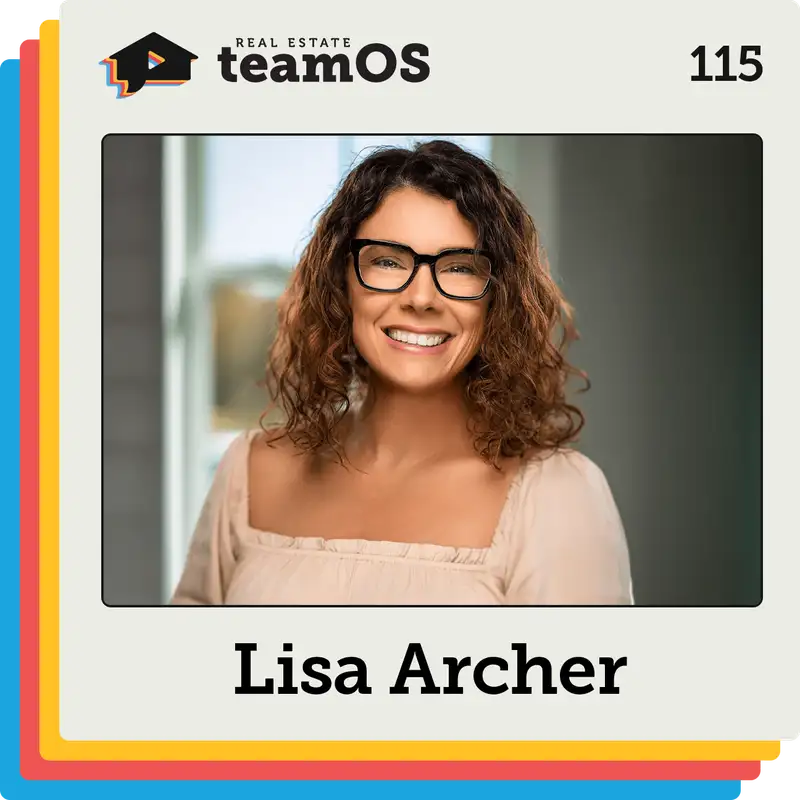
The Open House Strategy That Works Seven Days a Week with Lisa Archer | Ep 115
Speaker 1 (00:00):
Open houses are one of those things that many real estate agents say don't work, but Lisa Archer's team runs them seven days a week. Lisa founded Live Love Homes in Charlotte, expanded across the Carolinas and more than doubled production over the past couple of years. And a lot of that growth runs through open houses. Here in this episode, you'll learn the seven-day open-house strategy that's driving opportunity generation. Why agents say open houses don't work and what's really going on, how she uses them to dominate neighborhoods, close price conversations with sellers, and pick up listings, and what more than a dozen years of market expansion teaches you about growing beyond your home market. Enjoy this conversation with Lisa Archer, which was recorded in her car immediately after an open house. It's happening right now on Real Estate Team OS.
Speaker 2 (00:50):
No matter where your business is today or where you want to take it, you'll get there faster and more profitably with an operating system. Welcome to Team OS, your guide to starting, growing, and optimizing real estate team. Here's your host, Ethan Butte.
Speaker 1 (01:04):
Lisa, we first connected years ago when I was going to every single Keller Williams Family Reunion and Keller Williams MegaCamp. It's been a joy to reconnect. Welcome to Real Estate Team OS.
Speaker 3 (01:14):
Thank you, Ethan, for having me. It has been fun. All the different events, probably.
Speaker 1 (01:20):
Like 2012 to 2019-ish. I was at everything all the time. I know you were at a lot of them too. So we're going to get into a lot of topics because the time that you've been in real estate and certainly in the Keller Williams world in particular has been the rise of teams. I mean, you started basically when the Red Book was published, but we're going to start where we always do, Lisa, which is a must have characteristic of a high performing team. What comes to mind for you?
Speaker 3 (01:49):
Honestly, it's grit. And what I mean by that is that you just don't give up. And that's kind of like with anything, any team, whether it's a sports team or all of my kids have played on sports teams, played sports myself, my husband. So we're really big on sticking with something and growing a real estate team and being on a real estate team is no different. Most people quit before everything starts working. It's just like going to the gym or changing your eating habits. It's just have grit and keep going.
Speaker 1 (02:24):
The types of folks I have on this show, they generally aren't on this show unless they've persevered through things, but of course not everyone has that. Can you describe a conversation or how you maybe coach someone up or manage expectations for a new agent to the business that has all these wonderful imaginations about how fast momentum is going to be gained, et cetera. I assume you've had this conversation a bunch of times with a bunch of different people. Any advice or any signs that this person's going to make it or this person isn't. Anything you want to share on that?
Speaker 3 (02:55):
Yeah. So funny enough, I have this conversation consistently. That is probably when new agents are like ... Because I do a lot of teaching, speaking, training, coaching, all of that stuff in the office and on podcasts or on teaching at classes and different ... Anywhere. So the conversation comes up a lot is like, who is going to be successful? And the biggest answer to that is the one that's not going to give up. The one that you ask, "All right, what have you had to persevere through? Because if they've never persevered through anything, they've never bought a house, if they've never bought a car, if they've never gone to college, if they've never been on a sports team, it's really hard to determine whether they are going to be coachable.That's a huge piece of this. And are they
Speaker 3 (03:40):
Getting into business with somebody who's got some sort of track record that they've been through some stuff?" If everything they've ever done was straight up and there was no ebbs and flows in anything they've ever done, even though they've been successful, how can they help guide a brand new agent who ... It's not going to do that. That's not real estate. Most of what I tell them is, "Look, your job is to get off the real estate rollercoaster and do the things that I can promise you. If you do them consistently daily, that they're going to produce longevity for your career and they're going to produce results quickly." And we'll talk about some of what those things are, but that's the biggest piece of it. And if they come in and they want to shadow and they want to learn the systems really fast, whether it's CRMs or learning how to do scripts and all of the things that we do, and we've made scripts fun.
Speaker 3 (04:38):
We've made all of that where it's not boring because Gary Keller told me years ago, it was one of the first things he ever said in the mastermind or that I heard him staying on stage. And every single time we've ever met in our masterminds when we're at Family Union, whatever, he always draws the triangle and he said, everything goes back to least listenings and leverage and he talks about that every single time. Real estate is simple, it's not easy. The things that you need to do are simple, but they get boring and that's where people like, you've got to change your mindset. I have never woken up a single day in my life and thought today's going to be boring because it's always different. But you know what? I like lead generation. One of my coaches, my first ever real estate coach was Darren Persinger and he was like, "You are such an anomaly because you like to do this shit." And that's exactly what he said.
Speaker 3 (05:30):
And I said, "I do. " And he said, "Because you don't ever find it boring. You find every single day as a new opportunity." And that's how I look at people. They talk about lead generation. Well, we flipped the script on that. We call it opportunity generation. Every single person is an opportunity.
Speaker 3 (05:46):
Whether they're looking to buy, sell, invest, or start a career in real estate, guess what? They know somebody or they're going to come into contacts with somebody. And that's my whole goal every single day is fine. All right, who do I need to know that needs our help? Did that even answer your question? Yeah.
Speaker 1 (06:01):
It did. I mean, I'll just kind of ... And there's a lot in there, and that's why we have back buttons on our podcast players to get some of that. Again, one of the main messages in there that specifically address the question is this is a simple business that isn't easy and to persevere is just to do the things that we know we need to do. There's still the same things we always needed to do, which is talk to more people and treat people as people we can help as opposed to potential commissions and that's it. And like repeat, get up, do it. If you're not feeling it, change your mind and just do the things and keep going. What was going on for you in your business when you first started a team? When did you start bringing people around you? I mean, obviously, again, you were in that world at that time.
Speaker 1 (06:51):
You were probably predisposed to it in some way, especially if you had the personality type that Darren was responding to that way early on. You probably had leader written on you at that point, but where were you at in your business when you started bringing people around you and started the earliest stages of what became Live Love Homes?
Speaker 3 (07:10):
So I'll give you the backstory. So before I got into real estate, I was in banking and the reason I decided to get into real estate was I just had my daughter who is now 21. So I had her in September. I went on maternity leave and then I took like nine weeks after instead of my full 12 weeks. And before I left, I told my managers we had the number one branch in the region and I told my manager, I said, "Hey, look." It was the regional director person. I said, "Hey, look, if anything pops up, opens up closer to my house." I was driving an hour 15 during rush hour each way to the office. Well, when you have a baby and she didn't take a bottle, it was me or nothing. I told them, look, anything pops up, opens up on the other side of town, close to our house, I better be the first call.
Speaker 3 (08:03):
Well, I come back to my first manager's meeting three weeks early, I add, and there's three new faces there. Well, if you know anything about me or you can tell by my personality, I immediately introduced myself. All three of them were within five to 15 minutes of our house. And I was like, "Oh, hell no." So I literally went back as any good new mom who's hormonal. I went back and we crushed it. We beat number two by like 50% and the second that my bonus got paid, I put in my notice and I was out of there. My dad had gotten into real estate a couple years prior, was just starting to do the thing. He had retired from his 50 or however long career he had had in computers and so he was really good on the tech side and he was at KW.
Speaker 3 (08:51):
The office was brand new back then it was Keller Who and I was like, okay. So I decided to get my real estate license and the rest really honestly is history. So like the first year, obviously I didn't have a baby. I'm getting my real estate license. I'm putting together his CRM, which was top producer at the time. So you see how long ago this was. And I just immersed myself in like all the training. I went to whatever training was at the office. I went to my first family union, two family marines are in Vegas, just did all the things, met all the people, listened to what they said, the things that they said to do then we're still doing now. And like you said, it was rinse and repeat. And then why we started a team, so it was the two of us.
Speaker 3 (09:33):
I hated paperwork. He's got more CNN than I do. Obviously we had no Dotloop, no DocuSign. We've never done DocuSign, but we had no dot loop until obviously we met Alex and Austin. And anyway, so our first hire was an admin because that's what the Red Book says to do. And then our second hire was buyer's agents and I hired two. Ben Kenny has been a lifelong friend or a career long friend of mine, so almost 20 years now. And he said hire two buyer's agents. I was like, okay. And of the two, one's been with me for 18 years now. So Pam's been with me for 18 years. And Dale, the only reason he's not with us is like, he went back to his work as ... He was working with a builder prior. Things had gone south when things went down in 2008.
Speaker 3 (10:24):
And once things got better with the builder, he went back to the builder. I always knew we probably would do that, but Pam's moved to me 18 years. My admin both moved me from was 15 and that's why we started a team.
Speaker 1 (10:39):
What is Live Love Homes today? I mean, I know you've been through some iterations over the years. I know there was kind of like a COVID reset that we'll get into shortly, but like today, as we record mid 2026-ish, what is Level of Homes? Market size, structure, culture, whatever you want to share about the team, I'd love to hear. Sure.
Speaker 3 (10:58):
Well, my whole thing when we decided we were going to ... So it used to be like, it was my maiden last name. It was Team Liblo because that was my dad because now he's basically retired. He makes sure everything goes to the accountant and the taxes. It's still the stuff that I hate to do. He helps facilitate that and he's pretty much retired every now and then he'll go take a sign out or something. He still has his license, but he's pretty much retired. And so today, we've got expansion. So we're in Charlotte, North Carolina, that's where I'm sitting outside of an open house I just did. I think we have 10 agents here and then we've got expansion locations. So we've got agents that cover Wilmington, North Carolina, Myrtle Beach, South Carolina, Charleston, South Carolina, Columbia, South Carolina. We're just launching in Greenville, South Carolina.
Speaker 3 (11:50):
And then we've got an agent down in South Mississippi. So that's where I'm from, originally born and raised. And our admin team, part of our admin team works down there and they always have. So we've always had a remote admin team. They've never been on site. And then we've got a transaction coordinator, ISA team, and I think that's everybody. I forgot somebody, don't shoot me.
Speaker 1 (12:17):
I mean, we've certainly heard many, many, many, many, many times on this show, the idea of having admins who are remote, but typically that's like they're in the Philippines or something and they're connected to someone locally. Talk a little bit about setting up an admin team in Mississippi, like early days.
Speaker 3 (12:33):
Yeah. Oh, it was way before we had agents there. And then the only reason we have agents there is because we had the admin team there.
Speaker 1 (12:40):
Yeah. Okay.
Speaker 3 (12:41):
The person who is our director of operations, now she was our TC for years and she was able to set up because she was prior KW and she was an agent for 40 years herself. So it was super simple. She just basically just was able to take the templates and stuff that they did in Mississippi and just run it side by side, create auto plans, et cetera, et cetera. Because we started using Dotloop early. When we started using Dotloop, I want to say it was like 2012, and it could have been earlier now. Whenever it started, we were like customer number one. And so much so, we had an investor at one point, we were doing 50 plus offers a month, more than that, probably like 100 offers a month and then getting X amount accepted. Long story short, we had our own, like they called it the pink phone at Dotloop where like when we ran into Dotloop issues, they used to, bless their hearts.
Speaker 3 (13:37):
They used to say all the time like we broke it and we did. They got to do so much so fast and build it so fast because like we would break it because we were using it so much.
Speaker 1 (13:45):
Yep. Every company needs that customer.
Speaker 3 (13:48):
Well, we've done that for a lot of people. We did that for follow-up boss curator, we have been that for a lot of different companies. People they'll call and they'll say, "Hey, do you want a beta test?" I'm like, "Let me ask my admin." If they have the capacity, sure. If not, because it used to be I'd be like, "Oh sure." And then they'd be like, "Lisa, we are going to kill you.
Speaker 2 (14:11):
"
Speaker 3 (14:11):
So now it's on them. If it'll save our admin team time and/or save us money, I'm okay looking at it, but it's really come down to that.
Speaker 1 (14:21):
I know you're partnered with Place and I guess just to kind of make this continue in a thread, what does that partnership allow you not to have to do or not to have to hire? What does that add to your business?
Speaker 3 (14:36):
So our ISA team is out of the Philippines and our ISA in particular, the one who's been with me for five plus years, whenever we partner with Place and like just a little backstory on that, like I've known Ben and Chris for 15 plus years. We were in this really small group with Gary when we started talking about expansion and like we all did it, we taught it. I think some of the training's actually coming back out. I saw it the other day and so we've done expansion for a long time. And when they partnered and after COVID, when my admin passed away, it was just one of those things I was like, "All right, I'm getting back into production and I can't do everything." Because she was the director of expansion, she did all the hiring. So like that piece of it and me having to be back into production, like because obviously speaking and coaching and training literally stopped during COVID and so I couldn't do it all.
Speaker 3 (15:36):
And then Hat just ran into Ben at an event and we chatted and he was like, "Just look at it and see what you think. " Because I was like, "Do you think we're a candidate?" He said, "Absolutely." He said, "I think you'll find that it's a great fit." So we looked at it and we went down the road and I had my admin do ... They did the whole thing. I had them go through the whole thing because if they're not going to buy in, it's not going to work. And then I brought it to our agents and like we all, we had a meeting and we really looked at it, we looked at the tech and we looked at all the things. They've got an entire onboarding process. So like when we hire new agents, they go through an experienced or a new agent launch program, they get the training on the systems and the models and the tools and then they get into production super fast, even more so than what we were doing on our own.
Speaker 3 (16:27):
So like that's for us, that's the biggest ... And they've got a whole finance team. So we have monthly calls on our P&Ls and also things that I don't love to have conversations about, but we literally more than doubled our production less than two years and our profitability is through the roof in comparison to where we were two years ago. And if like we weren't bad two years ago, we're just really good now.
Speaker 1 (16:54):
Yeah. That's great. And just a note for folks watching and listening, if you feel like running your team is too much, place and there are a few other people and they all do it a little bit differently. I would say like in this zone, I would say that there aren't any real direct competitors. So like reviewing these things, there's potentially a good fit out there for you to supplement and compliment what you're already doing as Lisa just described and certainly places one of them that you should look at. Now I want to spend a minute here, Lisa. I would love to get your take on where we are and where we're going in the team model at a high level. And again, it's because you entered the business almost at the time of the publication of the Millionaire Real Estate Agent. You came up in that community, you were super early to team in general and you were super early to market expansion, which I feel like is just starting to like really get going over the past, I don't know, maybe three to five years in particular that's been going.
Speaker 1 (17:54):
So like you've seen it all in your time, like everything that we refer to as team team. If someone got in the business today or three years ago, teams, we've always had teams.
Speaker 2 (18:03):
No,
Speaker 1 (18:04):
We haven't always had teams and you've seen a lot of that. So I would love your take on like, where are we today and where do you think teams are going just based on your experience of that whole trajectory?
Speaker 3 (18:15):
I mean, it's funny because like teams were, when we started, obviously there were zero to very few teams. And as teams have progressed and now there's so many teams, it's one of those things, and it's hard for me to answer this because I think everyone should be on the team only because like I've seen the difference and if you were to ask any of my agents who are on the team, especially the ones that are doing like super well, they will all tell you, look, team leaders, not like me team leaders, but like office team leaders are like, "Oh, why don't you want to do this yourself? You can do this yourself." And they're all like, "But why would I want to?
Speaker 3 (18:57):
" And the amount of expenses they have and the amount of things that they've got to do to get going and like I love agents who have been in the business for six to nine months who've been doing the things that should make them successful, but because they're doing it on their own and they're not doing it consistently, when they have a conversation with us or they come to one of my training events or we meet at the office or somebody introduces them to me. A lot of where new agents on our team come from is other agents on the team
Speaker 3 (19:31):
Because they were in a training class with them or they started, they were in their Ignite class or they were in their class at the real estate commission and they're seeing how successful X agent is and they're seeing them do all the things. So like those are the best referrals because they're seeing the results. And so where I think teams are going, I think teams are going to be more and more prevalent because we can scale faster. Our expenses can go down because of the ability to scale and that's just not possible if you're single on your ... And you have to do everything and if you're like me and like you hate the paperwork side of it or that part of it, I have a full-time admin. The only thing I want our agents to do is opportunity generation, so lead gen, follow up with their people that are in their CRM and they get a daily task of who to call, what to say.
Speaker 3 (20:30):
We've got AI script practice, the whole nine, like there's nothing they need to pay for or do in that aspect. And then I want them to go on appointments, negotiate, rents and repeat. That's all I want them to do. Everything else our admin takes care of. So honestly, I feel like that's where teams are going because that's just how they have been going.
Speaker 1 (20:50):
Yeah. I did a presentation not long after I started the show. I was maybe like 40 or 50 episodes in max and we're over 160 now and the presentation was just like takeaways from ... And I was new. I didn't really know the team model that well when I started this show. And so it was like just sharing themes and obvious takeaways from it. And one of my six points in that presentation was that teams solve for ... I'm just saying the same thing you said in a different way.
Speaker 2 (21:21):
Yeah.
Speaker 1 (21:22):
Teams solve for the top reasons that real estate agents fail, like 75% fail out in the first year, half of those who remain are gone within five years. It's 87% failure rate within five years. And we know what all the reasons are, and we don't even need to list them out. You already checked a couple of them, but teams solve for those things. And so something that a lot of folks have said on this show is, especially an agent new to the industry, like I don't even know how you would succeed not being on a team. One more follow up in this zone for you, market expansion. You were doing market expansion 15 years before a lot of people were really talking about it and kind of like a common thing. Any tips or observations for someone who's thinking about opening up in a second market or a third market today?
Speaker 3 (22:10):
I'll say this, make sure that you lead with revenue and that when the new agent is starting, that they are willing to do the work. And that sounds so simple. It really isn't though like you don't want to get in and have tons of expenses and have done all of these things and find out that the person's not willing to do the work. We don't immediately go in and buy new signs. Now, luckily for us, like the places that we've gone, the only thing we've adjusted on our current signs ... So like at the beach, so Bloomington, Myrtle Beach and Charleston, those signs just say Level of Homes Beaches and they're the same because they run their teams out of our market center. So that's been really easy. Now that we're in Greenville, we haven't decided if we're going to stay in that market center or if they're going to come into ours.
Speaker 3 (23:01):
They're probably going to come into ours because I think it just makes it so much easier, have everything run out of our market center. Obviously the level of homes Mississippi is totally different because it's a totally different market, but you have to know like just you've got to lead with revenue and you've got to lead with somebody who is willing to do the work and they've got to understand like that's opening a brand new business. It's not like somebody joining the team here in Charlotte where we already have leads. Now, if they have a sphere there, and that's usually how we do it, either the agent has moved there or they live there part-time or they're coming from there and they have a sphere. That's where most of our current expansions are. In Greenville, we're acquiring a data bank. So we have a long, long lived team there that we are acquiring and partnering with.
Speaker 3 (23:53):
So like that's a little bit different. So that's why we're trying to decide how we're going to run the market center. We haven't nailed that down yet. But either way, expenses and making sure the person's actually willing to do the work.
Speaker 1 (24:07):
Really good. For folks who missed this earlier, Lisa is in her car. She just got done doing an open house. You also mentioned that you've dramatically grown both revenue and profit over the past couple of years. Part of that is you being in production. Part of that is open houses. I would love to spend, shockingly, I've gotten this far and we haven't really done the open house conversation. I would love like kind of top to bottom from like the process and the mindset overall, like what is the actual job of an open house, like how do you view it?
Speaker 2 (24:42):
Yeah.
Speaker 1 (24:42):
Kind of getting into the weeds, and we can just follow whatever order you want to go. What is the job of an open house? Why do you like them so much? And then we'll get into like some more nuanced tips for someone who has grown, again, revenue dramatically from them.
Speaker 3 (24:57):
We've always done open houses and we've obviously changed a little bit of the way that we do them. Back when I first got in, that was what everybody was talking about. So it's the least amount of money invested into lead generation, but back then, the only other options were either door knocking or mail. There was just getting into email marketing 20 years ago. And so that was really, it wasn't social yet, so that was it. And as a new agent, like the money was tight. I had two babies. Three years into getting my license, I had baby number one, my third. And so I had three kids under 10, nine-ish. Anyway, long story, that was just a thing. I was able to go do open houses for a couple hours before or after their T-ball games or baseball games or dance competitions or whatever it was that they were doing on the weekend.
Speaker 3 (25:56):
And as we started growing a team, then that gave opportunity for the agents on the team to then go and host open houses and pick up clients on their own. We did the door knocking, we did the signs, all of that. But as we got busier and grew and grew, then it's always been something we've done. And it's very interesting because I teach an open house class at the office. I teach it every quarter, I guess, so three, four times a year. And it's very interesting because agents in this class, most of them are new, like they're new to real estate, they just got their license and they're learning how to now build a business. And I always tell them, "Look, open houses is the most intimate relationship you can have with a client because you're hosting the open house, they're coming in to see your product and you can have a one-on-one conversation with them and they haven't hired you yet." So that's how they can get to know you, how you're going to respond to them, how you're going to answer their questions, if you answer their questions, because we discussed this before, it's one of the biggest knocks on our entire industry is that we don't do what we're say we're going to do.
Speaker 3 (27:06):
So if we door knock and we invite people to the open house, "Hey, I'm listening to Bobby and Susie's house on Saturday or Friday and our first open house publicly is on Saturday. Can you think of anybody who you want to be your neighbor?" And we pre-apologize for all the traffic we intend to create in the neighborhood this week and this weekend and we'll come back and make sure that we let you know how the open house went or we will let you know how the open house went or when it goes under contract or whatever you say, make sure that you do that. Whether it's you come back by and knock on the door and say, "Hey, guess what we had? We had 16 groups through. We got three offers, which means there's two more people that want to buy in here. Can you think of anybody else who wants to sell?" Or you send a postcard or you do a circle dial.
Speaker 3 (27:46):
I don't care what you do. If you've told them you were going to come back and tell them something, go back and tell them something. So that's a big piece of it. Obviously during COVID, luckily here for us, we were essential, so we did open houses. We just changed the way we do them. We had masks and we had the hand sanitizer and we realized we don't need paper. So we don't print anything, we don't bring any ... Still to this day, we don't print anything, we don't take anything with them because what we found, especially during COVID and after COVID, it was so crazy busy that it was all about how fast ... Speed lead's always been important, but like when you're doing open houses, it's even more. So we don't print the floor plans, we don't print the disclosures, we don't print the surveys, but we listen when people walk in, we have them register, we have QR codes just like we had during COVID and we have them register.
Speaker 3 (28:40):
And if I hear somebody walking around and they're like, "Oh, well, do you think this would fit there or this would fit there?" I'd pop my head and say, "Hey, I've got the survey. Do you want me to text or email it to you? " I don't put that stuff online. None of that's anywhere they can find it. It's in an attachment if they have an agent, obviously their agent can pull it up, but they can't find it anywhere. They have to need me. I need them to need me. Same thing if they're looking outside in the yard and they're talking about this or that. If I haven't already popped my head out, that's another place for you to go and be human and say, "Hey, I also have the survey. Do you need text or email that? " If they didn't give you a reason to send the floor plan yet and that's your reason, there's your reason.
Speaker 3 (29:22):
If they ask about the age of the roof or the HVAC or any of that, then that's your reason to say, "Well, I've got the disclosure. Let me text or email it. " Like you've got three different options to get their contact information if you didn't get it at the front door and to continue your conversation with them. And I think that's a big piece of it. Now back to the new agents, when they're in the open house class and we're talking about the best practices and all the things, a lot of agents don't host opens. And I'm like, "Well, I get that. " And that's also the conversation I have when I go and take expired listings. So my first conversation when I walk in is, "So tell me about your Showings. How many showings did you have? What was the feedback? I let them vent.
Speaker 3 (30:03):
I let them tell me all the things because honestly, if you're an expired listing, you want to talk about it. And my next question is always,
Speaker 3 (30:11):
Well, how many open houses did you have? And their answer every single time is zero or one. And I just look at them and I kind of have this pity look on my face kind of. I'm really concerned about that being their answer, but I know that's what's coming. And I just say, wow. Last year we had 32 of our clients home sold and the buyer came through an open house and their eyes are popping out. Now I can even say, we've already had 16 this year. We will double, at least double the 32 number from last year. So we'll at least have 60 of our listings that'll sell this year. And the buyer only came through an open house. And I don't care if they come with an agent. I don't care if they have an agent. I just care that they can come to the open house when it's convenient for them because that's going to help my seller.
Speaker 1 (31:03):
Why do you think that number is so often zero when you ask that question? Why?
Speaker 3 (31:08):
They're like, "My agent said they don't work." And that's where I'm like, because they don't want to do it. I don't want to call out my counterparts, but they don't want to do it. And it's very hard to backpedal when you've told the client they don't work to then say, "Hey, can we host an open house?" So honestly, they just don't want to do it.
Speaker 1 (31:30):
Yeah. Interesting. Talk a little bit about follow up. I mean, you already said, I don't really care if they have an agent. I think a lot of folks obviously are ... I mean, it's an obvious upside of having an intimate conversation, not just with a potential buyer, but with a potential client,
Speaker 2 (31:45):
A
Speaker 1 (31:45):
Potential buyer that you can work with. Talk about your follow up process with these folks. You're obviously, again, not handing anything out. You're offering them and giving them things they can't get anywhere else. What does the process look like in the 24 to 48 hours after an open house? How are you following up with people? Because I assume you're effective at that. Yeah. That'd be like a primary motivation to
Speaker 3 (32:10):
Do it. Yeah. So the way that our CRM works, we've got an open house app. They register on the open house app. Even if they don't physically put their information, obviously we're getting it somehow. One of the three ways that we talked about, or they're just registering right at the beginning. And we immediately follow up afterwards and we say, "Hey, just wanted to check back in. Thank you for coming, blah, blah, blah." Now, if they tell us they have an agent and then we go down that road and we confirm, do they have an agent? It's easy for me because I've been doing this for 20 plus years. I can easily say, "Oh my gosh, who's your agent? I bet I've worked with them." And then when they tell me and they actually give me a name, I'm like, "You know they're not just blowing smoke." But when you ask them who their agent is and they like deer in headlights, that usually means they're just not ready to tell you they don't have an agent yet.
Speaker 3 (32:58):
And that's fine. I'm fine with that. I'm not going to snake on somebody's client. We don't do that. That's not the whole point. But we are going to follow up because we told our seller that we're going to follow up. So that way we can give our seller feedback and we can, whatever, whatever. So long story short, that's what we do. They go into our CRM, immediately starts an auto plan. There's a text message that goes out and an email that goes out if we have all their information. Probably sets them up on a listing alert for home similar to that one. But one of the auto plan items is for the agent to say, to go in and check their listing alert in case they had a conversation with a client that actually it needs to be different because maybe they decided they didn't like that neighborhood or they aren't approved for that much or they're approved for much more or they need four bedrooms or they need to have a primary bedroom downstairs or they need a bigger yard or they're looking for a pool or whatever.
Speaker 3 (33:51):
It's for us to verify the information's right. And we do open houses Sunday through Saturday, every single day. And I'll tell you why. We found during the last probably two years, and so at least in Charlotte, there's 150 people moving here today, which is like a great problem to have.
Speaker 2 (34:12):
Well,
Speaker 3 (34:12):
Those people have to live somewhere. And most of them, if they're moving here, likely are moving here for a job, at least one of the partners or if it's two people, whatever, at least somebody is hopefully going to have a job when they move here or they're ... I'm not sure why they're moving here. So we have found that those people are obviously interviewing Monday through Friday. So we host open houses Monday through Friday. Well, when their partner, whoever they're in town with is not at the job interview, what are they likely doing? They're driving around. They're looking at neighborhoods, they're looking at areas, they're looking at this, and they go on Zillow or whatever portal they are using and they look for the open houses and they see that there are some open houses on a Monday, on a Tuesday, on a Wednesday, Thursday, Friday.
Speaker 3 (34:58):
And one of us is likely sitting at that open house and very few other agents are doing it at all. So we get to meet people before they even have jobs here, definitely before they have agents here. And we're getting to convert and talk to a lot of people that way too.
Speaker 1 (35:13):
And I love this multiple day of the week. And again, like on the portals, you have a lot less competition-
Speaker 3 (35:20):
Nobody's there.
Speaker 1 (35:21):
... on a Tuesday. I mean, we're recording this on a Friday. For me, it's like mid to late morning for you. It's like very early afternoon.
Speaker 3 (35:29):
Yeah.
Speaker 1 (35:30):
So obviously-
Speaker 3 (35:32):
I did 10 to 12 this morning on a new listing and we had three groups through.
Speaker 1 (35:36):
Yeah, that's great. When you're doing this class for newer folks, how into the weeds do you get on how to handle it? Are you getting into things like where to place the signs in the neighborhood? Are you getting into how to deal with like, I'm just browsing because I'm sure that's a common thing that happens. I was thinking of the reasons that an agent would say open houses don't work. My guess is that it's not just a traffic issue, it's not just a laziness issue, although I'm sure both of those play in. Someone would say, "Well, I'm not going to hold a house open for two hours to meet three people. " So what this says to me is that there's an efficacy issue. People don't know how to manage the situation well in order to truly capitalize on what's happening. And I'm sure there are a number of layers in there.
Speaker 1 (36:24):
Any kind of like nuanced things that turn something that someone would feel neutral to negative about in terms of investing their time to being, "Oh no, open houses are more valuable than I thought they were." Simple things that people are doing wrong that make them say things like these don't work.
Speaker 3 (36:42):
Well, so this is the deal. It's their mindset. You've got to do X amount of time of lead opportunity generation every single day. Why not do it at your product? We call it our mobile office. We use our vacant listings and like even this morning, like I said, it's a new listing and the people do live there. So when we go on a listing appointment, we have a conversation with them and we talk about open houses and they're like, after their eyes pop back into their head and they can think clearly against, we have a conversation, "All right, look, let's talk about your timeline. When are you ready to go on the market? When are we ready to do photos? When are we ready to do this? " And then we talk about our open house plan. And I tell them, "Look, this is how it's going to go.
Speaker 3 (37:26):
" If you do not have the availability to do an open house, then we do it on your timeframe. If they work from home, Monday through Friday is probably not going to work, but usually that first weekend they'll let us do Friday and then Saturday, Sunday, or Friday and Saturday, or Friday and Sunday, or just Saturday and Sunday, and we're okay with that. Or on that Friday, if we can do four to six, we'll do four to six. But we tell them, "Look, we're going to do as many open houses as we need to and as you allow." And that's a whole different conversation. So on our vacant listings, super easy. We can do it every day of the week. We can do it anytime we want. And we all have hotspots or if they have wifi, great. If not, it's okay. But our whole thing is we've got the flags, we've got our signs, our open house signs, and you see one in the back of my window.
Speaker 3 (38:17):
They say open house today, they have a QR code on them, they have a phone number on them, they go directly to the data bank, their information gets logged immediately. We know they're calling and they're calling on an open house sign. So we put a house on the market right before Thanksgiving and the seller obviously didn't go with my price. He went a little bit higher. So I'll just use numbers. He went at 4:29, I told him 4:20 and we went at 4:29. We did open houses all during Thanksgiving through Christmas, we reduced once to like 4:25 and then right after New Year's, we went to 4:20. Within a week, we did two more open houses. We went under contract. Well, about three weeks later, we were going to take the sign out of the yard because it was closing and the neighbor comes running out of the house.
Speaker 3 (39:04):
"Hey, put that sign over here, put that sign over here." And it was super fun because we were like, "Wait, what? " But they all watched us do those open houses. They said during two snowstorms, one was nightstorm, one was a snowstorm, didn't matter, we don't get that crap here. And they saw us doing open houses those weekends and they always saw us there and they saw the sign and all the things. So we've now got a new listing next door and they introduced us to the people across the street who are renting, who want to buy with one of my buyer's agents and they introduce us to people two doors down they're going to sell at the end of the school year and then two doors down from them, people in the cul-de-sac are going to sell at the end of the year. We're going to pick up four or five clients just in that one neighborhood because of all the open house activity we did.
Speaker 3 (39:45):
And they have piece on that is like, very rarely do I have a conversation with my sellers about price because we're doing the work. They see that we're doing the work. They come to me and say, "All right, what do you think? " I had one the other day that I told her we needed to go in at 2:50 and she started at 2:60 and we went to 2:57. I was like, "That's not enough." So two days ago she was like, "All right, can we go to 250?" I'm like, "Absolutely." But I don't have to have those conversations because they know we're doing the work. And it's more like even the ones that take longer because we've got some locations that we cover that are rural and that's 90 days is usually like how long it takes to sell. And we're getting a little bit under that, which is great, but it's because we're doing the effort and they're showing up on the portals and we're the only ones having open houses.
Speaker 3 (40:31):
So we get way more eyes and more traffic and like our numbers, our views online are like way higher than most people because we're doing the open houses. And even on the days that we don't do in- person open houses, we're doing virtuals. So I know every market doesn't have that, but in our market, we can do a virtual open house where we take the walkthrough video that we did and attach it. So when we do like a two hour virtual open house on the days that we're not physically there, which just works well for my clients that work from home. If we can't do Monday through Fridays, we're definitely doing a two hour virtual. And I tell them, look, if for some reason somebody didn't read that it was virtual and they knock on your door, say, "Hey, go call." Her number's on my sign.
Speaker 3 (41:10):
And they love it. And I tell them, look, look, my goal is for them to knock on your door if they obviously didn't read it and just send them back or say, "Hey, we're actually doing a public open house tomorrow or on Friday or whatever." And I want the virtual people to call me. So I let the agents from the class I teach, if my agents can't cover all of our open houses, I tell them, "Look, you've got to schedule on showing time and you got to leave feedback." If I need a room painted or if I need a price reduction, what do you think they're going to plot on the feedback for them? It totally helps me. It helps my clients to see, all right, this is actually what the people are saying. And if nobody's showing up, I get to talk about that too.
Speaker 3 (41:54):
We get to talk about it, we got a price issue. If nobody's showing up, it's your price or it's the condition
Speaker 3 (42:00):
Because we can't pick ... There's only four things that sell a house. Location, I can't pick it up and move it. Condition, that's totally on you. Marketing, obviously you see that we're doing the marketing because we're having open houses and we have all the videos and stuff. And then the only thing left is price and it's super easy for them to put two and two together because that's all that's left. Just keep doing the work and you've got to show up with grit, you've got to show up and do the work and you'll go from there.
Speaker 1 (42:28):
So much good stuff in there, like from mobile office to kind of starting to build reputation and dominate a neighborhood by engaging the neighbors and things, to getting all the feedback that you need on condition and price and some ... I mean, that is the marketing too. And that piece too, I thought was super interesting. I've taught it in different ways before. If clients don't know what you're doing, they assume you're doing nothing unless you're getting offers and writing a contract. And so just the tangible nature of that is a thing. I also love the way that you're doing expectation setting right off the top and then adjusting it based on the way that people are actually using and living in their home because you have to accommodate for that thing. So much good advice there. This has been super fun. I appreciate you joining me right outside one of your open houses.
Speaker 3 (43:19):
You're welcome.
Speaker 1 (43:20):
Before I let you go, Lisa, I always like to close these conversations with a few pairs of closing questions. The first one is, what is your very favorite team to root for besides Live Love Homes or what is the best team you've ever been a member of besides Live, Love Homes?
Speaker 3 (43:36):
My favorite team to root for, other than like my kids' teams, and this is a super soft spot in my heart right now because my youngest is graduating high school, so senior night was two nights ago and next week will be the conference tournament starts. So in the very near future will be my last time getting to root for him. And so that's going to be super sad. My husband and I are not going to know what to do with ourselves. We might have to go adopt a son just because, I mean, our oldest is 27 and he started playing when he was four. We've been baseball for 23 years. It's like, what are we going to do with ourselves? So that obviously is one. And then I'm also a Braves fan. Obviously our dogs are Chipper, Kirshaw, and my husband's a daughter's fan. So Chipper, Maddox, and then Kershaw.
Speaker 3 (44:27):
So obviously Chipper played for the Braves, Kershaw played for the Dodgers, and Maddox played for both.
Speaker 1 (44:33):
Yeah. Really good. What is one of your most frivolous purchases or what's a cheap skate habit you hold onto even though you don't need to?
Speaker 3 (44:41):
Well, I think I can sum it up in one thing, like my Tesla. It's both, but it's proving very much so to be my cheap skate guidem.
Speaker 1 (44:52):
Yeah. Just on maintenance and obviously gas.
Speaker 3 (44:55):
Yeah. Yeah. Maintenance, gas, time. The absolute amount of time I say of not going to the gas station is stupid.
Speaker 1 (45:02):
Interesting. Yeah, of course.
Speaker 3 (45:05):
If I have to drive one of my kids' cars or my husband's truck because of whatever reason, either I forgot to charge or somebody called and I was in the middle of charging or whatever, I'm like, "I don't want to. I just don't want to.
Speaker 1 (45:18):
" Yeah, that's funny.
Speaker 3 (45:20):
And I let it drive because I've got self-drive. I would say both the answer to both of those questions is my Tesla.
Speaker 1 (45:27):
Again, if you are listening to this on Apple Podcasts or Spotify, we do do video on Spotify. Video is coming to Apple Podcasts or of course you can go to YouTube or the website where we embed YouTube and audio. This whole conversation is from Lisa's car, so you can see it and spend time with her in her car as I have. Last one, Lisa, what does it look like? What are you doing when you're investing time in resting, relaxing, and recharging? Or what are you doing? What does it look like when you're investing time in learning, growing, and developing?
Speaker 3 (45:55):
I'm going to answer the first one. I'll probably answer the second one too. But the first one is definitely, so my husband bought me a sauna a couple years ago. I was in a really bad car wreck about three years ago, three and a half probably now. And they ran me from behind and then they pushed me so hard. I went in down into a concrete culvert and came back up. So it was basically like two wrecks in one. And so I do PT once or twice a week, and that's with my functional chiropractor. And then he bought me a sauna. So I spend 20 minutes a day at 104 with a red light and so that's at least four or five times a week. So I do that. And then like magnesium baths and all the things, because I'm not a spring chicken and I'm 48, but your body is not prepared for that type of impact, especially at my age.
Speaker 3 (46:44):
And then he just got me for my birthday, a power plate. It's a different brain, but it has to be a power plate. The other ones are not worth it. You have to invest the money. So like working on like bone health and lymphatic draining and all the things. So like that's my world. I could geek out about that for hours and like supplements and yeah, peptides, like all the things. I love it. And learning, like I'm a perpetual learner, like you've seen me at a million conferences and I still go to ... If I'm not teaching a class, I'm in a class at least once a month. May is like craziness. I think I've got like five days in a row, like I'm teaching two, going to one, then going to another. So invest in yourself. Podcast. My newest obsession is a book called Hormone Havoc, because we're in that stage of life, but I feel better now, honestly, than I did in my 20s.
Speaker 1 (47:47):
Yeah, that's great. I love that. And for folks watching and listening, I will round up a couple of links down below so you can kind of go into Lisa's world a little bit. And now if you really want to go into Lisa's world, Lisa, where should someone reach out if they want to learn more about you? They want to learn more about your business? What are some good links I should include in the description
Speaker 3 (48:06):
Below? Absolutely. Well, and even if you just want to mastermind or knock some stuff around, I love to do that. I love to like coffee dates, especially like if I'm, because I'm in my car all the time. My car drives itself, so it's a good thing. Obviously I have to watch. It makes me or it gets really mad. But long story short, you can text me, you can call me, you can send me an email. Facebook, it's Lisa Archer, Instagram, same thing, X. And anywhere, just I'm out there, super easy to find.
Speaker 1 (48:38):
Cool. Email, phone number, social links are down below in the description of this episode. Lisa, you're awesome. I'm so glad we reconnected. I hope you have a great weekend coming up. You too. And I hope you have some really good open houses coming up.
Speaker 3 (48:50):
Thank you.
Speaker 2 (48:51):
Thanks for checking out this episode of Team OS. Get quick insights all the time by checking out Real Estate Team OS on Instagram and on TikTok.