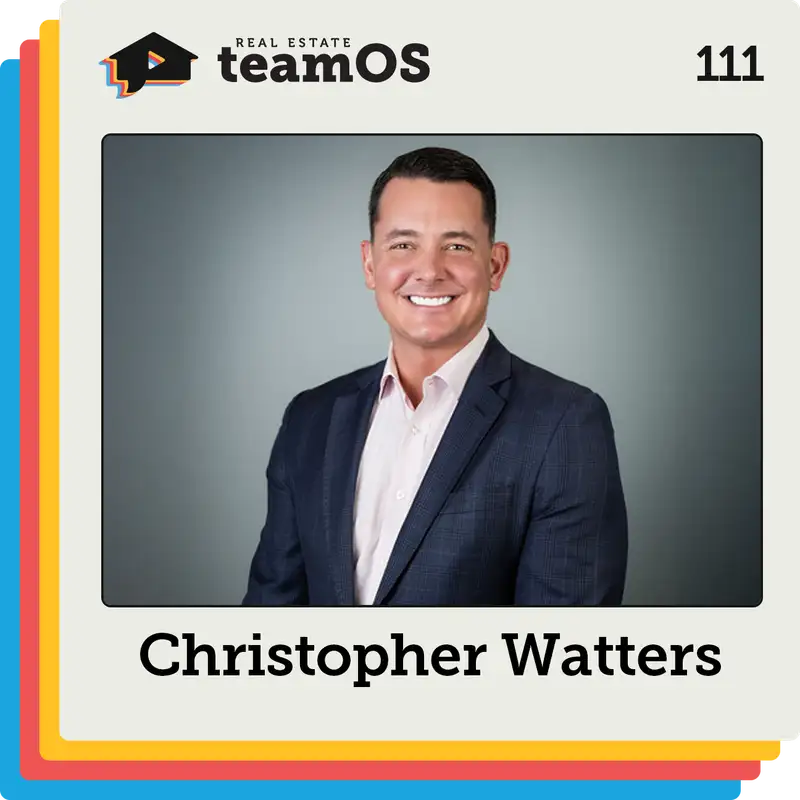
The Real Estate Team Bottleneck That AI Now Solves with Christopher Watters | Ep 111
Speaker 1 (00:00):
Your real estate team has a bottleneck and it's likely related to sales leadership. The time it takes to do recruiting, onboarding, training, and coaching well leaves little time for the accountability and inspection work that really drives success. Many teams are burning out their best leaders or simply getting stuck, but Christopher Waters is solving this with AI. Here in this conversation, he breaks down the enforcement loop that makes agent training actually stick. Why PPC leads often demoralize agents while high intent leads can drive a 1.6 to one lead to appointment ratio and the emerging enterprise model with Agentic AI handling transactions, voice AI, setting appointments, and agents showing up exactly where they add the most value. Enjoy this time with Christopher Waters right now on Real Estate Team OS.
Speaker 2 (00:56):
No matter where your business is today or where you want to take it, you'll get there faster and more profitably with an operating system. Welcome to Team OS, your guide to starting, growing, and optimizing real estate team. Here's your host, Ethan Butte.
Speaker 1 (01:10):
Chris, I've read most, if not every book written about real estate teams, and the Million Dollar Real Estate Team is one of only two books that I highly recommend. Thanks for writing it and welcome to Real Estate Team OS.
Speaker 3 (01:21):
Man, thanks so much for having me on.
Speaker 1 (01:23):
Yeah. It's been a while and I am going to make you revisit that book, but we're going to start where we always do, Chris, which is a must-have characteristic of a high-performing team. What comes to mind for you?
Speaker 3 (01:34):
Ooh, man. One word, perseverance.
Speaker 1 (01:38):
Tell me more.
Speaker 3 (01:40):
Man, what's really tough about real estate teams is most everything about the business stays pretty constant year to year. Whether it's recruiting or training agents, onboarding agents, most of the impact zones, speaking of the book that we talk about, most of the impact zones stay pretty consistent. The leadership and training side, the leadership books you can go pick up like John Maxwell and all those guys. Those things just stay constant. But there's one thing that seems to change, gosh, every three to six months. And it's the lifeblood of our business and it's the lead generation side. It's like every three to six months, something is radically changing. And so it takes a lot of perseverance mentally to deal with how fast things change. As of the filming of this, the big thing happening right now is agentic AI, autonomous AI, software, and the clawbot and those things.
Speaker 3 (02:57):
And so a lot of teams will get some cost savings from using those tools. When you would think about their operational expenses, but unless you're somebody like Amazon or Microsoft, and you can go shed 50,000 employees, on an absolute basis, the dollar amount's pretty small. And where it can materially have a massive impact on your business is on the lead generation front. I mean, this past year, I started having people call me saying, "ChatGPT recommended I reach out to you. " And that's a lead source that was not on the dropdown pick list, right?
Speaker 2 (03:45):
Yeah.
Speaker 3 (03:47):
And that just seems to happen every single year in this business, man. It's like every year you're chasing a unicorn, try to capture unicorn and get the formula on the lead generation side.
Speaker 1 (04:02):
So the perseverance piece that I'm hearing from you is staying in touch with what's going on, probably not overreacting or overinvesting in things that are ... I mean, I hate to use this term, but everyone understands it. The shiny new thing or whatever, there are things that emerge. I would think maybe at some point in your real estate journey, you've seen direct mail die and come back to life again maybe. So there's some of that stuff. Is that it? It's like staying in touch, experimenting, not getting yourself locked in versus, and I want to tie back so I understand it clearly, once you get some of the blocking and tackling the core pieces of leadership in place, once you get the core structure and cadence of agent training and agent onboarding in place, not that you don't need to update some of the material now and then, but once you get those blocking and tackling pieces in place and you do it well and you have good people doing it, that stuff is pretty well settled, but this is the edge that you've seen make the biggest difference and it requires a lot of attention, care, and patience.
Speaker 3 (05:06):
Yeah, exactly. I mean, ultimately, I think if you're running a team, it's about agent productivity. Your goal is to get agents to produce as many deals as possible and you're looking for emerging talent and you can't be in a position where you bring on proven talent because then otherwise you have to give them all the commission and then there's no profit left for the business. So the first key opportunity switch is to drive agent productivity. You have to give agents high intent leads. You have to give my high intent leads. Now, the second big opportunity switch that I didn't realize was that ... Man, it's so crazy you mentioned the book. So we wrote this book seven, eight years ago, right?
Speaker 2 (05:57):
Yeah.
Speaker 3 (05:57):
And I've had so many ... We had, I don't know, 30, 40,000 people buy the book. And obviously that's not a lot of people, but it's very niche, the book.
Speaker 1 (06:08):
Absolutely. I've
Speaker 3 (06:09):
Had a lot of people reach out to me and I've realized I needed ... I should have written an entire chapter on something I was doing that I didn't even talk about that a lot of people were missing the mark on. And this is the second opportunity switch is ... So one, again, you have to have very high intent leads. A vast majority of your leads need to be transacting, in my opinion, in less than 90 days. And that's even with an inside sales team. You shouldn't expect to have an inside sales team work leads for six to 12 months or longer. A majority of the leads need to be able to convert in the next 90 days, and some of them can convert in 180 days. But anyway, so high intent is number one. But the second big opportunity switch is you've got to think about the agent and how you ... Step one, you bring them on board, take them through onboarding, right?
Speaker 3 (07:11):
And then you take them through training, and then you do probably like weekly ongoing training, but then there's this key piece of the loop and the opportunity for the agent that's missing. And that key part of the loop that's missing that almost every other industry has is this enforcement component of the loop.
Speaker 3 (07:34):
And so what I mean by that is like, again, you do all this ... And most brokerages do a great job with training and onboarding and all these things, but where they stop is they don't inspect what they expect. They have no way to inspect what they expect because of the agent, the team leader ratio. A long time ago, I think God, 20 plus years ago, or yeah, 20 years ago, my wife worked for this massive property management company called Greystar. And I think they're one of the biggest property management companies in North America. It's an insane number of apartment complexes that they oversee. And they mystery shopped her ... She worked in one of those little community centers, right? And it's this
Speaker 2 (08:19):
Huge
Speaker 3 (08:20):
Community, and they mystery shopped her every single month. And so think about that. They have apartment complexes all over the United States. Think of how that expensive that is. But right after they mystery shopped them, they would send out a report to the leasing agent and to the property manager for that complex. And then they would give them feedback on what they could have done better. And so they had kind of this grading rubric, right? And basically what was in the grading rubric was all the things that they had learned previously in onboarding and training and also in the continuing education that they took the leasing agents through. And so what I didn't write about in the book was that last piece of the agent opportunity. And again, the last piece of the agent opportunity is the inspecting what you expect or the enforcement part of that loop.
Speaker 3 (09:18):
And without it, no adaptation happens. So if you're not inspecting what you expect and you spend all this money in training, onboarding, continuing education, and you don't inspect what you expect, then adaptation never happens. And everybody's heard that saying about you go into a seminar and you can only remember 10% of what they said, right?
Speaker 1 (09:40):
Right.
Speaker 3 (09:40):
And so it's not even about criticizing the salesperson or any of those things. It's just like helping them get adaptation.
Speaker 1 (09:49):
Yeah. I mean, it's adding a layer of awareness and consciousness of their own behavior. You're staying in touch to kind of like, I don't know if it's super ego or not, but whatever that piece is, the more feedback you can give them, the more you are in their head in a positive way where they're consciously aware of, "Oh, I need to do that
Speaker 3 (10:12):
Thing." There's a class Keller Williams talk for a really long time called Recruit Select. I'm not with Keller Williams for the record, but I'm a big fan of Gary Keller's book and Mad Respect for the company they built, but they had an acronym in that class and it was RSTLM. And each one of those letters described the job of a leader and it's recruit, select, train, lead, and motivate. And so when I said about the book, and if there was a chapter I could add, it would be specifically about the leading and motivating part,
Speaker 3 (10:49):
Because what Brad and I used to do when we kind of divided and conquered and split up the team was we did write alongs. We literally would go right along with the agent to go on appointments. And we didn't do that on just the first 30, 60, 90 days they were with us. No matter how long they were with us, once a month we were doing a ride along. The other thing we were doing was we spent time listening to the phone calls, like the call recordings. It was through doing those activities where we were able to inspect what we expect. And I had a lot of people reach out to me about the book and say, I've had a tremendous number of people reach out to me and tell me that they got stuck between the early climb and the Aqua Teenager stage. And so that's usually like once you exceed somewhere around 150 deals when you go into what I call the Aquatinager stage, the reason most people get stuck, what I have found is they, at that exact stage is when you have to hire your first sales leader, because that's when you start the agent to team lead ratio, you start getting spread too thin.
Speaker 1 (12:01):
Yeah. By the way, really quick, sorry to interrupt, what is that number approximately, especially if you're still producing, what is kind of the breakpoint ratio of agents to leader? Five
Speaker 3 (12:13):
To seven agents max.
Speaker 1 (12:15):
Good. So that breaks and now you're looking for a leader for the buyer's
Speaker 3 (12:19):
Agents. Yeah, exactly. And so I had all these people reach out to me and even people I partnered with to help them scale their teams and a high percentage of them, very high percentage of them, number one, had a very tough time finding that first sales leader to join their team. And a lot of them would turn through a lot of sales leaders to help them find the right one. And something I think I realized that's a big flaw in the team model, and again, something I wish I could do a whole chapter on, is when you think about the responsibilities of a team leader, they're way too wide.
Speaker 3 (13:03):
You have way too many activities. So even that first sales leader you hire, that's going to help you go from, we'll call it five to seven agents to 10 to 15, that person's job title is too wide. They're doing the recruiting ... They might have an inside salesperson helping them put appointments on their calendar to recruit, but they're doing interviews, they're running team meetings, they're doing training, they're doing onboarding, they're inspecting the CRM to see if people are following up with the right process to convert leads. Man, their job title is so wide. And I had a lot of people, again, that read the book that told me that they were getting stuck and that they were burning through sales leaders. And I was like, "Man, I guess I just got lucky down here in Austin." So for example, Brad was my first sales lead and he worked his butt off.
Speaker 3 (14:00):
He was working 60 plus hours a week minimum. Weekends, evenings, like everybody was just working their tails off. Thank God none of us had kids at the time. We brought on our next sales leader, her name's Susanna Medrano, who is just a complete ... I mean, she is just such a badass.
Speaker 3 (14:23):
I mean, just a freaking unicorn. And then after we started expanding, I moved Suzana up into this kind of national leadership and trainer role to help out all of our partners. I tried to replace her and then I finally started to see what everybody else went through.
Speaker 2 (14:44):
Yeah.
Speaker 1 (14:45):
Totally. I hear that story a lot. Even with a highly productive agent in their first assistant, they go through two, three, four, five of them and they feel like I can't get there. And now you're looking for something even more specialized with even more responsibility. It requires some good luck, some good training. And how did that process go for you once you tried to replace her?
Speaker 3 (15:06):
It was not good, man. It was expensive. We went through several of them.
Speaker 1 (15:12):
What's the process? Are you looking at other teams and brokerages? Are you looking for great agents on your team? Are you like headhunter out there to get people you don't even know? How are you looking for that type of a role? And I'm asking, of course, on behalf of a team leader that's either struggled the same way or on the verge of trying to do that thing.
Speaker 3 (15:31):
So I've literally done it all. I've paid the headhunter ... A headhunter charges about 25 to 28% of the annual salary or annual total comp package. And so I've hired multiple people using headhunter. I've tried growing people organically. I've tried finding people in other industries that are adjacent to ours. And I wish I could just give you just a roadmap and say like, "Hey, this is the approval to do it. " It's just you're looking for a driver personality, you're looking for someone on the upward curve on their career from a trajectory perspective, and you need someone that's going to work a lot. I mean, this is not a 40 hour a week job. I'm married, I have two kids now, I'm not the person to hire to go be a team lead because I'm just ... Now there's one thing with that being said that I think's been a pretty big breakthrough for us this past year on the technology front, and that's been leveraging AI to help our sales leaders be able to manage more and do it in less time.
Speaker 3 (16:48):
I have the right sales leader now, and we've been using this AI grading tool for about six, seven, eight months, and it's been a game changer for her. And I ask myself, if we gave this tool to another sales team leader or one of the previous ones I had, would they have been successful? And I can't say with certainty that they wouldn't have been successful because the people I had previously worked really hard. They all had great intentions. It was really, I think, just a matter of time. They weren't able to ... I hired people that were super seasoned. They've been in the industry 20 years. They came from companies like OpenDoor, OfferPad, and got to see hundreds of millions of dollars get burnt and all the things not to do, and hired people from the home building industry. And man, I kind of think back and I'm like, "God, if I had had these AI tools for them, I think they probably could have done the job in a 40 to 50 hour a
Speaker 1 (18:04):
Week." And it's knowing what to look for and listen for, what are the signals in all of the noise that you don't have time to go through yourself, all the calls and everything else, and being able to feed that back to the agent in a constructive way, and then the AI is doing all of the signal findings so that you're giving them good information to process-
Speaker 3 (18:25):
That's exactly right. ... and
Speaker 1 (18:26):
A lot more of it than they could ever look at and process on their own.
Speaker 3 (18:30):
So when I quantify the number of hours a sales leader should be listening to calls, it should be a minimum of one hour a day. So that's 20 hours a month, right? That's a chunk of time. When I think about how many ride-alongs they should be doing with agents, they should be doing at least one every afternoon from three o'clock to six o'clock, and that's three hours a day times five days is 15 hours a week, times four weeks is 60 hours. And so we haven't even talked about recruiting, onboarding, training, none of that stuff. All the
Speaker 1 (19:10):
Data minutes, which I'm sure there's maybe potentially an AI solution for now.
Speaker 3 (19:15):
Yeah. But those two things equate to about 80 hours of time. I think either you need someone that can clock 60, 70 plus hours a week, or you need to be empowering that sales leader with AI to listen to the calls for them and to be digesting the in- person meetings.
Speaker 1 (19:39):
Okay. You have opened up a number of doors. I already have a zillion follow-up questions. I definitely want to double back into down funnel leads, like where are we going to get leads that are going to transact in 90 to 180 days? I definitely want to get back into lead enforcement, inspecting this kind of like how to get ... When you have your one good sales manager, how do you let them double, triple, maybe quadruple the number of agents they're responsible for so you don't have to go out through all the different means you've tried where there's never a guaranteed success and there's never a guaranteed fail. I still need to try that channel to find my next sales manager. This prolongs your ability to stack agents with this person. But I would love for you just really quickly to reset for us Waters International Realty, just give folks a sense who've spent 20 minutes with us now, give folks a sense of like the nature of your business and like a quick historical arc.
Speaker 1 (20:39):
When did team occur to you and what is Waters today?
Speaker 3 (20:43):
Yeah. So got licensed 2006, right out of college, joined as a buyer's agent at Keller Williams, was 21 years old, way too much ego, not enough humility. Found myself very quickly. That
Speaker 1 (20:56):
Doesn't sound like any 20 year old male I've ever met.
Speaker 3 (20:59):
Right. Anyways, so kept selling homes and I invested in a bar and restaurant with a loan officer I sent deals to in 2009 as the market was crashing. I don't know if anybody watching this remembers, but the Dow Jones was at, I think under 5,000 in 2009. I think in the summer of 09, it was like under 5,000. Somebody comment below, can you check me on that?
Speaker 2 (21:27):
Yeah.
Speaker 3 (21:28):
And now we're at like almost 50,000. That's crazy. Anyway, so invest in this bar and restaurant and like six months later there's literally chains on the door and I have the Lebanese mafia trying to hump my ass down because they owned all the big liquor stores and we owed a bunch of money to them for alcohol. And I thought my business partner was paying the bills and taking care of all the money. And then I had the Texas Alcohol Beverage Commission trying to hunt me down and I was like, "Man, I have to make a lot of money really fast." So I end up literally sleeping on my girlfriend's red Ikea couch. I'm too poor and I have too much pride to go back and live with my mom. And so towards the end of 09, I'm just laser focused doing the only thing I know how to do at 23, 24 years old.
Speaker 3 (22:12):
And I just start hammering the phones. I start closing a lot of deals really fast and I started making a lot of money, but I owed so much money I need to make even more money. So I started recruiting agents in the summer of 2010 and trying to show them what I was doing because I got to a point where I closed like 13 deals in a single month and I was like, "Man, I'm running out of time in the day." And so in summer of 2010, I hired 20 agents and that was my first iteration. And I actually became a licensed broker. I was able to get my broker's license. I don't know what the hell they were thinking giving me my broker's license, but they did. So anyway, summer of 2011, a year goes by, I've got 20 agents on the team and I'd like to tell you it was a wild success, but again, it was a complete failure.
Speaker 3 (23:00):
I had 18 agents sell 18 homes and me and Brad sold 80. And I went to Brad and I said, "Hey, I'm going to burn all this down and we're going to start all over. You go focus on the buy side. I focus on the list side." And in the two subsequent years, we basically went back from zero to 325 closings in a single year in 2013, and we had netted a million dollars after all expenses. And so we kind of thought we had it figured it out. In 2013, we were feeling pretty good about ourselves. And so then we started helping other people. The first person we helped was my cousin in Amarillo, Texas, and she had been a realtor for 10 years. She had been stuck at like 25 to 35 deals. And we started just giving her everything we were doing and she grew like a rocket ship.
Speaker 3 (23:43):
She went from like 25 deals to 250 deals in a year.
Speaker 2 (23:48):
Wow.
Speaker 3 (23:49):
And then we felt pretty good about that. And then we started helping more and more people and more and more people started going from 25 deals to 250 to 300. In 2019, I started basically realizing that technology was becoming a pretty big limiting factor. And I started hiring a leadership team to run the real estate brokerage for me. And so yes, the name is Waters International Realty. I called it that when I was sitting on that red IKEA couch and I was inspired by a lot of other successful entrepreneurs. I had read their books and they talked about, I think international to the name to make it sound bigger than it actually was.
Speaker 1 (24:27):
It reminds me of like some airports. I'm like, did they find Mexico or Canada because that's
Speaker 3 (24:32):
Got
Speaker 1 (24:33):
To be the extent of it.
Speaker 3 (24:35):
Hey, I technically have an office in Canada, so we are international.
Speaker 1 (24:39):
Love that.
Speaker 3 (24:41):
Yeah. So anyways, I went full tilt on the tech side. We hired a leadership team to start running the business. The brokerage uses the team model. So every single one of our agents is selling worst case, 60 homes per year, worst case. And they're not experienced agents and they have zero database. So they come to me with no database, no leads, like minimal experience, and we get them to sell in 60 to 120 homes per year. I can tell you, I've had people come to me that were like 911 operators, had five kids, she sold like 117 homes, people of all kinds of backgrounds, and they're selling between 60 and 120 homes a year. Yeah. And so that's how our business runs and we have some people across the US we partner with to really help them give our operational playbook to scale up. But I spent the last seven years on the tech front.
Speaker 1 (25:44):
Five-ish offices, like you have multiple markets covered.
Speaker 3 (25:49):
So I have, I guess what you would call is a corporate team. My home base is in Austin. We opened up a team in San Antonio in 2020. We opened up a team in DFW in 2022. And then last year we opened up a team in the Killeen Temple Waco market. And then we've got about, I think half a dozen or a dozen partners that we work really closely with. Our team flies out to them, they fly to us. It's a very tight-knit kind of situation. Yeah.
Speaker 1 (26:22):
What is central to Austin and what happens locally in those other offices? I assume the guts of the operation are all centralized and you have like a team leader, a sales lead there. Anything else that's local to each of those?
Speaker 3 (26:40):
Yeah, great question. So this took a lot of trial and error, figuring out what could stay local and then what did you need to hire ... Excuse me. "What did you need to hire local in the expansion markets and what did you need to keep at Homebase?"
Speaker 2 (26:54):
Yeah.
Speaker 3 (26:55):
And so the key things we try to keep at home base is the leadership team, the marketing team, HR, accounting, bookkeeping, all that kind of stuff is at home base. Our primary sales leader is out of Austin. I don't necessarily think your sales leader has to be in your home base, but the people that we have found that it's surprisingly helpful to have physically in the expansion office is the person that helps you with recruiting and like HR and onboarding, that type of thing. Ideally in a perfect world, you'd have a sales leader in the physical office, but like with AI now, it's not actually ... It's pretty wild. You don't actually have to have them at that physical office, but it's definitely preferred. But worst case, they drive there. The other person that's I think pretty key in that physical office, like local and each expansion market is your transaction coordinators.
Speaker 3 (27:58):
So we get our TCs, they either come to us licensed or we get them licensed and there's a tight bond that forms between them and the agents. And so that physical presence of them in the office really helps. So recruiting, sales leader and TC. And then what we call is the field team, which is like your courier, photographer, stager, you want those people local.
Speaker 1 (28:23):
Thank you for that. That's a really good rundown. Obviously there's a lot more expansion today even than ... I remember the first talk of expansion, I was at a software company called BombBomb and I was going to all the Keller Williams events like 2012, 2013, 2014. That's the first time I heard about expansion teams. And I feel like it's actually manifest today more so than the early day and the early vision and some of the stuff that you've worked your way through still isn't standardized yet. So thank you for sharing that. So the double back I wanted to do was taking someone who obviously has some promising characteristics. If you're a 911 operator, you can obviously operate under stressful situations, you're a good communicator. There are a lot of checkboxes there. So speak to either side of this. And I think this is also going to check my interest on how to get really good down funnel leads that are ready to transact in under 90 or certainly in under 180 days.
Speaker 1 (29:15):
How do you take someone new to the business and get them to 60, 80, 100 homes? Obviously not in detail and you can't like break it all down, but like high level blocking and tackling, what are a few things that you've put into place that has allowed that to happen on a repeatable basis?
Speaker 3 (29:34):
So first off, our churn rate in the first 90 days is pretty high and it's part of our process. So I read this book probably, gosh, 12, 13 years ago called The Rare Find.
Speaker 3 (29:47):
What the author did was he went and studied all of these industries and specifically the companies within each of these industries that perform at a really high level. When you look at the income per employee or whatever, it's like through the roof, he also looked at a Nonprofit, there's a nonprofit called Teach for America, which I think is ranked number four or number five as one of the hardest companies to get a job for. And it's a nonprofit and you make no money and they put you in the worst schools in the entire United States where there's guns, violence, like parents or drug addicts, all that kind of stuff. They made a movie about this called Dangerous Minds back in the '90s. Oh,
Speaker 1 (30:21):
Sure. Yeah.
Speaker 3 (30:23):
The key thing I took away from that book is how important practical application is. And so the thing that's common and that the author finds as he's going into all these different industries is when you're hiring somebody that's going to be in a very performance oriented role, you really need to see before you put them out in the field, how are they going to perform in a real world setting? And so Teach for America, for example, sets up a mock classroom as part of their test out. In the military, I mean, you've heard all the stories of what they do to the special forces guys taking them through these training exercises. So our training is, it's very classroom style for the first week. And then the second week it's like super heavy role playing. And then we send them out on appointments to shadow our other agents.
Speaker 3 (31:21):
And then the second thing is we have them come back to the office and do a test out. And so they have to test out with somebody else on the team. And then once they complete the test out, then we send them on five appointments by themselves. So at this point, they've gone through training for two weeks. They've shadowed multiple appointments. They've done the test out. We have a lot of people fail. So they've probably done the test out multiple times. And then they pass and then we send them on those five appointments and they have to bring back three of those five appointments and the listings have to be priced accurately. And they have to have used our AI appointment grader app so that we can get boots on the ground feedback. And then if they bring back three of the five, then they've made it on the team officially and they're going to stay with us for a long time.
Speaker 3 (32:20):
I mean, again, we still have some people fall off in month two or month three because they realize this is what they want to be doing or whatever. But usually after month three, they're with us for a long time. And I've had listing agents that have been with me seven, eight, nine, 10 years at this point. So in a nutshell, that's kind of the framework.
Speaker 1 (32:40):
Yeah, really good. Give me two minutes on down funnel leads. And I know just going back to the beginning, of course, you said it changes every three to six months. But historically, what have been a couple of ... And I would assume that the AI opportunities that you're getting are based on all of the seeds that you've planted digitally over more than a dozen years time. But for someone that's like, where do I get leads that transact in 90 to 180
Speaker 3 (33:09):
Days or
Speaker 1 (33:10):
Less?
Speaker 3 (33:12):
For the most part, I have to tell people, for the most part, these PPC campaign strategies and social media strategies that get run by most of the tech companies that are ... They employ these search engine marketing people and then they run PPC ads for you or they run social media ads. When they set those up, their goal is to generate mass quantity of leads at the lowest cost per lead.
Speaker 3 (33:41):
And what I have found is that is the worst strategy for agent productivity. And I have firsthand experience of that because one of the mistakes I made in 2010 was we were generating so many leads and I still only had 18 agents sell 18 deals. And you could blame the agents and say they don't like to make calls, I hired the wrong people. But the truth is, if you call a hundred people and only one person is going to close a deal, and that's like best case on PPC right now. Actually, I think I read a report last year, the National Association of Realtors surveyed agents and team owners, and the conversion rate of PPC leads was between 0.45 and 0.65. I think you guys listen to this can go Google it, but I think that's what they said the range was. So that means you need almost 200 PPC leads to get one deal closed.
Speaker 3 (34:37):
And so it's no wonder the agents are demoralized about making calls because you have to make so many calls to get one deal to close. And then you have to have such a big pipeline and manage such a big pipeline over three, six, 12 months. It's super hard. It's demoralizing. It's not fun. Who wants to stay on top of hundreds of leads and close, best case, maybe two deals a month. So to answer your question about the leads that convert the fastest, the people that are selling a home, they're typically experiencing a major life event. So a vast majority of people selling, they are going through divorce, they inherited a home, they're going through probate proceedings, they're facing foreclosure. By the way, those three things I just mentioned is a high percentage of the number of people selling, death, divorce, and financial distress. And the interesting thing about those three life events is you have to file public record in most
Speaker 2 (35:42):
Instances
Speaker 3 (35:43):
When it happens. You can go to a site. It's about tosell.com and we use them. It scrapes the county public records and then it pulls in the contact information for the people that are going through those major life events. So we can build this highly targeted marketing list. And so we don't cold call them, we don't pick up the phone and cold call them. We used to, but we don't anymore. But what we do with that data is we do multiple things. We'll send cold email, we'll send ads via OTT. So this is a new thing in the marketing world that a lot of people don't know about is OTT, which is over the television. These are the ads that pop up on streaming apps. And what's really crazy about running OTT ads is it's so cheap. So you can serve your ad to a thousand homeowners for $32.
Speaker 3 (36:48):
Yeah. That's pretty
Speaker 1 (36:49):
Good.
Speaker 3 (36:50):
Everything we do is about maximizing the lead to appointment ratio. So if you really focus on the lead to appointment ratio, this is really going to help drive agent productivity. That's one of your first, earliest indicators of like how good the lead source is. How many leads do I need to get to generate an appointment? And hopefully your sample size is less than 90 days. And so the more you can get that number down, the more efficient your agents get, the more motivated they're going to be, the less demoralized they're going to be. And so anyways, that data set is super hot. And so we get that data enriched. We have an inbound strategy with those people coming to us using, again, cold email, OTT. And then we will also do, there's a website called thanks.io, and they'll do handwritten letters that look amazing. So those are the things we'll do to generate the inbound lead.
Speaker 3 (37:59):
And our lead to appointment ratio for all of 2025, now this is across a lot of lead sources. Ours was 1.6 to one. So every 1.6 leads generated one appointment, every two appointments generated a deal.
Speaker 1 (38:21):
ISAs have a role in there?
Speaker 3 (38:23):
Correct. And when I give you that 1.6 to one ratio, that includes our ISAs working them. Good. So my team's a little different in that my agents don't make calls. Our inside sales team basically loads up their Google calendar. My agents just focus on going on appointments.
Speaker 1 (38:40):
In the million dollar real estate team, there's obviously a lot of talk of shadowing. We've talked a little bit about how you've used AI to do some of that or to be able to scale that thing. I would love for you just to share a little bit on, because when you're breaking down the way to qualify into the team, there is some real in- person shadowing. And then of course there's also this AI supported listening in on conversations in person and over the phone, so that a sales manager can give constructive feedback and make some judgements, et cetera. And I'm sure the AI is making some judgments against criteria that you give it, et cetera. I would love for you to speak to the importance of in- person shadowing and the AI supported shadowing, I'm air quoting for people who are listening and not watching.
Speaker 3 (39:27):
Yeah. So the in- person shadowing is great just to like show an agent how to move around the house. That sounds so simplistic, but it's like, for example, showing somebody how to do an open house or showing somebody how the flow of a listing appointment should go from the point when you knock on the door to like touring the home and the things to be looking for when you're physically in the home. The cues, there's things you physically see when you're walking around the home that you should be queuing up in your head as questions to be asking. That stuff like the AI, it's hard for that to do, whereas it's easier to do when you're face to face with somebody. So on the AI side, it's surprising how much information you collect and you hear. But again, there's things like from a training perspective that you want the agent to be mindful of that they look for as it relates to the physical structure of the home itself, assessing condition, thinking about things that can bust the deal, externalities.
Speaker 3 (40:33):
So like an externality, like for example, is there a water, huge water tanker behind the house? Is there commercial property behind the house? Is there a highway behind the house?
Speaker 3 (40:45):
You want them to bring those things up and talk about them. The AI is not going to capture it if you don't bring it up. And so again, what you're trying to help the agent assess is risk, essentially the risk factor of things that could potentially bust the deal or slow things down or just expectation setting around getting the home sold.
Speaker 1 (41:08):
I would love with just a few minutes left to get your take on where we are. I mean, you wrote the Million Dollar Real Estate Team years ago. You've already shared some of what the feedback has been and how you might do it differently. I want to broaden it out from that and say, you've obviously witnessed the growth of real estate teams over the past, well, over your entire career. Where are we and where are we going in the team movement in general? Where do you think we'll be with teams in five years or 10 years or however you want to position or characterize that? I'm not asking for predictions, but any thoughts you have about the present and future of teams?
Speaker 3 (41:46):
Great question. So I think there's a new model that's already arising that people aren't even aware of yet. There's only a small circle of people that are aware of it, and it's what I call as the enterprise model.
Speaker 1 (42:00):
Okay.
Speaker 3 (42:02):
And the enterprise model is where you have all these sophisticated systems and agentic tech. The actual role of the agent is minimized down to the, like in the tech world, they would call it the minimal viable product. The minimal viable product is basically boiled down to the things that are required as a result of the bureaucracy and governmental regulations around transacting a home. And so agentic AI, we're using it and it's putting listings in the MLS, it's updating sellers. Once the voice AI gets better, I think it could be updating sellers via success calls. We're using self-tour lockboxes already. So if a house is vacant, for example, we use self-tour lockboxes versus like a traditional lockbox and we have buyers going there without agents that go look at the house. Our home base is in Austin, so I have autonomous vehicles here and we have humanoids.
Speaker 3 (43:09):
I know this sounds so crazy, say this out loud, but literally I was on the phone with a friend of mine last night and he's working on the optimist humanoids. He's like doing functional testing all day to make sure the elbows are moving correctly to do chores
Speaker 3 (43:25):
In your house. Literally, that's what he was telling me last night. Between autonomous vehicles, humanoid robots, self-tour lockboxes, if you have those things plus the agentic tech to help do tasks autonomously for you, the model that I see coming up is this very sophisticated enterprise model. It's adjacent to the team model, but it's a little bit different in that you have department heads. So think like a director of operations who would normally have like a huge team of transaction coordinators, listing managers and all that kind of stuff underneath them. And so instead of having all those people, their staff is going to be much smaller and they're going to do 10X the amount of productivity and like that director of ops is running all of these AI agents and the AI agents are doing the tasks autonomously and that director of ops can oversee thousands and thousands and thousands of transactions.
Speaker 3 (44:28):
And then you've got a director of inside sales who normally would be having people like what I call our SDRs, somebody that's like doing cold outreach and
Speaker 2 (44:39):
Trying
Speaker 3 (44:39):
To generate some interest and then tee it up for a local or more skilled inside salesperson. And so ultimately I think that the director of inside sales is going to have this massive team of voice AI agents. And then the voice AI agent's job is basically to just tee it up for a ... It's still going to be a phone call with an ISA that's, in our case, we're going to make sure they're licensed and that they're a subject matter expert, but we're not going to have very many of them. And our inside sales agents won't be doing any outbound calling. They'll literally have discovery calls on their calendar booked every half hour.
Speaker 3 (45:21):
So my inside sales agents right now book between 60 and 90 listing appointments per month, each one. And so I think I can 10X that number with voice AI agents and then just putting the discovery calls on their schedule. So the next department is like recruiting, training. I think the recruiting and training functionality, that's going to be a difficult one to leverage Agentic AI on. And we'll still have like a team of trainers that'll be traveling. And I think this is what, again, enterprises will do. And then the agents will really be focused on three key things. They're focused on preparing and going on the listing appointment to help educate the seller, earn their business, and get the listing signed. And that's number one. Number two is just kind of being the quarterback to making sure everything's going smoothly with the seller's transaction. And I'm kind of in my head, I'm debating like, could we use a voice AI agent to do the seller success calls or should the agent make those calls?
Speaker 3 (46:45):
And we've been kind of testing this, believe it or not, on a very small scale. And the way we've been testing it is I've tested sending agents on the appointment, they go and get the listing signed, they turn it in, and then they never talk to the seller again. And they set the expectation at the kitchen table like, "Hey, my job is to educate you on pricing, tell you how to set you up for success." And then we have a seller success manager at our office that's going to take the ball and run with it to execute. We've been testing that for the past year and it's been surprisingly effective.
Speaker 3 (47:18):
And so I think with the voice AI agents and using this same kind of talk track and framework, instead of having these 70, $80,000 a year seller success managers, well, I'll still have them, but they'll be able to facilitate a lot more using voice AI agents that do the seller success calls. We're already using Agentic AI to like aggregate feedback on our listings, to SMS text, the buyer's agents to get feedback, to capture the lockbox activity, pull in the aggregate data from all the third party portals. It's already doing all this stuff autonomously. So anyways, I'm going down the rabbit hole here, but the next model is this very sophisticated enterprise model where you have these amazing leaders that are overseeing fairly large teams of AI agents. And you're keeping the agent really focused on the thing that drives the most value for the consumer and keep them away from all the things that slow the agent down and don't help them add value to the transaction.
Speaker 1 (48:27):
Yeah. Really well done. Okay. So I don't know if you know this, Chris, but this will be the third fall in a row that I turned September into Tech Timber. I've got two Tech Timber series up. People can find them in a playlist on our YouTube page. I'll link it up down below, but I definitely want to have you back. We'll record like late summer for a tech timber release on where you are with all this and we'll get into the weeds on all of it. For now, I'm going to say thank you so much for spending this time with us. And if someone wants to learn more about you, some of the tech that you're using, some of the stuff you're working on, you're obviously a very thoughtful operator who's doing some very clever and progressive things as you have throughout your entire real estate career.
Speaker 1 (49:09):
Where would someone reach out to connect with you or learn more about what you're up to?
Speaker 3 (49:12):
So kind of the latest and greatest thing I've been doing is the AI call grading and the AI in person grading. You can reach out to me, go to table OS. It's like kitchen table, but just table. Tableos.ai. It's a landing page for the AI tool we built. It's a mobile app for the agents. It integrates directly with follow-up boss. It helps you easily copy and paste notes from your actual appointment without having to write anything down, transcribes the entire audio. Anyway, so that's been my latest, greatest passion project.
Speaker 1 (49:50):
That is linked up right down below whether you're watching on YouTube, whether you're watching or listening in Spotify. I think Apple Podcast is going to add video soon, but if you're listening to Apple Podcasts or you're watching or listening at realestateteamos.com, that's linked up right down below. Check it out. If you enjoyed what Chris was sharing about lead enforcement, that's the key to the whole thing. Is that fair to say, Chris?
Speaker 3 (50:10):
Absolutely. Yeah.
Speaker 1 (50:11):
Jay, cool. Thanks again for spending this time. Look forward to our next conversation.
Speaker 3 (50:15):
Thanks, Ethan.
Speaker 2 (50:17):
Thanks for checking out this episode of Team OS. For email exclusive insights every week, sign up at realestateteamos.com.