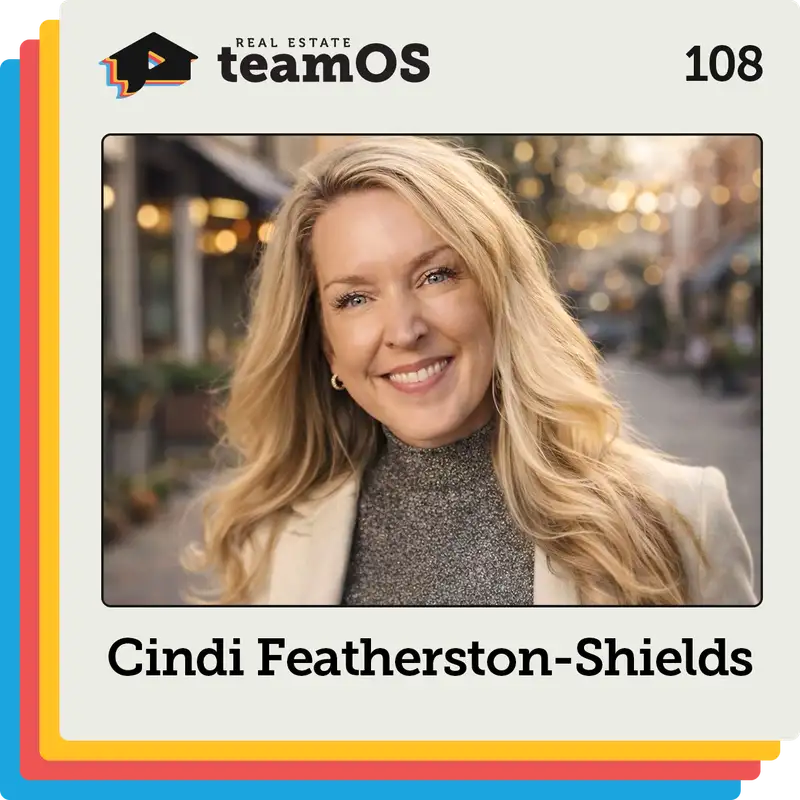
Why This Real Estate Team Hired a Chef for Lead Generation with Cindi Featherston-Shields | Ep 108
Speaker 1 (00:00):
A full-time chef, a margarita machine, live bands, charcuterie boxes, golf trips, a consignment shop, an animal welfare nonprofit. These are the kinds of things that happen when building community is your marketing and lead generation strategy. You're about to find out how and why Cindy Featherston Shields brings this strategy to life with her 41 agent real estate team get details on the daily accountability call she holds with her team. Why she's positioned for more than two x growth liability in the brokerage model versus the team model. And she's done both. Why she stays in sales production and how niching down makes it easier and what it really means to have community as your strategy. Owen, we'll also talk about her full-time chef. Get all that and much more right now with Cindy Featherston Shields on real estate team os no matter
Speaker 2 (00:54):
Where your business is today or where you want to take it, you'll get there faster and more profitably with an operating system. Welcome to Team Os, your guide to starting, growing and optimizing real estate team. Here's your host, Ethan Butte.
Speaker 1 (01:09):
Cindy, I'm about 99.5% sure that you're the first team leader. I have hosted on this show who has a full-time chef on staff. Welcome to Real Estate team os.
Speaker 3 (01:21):
Yes, thank you. Thank you for having me. I'm so excited to be here today, Ethan.
Speaker 1 (01:25):
Yeah, I'm excited to have you. I loved our two initial conversations and I'm excited to share it with other folks too. And it's funny when I pre-meet with folks like you who I didn't know you, we got introduced by Mike Shum, one of my previous guests and just an awesome person in the industry and so when I get to know somebody I always, I struggle withholding questions. I wanted to ask you in our earlier conversations to save some of it for here, but where we'll start is where we always do, which is a must have characteristic of a high performing team. What comes to mind for you?
Speaker 3 (01:57):
I think for a high performance team, you've got to have clarity first. People have got to know where we're going. People got to know where they're going, they got to know what their goals are and then the second thing you do is a lot of accountability because there's so many distractions in this business nowadays and just in life in general. There's a lot of distractions. So that key component of accountability I think is very important on a daily basis.
Speaker 1 (02:20):
And so in that it's like clarity on priority of tasks and activities from an agent perspective?
Speaker 3 (02:26):
Absolutely, absolutely. Everything from down from the contacts that you make every day and how many showings you're doing, what your goals are to define how much money you want to make for the year and correlate that down to the transactions and the price point. I mean it's definitely a formula and it's a strategy that has to be put into place.
Speaker 1 (02:44):
Yeah. Is that something that you're doing with your agents on your team or do you have a sales manager? Are you doing all that stuff day to day, week to week, month to month?
Speaker 3 (02:53):
I am doing that one-on-one with our people and we have a daily accountability call. It's every morning at eight 30 and that's how our ages start their day is on that daily accountability call
Speaker 1 (03:06):
And so there's that maybe exaggerating it a little bit, but there's a little bit of that peer pressure when you are coming to a call with a group of people saying what you're about to do,
Speaker 3 (03:15):
You bet there's camaraderie, there's pressure, there's also that thought of well, if they can do it, I can do it. When you see a lot of that and it makes you want to produce more, when you start building that community of people that care about each other, they're rooting each other on. And so there's a lot that happens on that call. A lot of energy is on the call in the mornings, how many people are on that call? We have a large group, but we have ones that can join and can't join different times, and so it's kind of a person that comes in. Maybe they'll join three times a week or maybe twice a week that we see some of them, especially when they have so something to report, they're on the call because they want to beat the drum and tell about it.
Speaker 1 (03:58):
So what I would love to do, you have such an interesting story yourself. I mean you bought a brokerage only two years into the business when you were at 20 something and I'm sure some of that stuff will all surface. What I'd love to jump to right now in that whole story arc is what was going on in your business when team occurred to you?
Speaker 3 (04:19):
Yeah, I've been through a lot evolving in this industry. I started when I was in my twenties. I'm in my fifties now and back then teams were not a thing back when I started in this business. We just had brokerages and so when I decided to buy it, I was buying a brokerage again, the team concept was not even there. It was a brokerage. I ended up opening five offices, had over 120 agents at one point, and then when I decided to scale back to one boutique office, I sold my offices off and scaled to one and then decided to actually have a high performance team. What
Speaker 1 (05:00):
Made you say, I'm going to buy this brokerage?
Speaker 3 (05:03):
The broker passed by my door one day I'm in. It was an old brokerage style building. Each person had the individual offices and back then there was no real training so to speak. I think Mike Ferry was the first training I ever heard about in the real estate industry and actually it went to one of his events, but for the most part there was not a lot of training and so it was an independent company. My partner and I purchased it truly, we paid a hundred thousand dollars for it and we were going to do that over time and the day we announced it in our sales meeting on Tuesday morning, half of 'em walked out. So we'd already made our deal when we made the announcement and I still was on the hook to pay the money, so we bought the building we bought and we ended up buying the business and we paid it out over time.
Speaker 3 (05:53):
But what happened is I joined a franchise. I knew I needed that extra help and training to train agents and so we were kind of the new kids in town and people came, I mean they came and they wanted the workforce and like I said, I knew I needed to be able to train 'em and so I was trained by a franchise on how to get agents into production and then we grew from there and it was a very good company. It was a lot of liability though. I found that being a broker in the beginning, I hired brokers to broker for us until I could get my broker's license and it became a lot of liability. No matter how well you train your agents, you're going to have issues, you're going to have some lawsuits if you do enough transactions, and we were up doing over 500 transactions at the time and I was fighting lawsuits or trek complaints and it was stuff that was no fault in my agents, truly no fault of my agents, but I sat in mediations quite a bit and had to listen and learned the hard way in this business and so fortunately, I mean method never, we always settled things our insurance company would settle, but we would hire independent lawyers to represent us and they would prove we didn't do anything wrong and sometimes insurance companies would just settle just to get it off their books.
Speaker 3 (07:17):
So it was interesting.
Speaker 1 (07:18):
This conversation comes up a lot on the show, which is typically indie brokerage or team brokered by another company and that liability piece is one of them that comes up a lot. Another one that comes up a lot is people who want to expand into other states, not just to other markets in their community or within their existing state, so that becomes easier with someone else who's running teams and agents, probably all of the United States. For you, what was that choice when you decided to narrow down and focus and to run your own high performance team was letting go of some of that liability and some of those logistics so that you could do what you really enjoyed doing most? Was that what that decision was about for you?
Speaker 3 (08:10):
Absolutely, absolutely. I knew at heart I was a agent that I wanted to be a top producer myself, so I'm running a team and I'm a top producer also on the team and I knew I only had a little bit of time. Time is a commodity when you have a family and I knew I did not want to be part of that brokerage, the yucky part of it of having to battle when there's a problem, even if it's a truck complaint, and so we aligned with an online brokerage. I'm still a broker, but they are the broker, so they take all that liability. I was with my franchise and the broker for 25 years and so I learned a lot and then decided to move to the cloud-based business where, and those guys are a lot more equipped to handle the legal aspect of it. I am so impressed with how they handle that aspect.
Speaker 1 (09:09):
Awesome. I want to double back to one more topic you already hit, which is half of the agents walking out. Why do you think it happened and how did you recover from it?
Speaker 3 (09:19):
I'll never forget it. We were in the sales meeting and everybody's mouth dropped when she announced it. Now my broker was probably in her eighties. She was older, she was ready to be done. She stands up in sales meeting and she's so happy and she announces it and I am green as can be. I'm happy too, and you have to understand the people that worked in this brokerage were 50 and over. There wasn't any young people. I remember I brought the first computer into the brokerage and show them how to write contracts on computer because we were doing it on typewriters. It was very old school and so they were a little scared. Think about this, somebody taken over that had only been in the business two years. I'm not sure I would've stuck around either to be perfectly honest with you. So it ended up turning out very well. I've run into those people now. They come into our boutique that we have our nonprofit and they say, Cindy, you did so well. We are shocked at how well this turned out for you. And so yeah, it's been a learning curve, but it's been wonderful. It has absolutely been wonderful.
Speaker 1 (10:32):
Really good. I would love for you, before we go further to just characterize the property shop however you wish, market size, structure, culture, anything you want to share about your team as it is today.
Speaker 3 (10:44):
Okay. The property shop is a boutique office. It's a high performance real estate team. It's located in Tyler, Texas. We do things a little differently here. We don't particularly buy leads. We cultivate our leads through relationships. We are at a relationship company, hence it's the reason we have a chef, so we feed people. When you feed people, you pawn with them, you invite 'em to events. Our chef is available to do events for us. We just did one last night that had 50 people at it and those are just clients. Most of 'em were just our past clients that came and of course real estate was talked about, real estate was talked about in the room. I think probably three or four of 'em were already under contract with something, so we see these people on a regular basis. We cater to 'em, we love on 'em, and that's just part of our model. It is different. We are definitely leadership focus. We call ourselves leaders, creating leaders. We train daily, we track KPIs, we expect excellence. We're not a hobby brokerage. We're more like a leadership incubator.
Speaker 1 (11:58):
You gave me a lot of directions I can go. I love it and I also love the way you roped in chef. I just said that off the top because I thought people would find it interesting and I do too. So I guess let's just go into that a little bit. What I think some people here is like, well, yeah, client events. Yeah, we do those quarterly. We do the pie giveaway around the holidays and then we do a spring thing where we maybe put a movie up on an outdoor screen and we do that and that's our thing. We have that box checked. I have a feeling you're doing this differently. I would love for you to kind of break down events in particular and then maybe we'll pull out to other air quote for people who are listening marketing activities, what do those include? Staying in touch with people and engaging people and having real conversations in order to generate a hundred percent of your business, repeat and referral. So events.
Speaker 3 (12:50):
That was my long way around events. Tell me more. Let's start there. Well, let me tell you the reason why we ended up hiring a chef to begin with. I was put on a project back in say 2005, 2006 for a large high rise come into our area. It was the first high rise in Tyler and the only high rise. It was 82 units that we were going to build the building and sell, and what happened is we were buying marketing in different markets. We were major magazines, we were on television, we were buying Google ads, everything, nothing was working, so we got bright idea to start hosting events. We were hosting events and in a building that was somewhat even not completely finished to sell this high rise out, but we built such community by feeding people and they got used to coming every Thursday night when we opened our high rise, we opened the first phase one through six floors. First we would host a dinner every Thursday night. They got used to inviting their friends and the next thing you know friends became friends and the next thing you know they began buying units. We sold the entire building out that way is just simply by feeding people and creating that community.
Speaker 1 (14:06):
Approximately what do you think you were spending on a Thursday dinner compared to Google ads and other channels that you had spent money on less successfully?
Speaker 3 (14:17):
The thing about it is is people will sponsor food
Speaker 3 (14:22):
Title companies, lenders will sponsor. Our chef is sponsored. Events that we have are sponsored. We get $350 an event in sponsorship. We hosted an event last night at our high rise that we have multiple vendors that will pay $350 and so it's just sponsored out with a chef. The food is sponsored, she does all the cooking, she does all the grocery buying. I bet you we're spending five or $600 in an event is all, if we have a large event with 250 people, we get out for about $5,000 if we are serving alcohol as well. Again, those events are all sponsored out in our office. We have TVs that scroll through vendors. All of those are paying to be here and that helps offset the food cost.
Speaker 1 (15:21):
A sponsored program isn't a completely novel idea, but at some point it was novel to you in your business. How did that become a part of how you were operating?
Speaker 3 (15:31):
We do events on a regular basis. We used to open our office up for every Wednesday at lunch. We were feeding attorneys and judges downtown. When our office was there, we had valet parking. It was just the cool place to come to have lunch. We had an older office bill, an old house that we converted. We had a big gourmet kitchen put in it and the food was always free, but we always had a sponsor sponsors. The first year I just paid for it myself and then they started calling me asking to sponsor. We had valet sponsored out and the food sponsored out every week, so that's how we built it.
Speaker 1 (16:09):
What other types of, I mean you're just feeding people all the time. Any other events in a calendar rotation?
Speaker 3 (16:16):
Sure. Last night, just for instance, we were involved in We Cookoff. It was a showdown Cookoff between two teams and my vendors that pay the money to sponsor and a few of my agents and the shelf formed a team and we cooked Cajun food. Now of course our Cajun food was amazing and we ended up leaving with the trophy last night. We have entered that those and it's all around our high rise. We have a 14 story high rise in our area and I did all the pre-sales for it. We sold it out and now we do all the repeat business for it. It also went out into our community because I specialize in golf course communities and my husband is a PGA golf professional, so that kind of helps that as well and so the people from the community started coming in to our events as well. I do a hundred person, like a VIP, they get something at their door probably every month from me.
Speaker 3 (17:29):
That's part of what the chef does, whether it's a charcuterie box for Valentine's, we did a cherry butter with sourdough bread. We had so many people comment and send letters and Facebook posts about it. We even had lady that made the recipe and brought it to our door Saturday morning. Again, it's about building community and we do that around food partially. I am not the one that goes door to door and delivers this. I have staff that does it and they just execute beautifully on it, but we can do that for less than we could do a mail out to our area. It just makes sense to build that community and people will use this over and over again in their real estate transactions because we come top of mind when they're getting something from you pretty much every month and it's not just a little something, it's not a lottery ticket. It's something really nice that they look forward to.
Speaker 1 (18:30):
Yeah, I mean it's something that you can use and it's handmade
Speaker 3 (18:36):
And it's on a high level. I mean it's really, really good. We do cake balls, we do chocolate covered strawberries. We do all kinds of things that people absolutely love. We own a margarita machine when we have our events, I mean they're really nice events. We hire bands for a lot of our events and so we are just known for that.
Speaker 1 (18:57):
So you're basically throwing dinners and parties constantly as your primary lead generation source. I assume that a number of the agents that work in your team, you met through this network process as
Speaker 3 (19:09):
Well. Most definitely. We host agent mixers every quarter with a band. We have agent mixers and people come and they, it's just a glimpse into our community, our sales meeting every week she puts a full spread of food out. Again, it's the ability to come into the community and see what is, take a little peek into it before they want to commit to it.
Speaker 1 (19:32):
You have opted to continue selling. You mentioned golf courses. We're definitely going to get into that niche too, but you've opted to continue selling so you've, you've run your own brokerage and grown it to multiple offices. You've narrowed it down and gotten more specific and created a high performing team. Throughout all of this leadership and you're focused on leadership, you're building other leaders. You've opted to continue to selling yourself. Why?
Speaker 3 (19:57):
Because I like to lead from the front. I never ask an agent to do something that I have not been willing to do, and I think leadership without proximity loses power. You have to be in the market. You have to know the market. I can't not sell real estate and be out of touch with what the agents are, the challenges they're coming through. Real estate's a lot different than when I started. It's different than it was five years from ago, so I want to be on the forefront of what's going on When the contract changes, I want to know how buyers and sellers are responding to those contract changes and I get a front door seat to it.
Speaker 1 (20:38):
Have you tapered it down at all or are you still producing like you were five years ago?
Speaker 3 (20:43):
I have tapered it down. I wouldn't say I prospect like typical. We do these events and my phone rings from that. My business is very easy at this point. People just call at this point, I've sold 'em four or five houses, they're going to call me for the next house usually
Speaker 1 (21:05):
Golf courses. Obviously there's a connection in that your husband is a PGA pro. That of course obviously creates interest, but that doesn't necessarily mean that you're going to specialize your real estate business in golf course communities. How did that niche develop for you?
Speaker 3 (21:22):
Well, we live on a golf course. My husband plays at that particular golf course. He travels a lot. He plays with a group of people, he plays with my clients. If we have somebody relocating to our area that likes golf, he's able to bring them onto the course and kind of help them get acclimated with other golfers and so again, it's about building community. We bring a golfer that's never been in our area and we can introduce 'em to four or five people that they can play with our regular teams and again, it's about that community we're building. The golf business is a very social business. We have planned golf trips. We've been to Las Vegas. We're building one right now for Lajitas where our clients go with us. How do clients
Speaker 1 (22:11):
Get this invitation?
Speaker 3 (22:13):
Well, because we are in the golf community, he just puts out a text message and says, we're going to Lajitas on this particular day and they just want to sign up. We go through with the hedis, we're going to be going through a travel guy. They will put it all together for their flights. When we went to Vegas, it was kind of the same way. They just decide they want to go and they book their airlines and then they can play on the courses when we get there. We've been to Pebble Beach with a group before, so it's very handsy when you have people in the golf business and know the ins and outs. We do host a golf tournament every year and so for our 5 0 1 C3, our clients come out and they play in that and they have a ball playing in our golf tournament.
Speaker 1 (22:57):
Is this similar to the way that someone might farm a particular neighborhood? They get some momentum there and now every sign in every yard or 70% of the signs in the yards are all one person or is there a formal, I assume that at some point your relationship to selling the high-rise was semi-formal. It wasn't just that you had earned the business. I assumed that there was something formal about that. Is there anything formal with these golf course communities or is it exclusively she's the person to talk to? Exactly.
Speaker 3 (23:27):
It just has become, the people at the course will tell you that I'm the one to draw to because you want somebody that's very versed in the area, somebody that's lived there, we've lived there since 2008. Again, we can acclimate 'em to the community. We can introduce 'em to people so that they don't feel like they're alone if they're coming in from out of town and help build community again. That's what it's about, and so yeah, very. I would encourage anybody that wants to sell real estate long-term to build into a community build and then those people become your class. They become your friends, you start traveling with them, you have dinner with them and they become a part of your life.
Speaker 1 (24:07):
Any other agents on your team that are niched down in their own unique way?
Speaker 3 (24:11):
I have agents on my team that are niched into the same market with me now because I have backed up from production. I have three agents that work that same area with me
Speaker 1 (24:23):
And was that kind of come under my wing type dynamic?
Speaker 3 (24:28):
It happened naturally because one of 'em is the golf pro's wife because she knows the same people that I know, so she kind of comes in. She was at our event last night. She's loving on them just like I do and some of 'em are going to use her and we have another girl from the country club that was the membership director now as a realtor for us. It's a natural fit. She knows a lot of people in the neighborhood and so our plan is to absolutely dominate that neighborhood with our agents.
Speaker 1 (24:56):
Really good. Let's go to training a little bit. Say what you said again about building leaders. What does that mean? What's the motivation there and how do we do that?
Speaker 3 (25:07):
Leaders, creating leaders is what it basically is. We are ready for people to step up, we train them and then they step up into their areas, whether they're leading a B and I group or they're leading some committee for our board of realtors or WCR, we are leaders creating leaders. We like to see people step up as a leader in our office and again, we are a leadership incubator. We want people in leadership. To be a high performance agent, you have to be a leader. You have to direct and guide people through a transaction.
Speaker 1 (25:44):
Again, is that you one-on-one, is that group coaching and training, is this just like an undercurrent of the way that you do coaching and training?
Speaker 3 (25:53):
Again, it's one of our core values. We talk about it in every sales meeting. There's no question our agents know what the core values are in our company. We start every meeting off with them so that they're not ever have to wonder what we are standing for, so again, when they step up and they start doing events on their own, that's part of that leadership.
Speaker 1 (26:15):
What does the training and coaching cadence look like, and let's start maybe with someone you meet at one of your events and you have a conversation. Who is the type of person agent that you're having this type of conversation with where it occurs to them or it occurs to you, this person might be a good fit in the property shop. What characteristics do they have? What types of agents really work well with you and then what does the first 90 days look like?
Speaker 3 (26:45):
The agent, our avatar is somebody that has to make a living, has to engage into this business. We probably are not looking for somebody that wants to do this as a hobby that gets into the business and wants to see how it works out. Maybe they're holding another job somewhere. We are wanting serious people in our space and the reason why is because we're very dedicated. We are on a call every morning with them at eight 30 Monday through Friday and then we're face-to-face on Tuesday mornings. We handle all of their backend portion of their transaction. We provide the services for transaction control, we write all their contracts for them, we take all the pictures. We have a photographer on staff, we have marketing people, and so we are so dedicated. We want that person to be as dedicated as we are to them, so the first 90 days is about prospecting.
Speaker 3 (27:48):
How do you be in the real estate business? We have them come up with a list of 50 people. People not necessarily want to move, but people that know love and like them and that will refer business to them because remember, this is a relationship business. We tell 'em and so they come up with their 50 list and their job is to stay in touch with those people on a monthly basis, go to coffee with them, go to lunch with them, invite 'em to an event, get 'em into your space, get 'em into your world, but they are very clear that we are looking for that to send people to us and it works. People work their top 50 lists in this business and it's better than going to the grocery store, handing out cards or even cold calling a neighborhood. The top 50 list definitely works.
Speaker 1 (28:36):
I assume that someone new to the business or newer to the business, that 50 people is probably again just straight friends and family. How do we expand beyond that?
Speaker 3 (28:48):
Well, it's definitely friends and family initially and what happens is the person knows what the goal is. The goal is to ask them to get one referral a year for you. That's the goal. It's very simple and it's not that they pre-qualify the person or find out what they're looking for. It's simply just the introduction. If this person says, Hey, I don't want to do that, you take 'em off the list and you put somebody else on the list, and again, this is somebody you're going to conversate with on a regular basis. Every month you're going to be talking to this person and this person is a friend of yours. They want to see you succeed. People like to help people if you just tell 'em how to help.
Speaker 1 (29:31):
Yeah, absolutely they do. I get the feeling that you're focused on or had focused at some point and have since built it out and you're now delivering it significant leverage behind the agents so that they can be more relational in general. I would love for you to share what does the staff look like?
Speaker 3 (29:51):
Okay, so the staff on our team, we have transaction coordinators. We have one that's been very, very dedicated. We have a second one that does listings and she also does contracts when needed. Now this staff is available till nine o'clock at night. We ask our people to do most of their business during working hours until five 30, but a lot of times we do have a contractor, an amendment that needs to be done after hours and they're there to do that. They're there to do it on the weekends as well. I will truly tell you that VAs are also an opportunity. We do have some VAs that work for us in the Philippines. We have two of those. They help us with marketing. We have an onsite marketing person as well. We have photographer that takes all the pictures because we have a certain standard that we go by and we want to make sure the photos on all the listings look very well, and so she does the video and the photography for all of our listings. Of course, we have an accountant on staff and then we have a COO also that kind of runs everything and connects the dots for us.
Speaker 1 (31:04):
Approximate agent count, approximate staff
Speaker 3 (31:06):
Count. We have eight staff members and we have 41 on our team right now.
Speaker 1 (31:12):
Awesome. A year from now, do you want it to be 40 to 50 people who fit, who want to do business this way, who want to learn and grow together the way that you're building your team and your community, or do you have aspirations to push to 80, for example? How do you think about the growth of the team?
Speaker 3 (31:36):
We're in an area of about a hundred thousand people. We have people also that are in, say in South Texas that have joined our team. We are prepared to scale, and so yes, we do see having a hundred agents on our team and us being able to provide those services to them. The services will look a little different from somebody that's say down in the valley, near McAllen, Texas near the border. We'll be still hiring a photographer for the photos to set the standards for the listing, but all of the transactional control will be done from here. Think you about it. If you can do transaction control from the Philippines, we can certainly do it from here.
Speaker 1 (32:16):
You're capable of scale. What's your motivation? I also get the feeling that you enjoy cultivating these relationships and selling. Pushing into new markets is going to demand. You can only be in one place at a time, so I get the feeling you'd rather be at a really nice dinner or maybe a golf trip than necessarily scouting and interviewing people two towns away, but I could be wrong. You could have competing interests and priorities
Speaker 3 (32:47):
The way Zoom is now, you can interview people over Zoom people. A lot of them I've never met face-to-face, but they tune in on Zoom. All of our sales meetings are on Zoom. I interviewed them on Zoom and they are able to be a part of that community online and people, that's what they're looking for. They want to make sure that they have help with our cloud-based brokerage. Also. There's a tremendous amount of help through that community as well. What am I looking for? I'm looking to impact people's lives because I've been in the business so long. We've been able to, I feel like impact several people's lives. I had a lady that used to work for me that, and this is what made me decide I wanted to impact people's lives is she worked for me as a secretary back in the earlier days and I remember her crying one day when we were coming back from lunch.
Speaker 3 (33:39):
She was in a bad relationship. She couldn't leave this person. She was working nine to five for me, making 10 bucks an hour at the time, and I said to her, I said, you need to get your real estate license. We jumped bill a lot of hoops to help her get her license and the next thing you know, she is one of the top producers now and makes multiple six figures. Absolutely has changed her life, changed her family's life as well. It has impacted her sister. Her sister works for her. I mean that's the kind of stories we want. We want to help people. This isn't just about selling houses, this is about changing lives and we have figured out how to do that with this business.
Speaker 1 (34:22):
I feel like retention is probably high in this organization. A characterize that however you wish, and B, are you doing anything actively to retain folks as they do find their footing and grow with you?
Speaker 3 (34:36):
Again, building that community, feeding people, giving them the ability to grow their business. Retention with a cloud-based brokerage is amazing because cloud-based brokerage will give stock to them, give them the ability to grow revenue share, and that alone is retention and then we are just icing on top because of the fact that we do feed 'em, we cultivate the relationship. I have strong relationships with all of our agents. I'm here for them. They know that they can call me after hours. There's not a question that we can't get answered for them, and so they like having a leader that's available, so our retention level is good. The people that probably leave our team are people that don't want the pressure of performance, they don't feel comfortable. They will leave. People will leave a community like this when they don't perform.
Speaker 1 (35:37):
Yeah, we see that happen a lot just because, I mean you've set a standard and you've used that term a couple of times, like you've set a standard, you hold accountability and that works for some people and some other people don't like that so much. So when you made the shift from brokerage to team, how did you choose your brokerage? What was that process like? I mean, I assumed you looked at various options. How did you make that decision?
Speaker 3 (36:07):
When I made this choice, and I will say I definitely believe in coaching, I got several coaches. Mike is one of my coaches right now. At the time I was being coached by a company called NAEA and they were out of Frisco, Texas, Jake, Kendra, Michael Reese, John Kitchens, those guys are just top performers and I was watching what they were doing. I remember sitting in a meeting where exp was this cloud-based brokers was explained to them and I thought to myself, I still have a contract on where I was in my franchise. I couldn't even consider it, but I watched them grow and I've watched them impact lives. I watched how it impacted their lives, and so that's what made me decide to go to a cloud-based brokerage. It relieved a lot of a liability. My attorney loved the facts and he tells me on a regular basis, anybody that has a brokerage should consider it because of the liability now.
Speaker 1 (37:08):
So as someone who has her own successful career, who has built in a brokerage model, has built a successful team, you also run a nonprofit?
Speaker 3 (37:21):
Yes.
Speaker 1 (37:22):
A how many hours do you sleep at a night? I'm just kidding. Tell me about the nonprofit. Tell me what motivates you about that. I assume that the cross benefit, just hearing the way that you talk about feeding people and building community, it seems obvious to me that the nonprofit is a net benefit overall. The time and attention you invest there pays you back probably in your real estate business, not that that's how you think about it, but share a little bit about the nonprofit that you've built and how it relates to your business.
Speaker 3 (37:55):
Okay. I love talking about this because it's for animal welfare in our area. I served on the board for multiple years for the SBCA and got to know kind of what animals, how they're looked at in society and how they're treated in society. I felt like population control of animals is a big deal and people don't realize that. We started our nonprofit because we were helping the SBCA raise funds and then we decided to go straight on our own and then support other missions as well. Through rescue, we transport, we supply the funds to transport dogs and cats to different parts of the country. We also spayed neuter. Right now we have a goal of spayed neutering 500 animals here in our local area, so it started with obviously we sell real estate and we would get somebody when they were selling their home, they would have a sofa or chair leftover and I got the bright idea, well, let's just sell this.
Speaker 3 (39:04):
They're going to donate it anyway. We'll sell it on marketplace on Facebook and we will donate the money to the SVCA. Before we knew it, I had a whole warehouse, 1500 square foot warehouse where people were donating all of their furniture to us. When they moved, we had several estates donated and we were stu it. I had a girl driving back and forth, meeting people at the warehouse, and after a while I thought, that's not a very safe thing to do, so I decided to open up a retail shop. It's a high-end. We turned it to consignment as well. People do donate, but they also consign with us. It's very nice furniture. It's not like you're walking into a garage sale. This is a very, very nice staged furniture. It looks like a furniture store when you go in, smells nice. We have a whole section of retail items.
Speaker 3 (39:58):
Retail items would be for closing gifts, for birthday gifts, anniversary gifts. Somebody can come in and they'll build a basket for 'em for gift and of all retail items, but then the consignment part of it, and we'll pick up, we have a moving truck with movers. We'll pick up items from their house. Most of the time it's household goods, sofas, leather sofas, furniture. We do have a Facebook page. It's called Wags Wags Upscale consignment. We're located in a high traffic area. We have our stores about 6,500 square feet I think now, and it does very well. We have a manager, it's fully staffed, the bonuses. I get to just walk in there now and sit in the corner at a table and just watch and it's amazing the clientele of people that are my clients that walk in and out that door. We did develop a line of jams and jellies called Sweet Bees and it's got a picture of a dog on there, a three legged dog, which is our chef's three legged dog bee, and we did private label that We have a lot of different product around sweet bees and that has become client gifts, agent gifts.
Speaker 3 (41:25):
When somebody has a transaction with their office, they get something from sweet Bes and again, that has helped us also bring agents in to our business.
Speaker 1 (41:34):
So the consignment and retail shop is funding the nonprofit? Oh, for sure.
Speaker 3 (41:40):
100% of the proceeds. We pay the electric bill, we pay the rent, we pay our staff, and then what's left over goes straight to whether it's vetting a dog or a senior citizen. Like I said, we do transport with different rescues here locally and I mean we had a group of dogs that just went to Canada. We have 'em go into New Jersey with transport, so yeah, we spayed neuter animals, so yeah, it's what's needed in our area.
Speaker 1 (42:18):
Cindy, you are an absolute gift to Tyler, Texas. I have to tell you, the way that all of this works together is really, really cool. It's obviously life giving to you. You're doing this the way that you want to, you're doing it in the right motivation and the right spirit, and it's just really wonderful in addition to being impressive as a business, and I'm just glad that you have invested in your community and been rewarded by your community for that investment. Anything else we didn't cover about the nature of your team?
Speaker 3 (42:50):
We have covered so much, and our team, they all approach this with heart alignment is very important. When somebody comes to work here, they have to be in alignment with what we are doing. They have to be alignment with what the mission is. They're going to have to have a heart for the community and a heart for their clients. A lot of 'em have a heart for animal rescue also, so alignment is very important when we bring somebody in
Speaker 1 (43:23):
That level of sincerity and commitment can't be faked, and in that way it is completely differentiating in addition to again, being life giving. Cindy, this has been a pleasure. Before I let you go, I have a few pairs of closing questions for you. You can answer one or the other or both, and the first one is, what is your very favorite team to root for or what's the best team you've ever been a member of besides the property shop? Well, I get
Speaker 3 (43:49):
Jazzed rooting for my husband on the golf circuit. I mean, he played at the US senior open this year and we had a group of people that went with us to cheer him on and that was the biggest pleasure ever was getting to see him compete.
Speaker 1 (44:10):
That's awesome, and I love that you of course turned it into like a group event too. Of course you did. What is one of your most frivolous purchases or what's a cheaps skate habit you hold on to even though you don't need to anymore?
Speaker 3 (44:23):
I'm not a frivolous girl, but I will tell you, my husband buys some absolutely amazing gifts, and so if there's a frivolous thing that I get, it would be a Louis Vuitton purse and I have three of 'em that he's purchased for me, so I actually had an agent buy me one as well, but that's probably the most frivolous. I drive a really nice car, but that's him again, wanting to pick that out for me and then probably a little bit of a cheapskate about things. Again, I'm not frivolous. I use recycle gift bags and things like that, so I'm pretty frugal myself.
Speaker 1 (45:00):
Yeah, that's funny. We have a set of bags like Christmas in particular, Christmas gift bags and we'll just recycle those. We'll keep using those. Sometimes you pack 'em with the wrong gift and it splits a scene and you got to give up on it, but yeah, I got cheapskate habits for days C, last one. What does it look like for you? What do you doing when you're investing time in learning, growing and developing, or what are you doing? What does it look like when you're investing time in resting, relaxing and recharging?
Speaker 3 (45:34):
The growth in real estate is kind of interesting. This last year I have gone to Costa Rica and have attended a women's retreat with one of another real estate leader. It's just you get to rest and relax. We're headed to Cabo here at the end of the month to rest and relax, but we always pair it up with something with real estate. I don't think I can go somewhere and not know that I'm not going to learn something while I'm there because I am a lifetime learner. I love to learn and so there's not a lot of, I guess I get my relaxation from learning something else on the weekends. I'm taking some course or learning something. AI is a big deal for me. I'm learning a lot about AI right now. I became one of the first certified AI people with Nick Rim's group when it launched ai, so I like to stay on the cutting edge of ai.
Speaker 1 (46:33):
Really good. If someone wants to learn more about you, Cindy, if they want to, we covered a lot of different stuff, but if someone wants to follow up, learn more about you and learn more about some of the businesses and activities you put around you, where should they go? It's Cindy
Speaker 3 (46:46):
Featherston Shields. We're on Facebook, Instagram, LinkedIn, TikTok. You can find us everywhere.
Speaker 1 (46:54):
Alright, I will link those up and include them right down below in the description. Cindy, I appreciate you. I wish you continued success and thank you for what you're doing for your community.
Speaker 3 (47:02):
Thank you,
Speaker 1 (47:03):
Ethan. This has
Speaker 3 (47:03):
Been such a pleasure.
Speaker 2 (47:05):
Thank you. Thanks for checking out this episode of Team Os. Get quick insights all the time by checking out real estate team Os on Instagram and on TikTok.