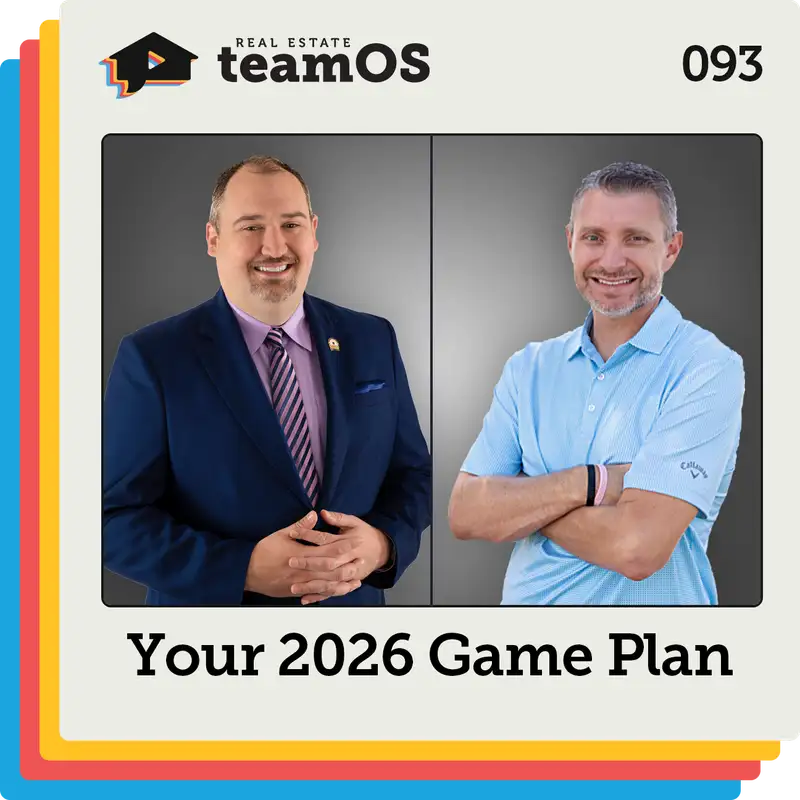
Your 2026 Game Plan with Mark Hiller and Drew Coleman | Ep 093
Speaker 1 (00:00):
You're about to go inside, not one, but two high-performing real estate businesses. Hiller Group, a 20 person real estate team on Florida's Emerald Coast and Opt real estate, a 100 person brokerage in Portland, Oregon. I sat down with their leaders and a live audience out on lock at the Fountain Blue Las Vegas last month to get key components of their team operating system and their game plans for 2026. You'll learn when, why, and how Mark cut $25,000 a month out of his budget. You'll get a step-by-step walkthrough of how Drew business plans with agents. You'll get about a half dozen tech products that they both rely on and the transformative nature of an open API. You'll learn how and why they both successfully integrated virtual assistants into their systems and so much more. Enjoy our time with Mark Hiller than Drew Coleman right now on real estate team os.
Speaker 2 (00:54):
No matter where your business is today or where you want to take it, you'll get there faster and more profitably with an operating system. Welcome to Team Os, your guide to starting, growing and optimizing real estate team. Here's your host, Ethan Butte.
Speaker 1 (01:09):
Thank you so much for being here.
Speaker 3 (01:11):
Thanks for having me.
Speaker 1 (01:12):
Yeah. So what we're going to do over the next 15, 20 minutes is learn a little bit more about the operating system behind Mark's success with Hiller Group and talk a little bit about what's coming ahead in 2026. But to kick us off, share a little bit of context for folks like what is Hiller Group, how long you've been doing it, what's the nature of it, where are you? Anything you want to share about your business? Sure.
Speaker 3 (01:33):
Where are a small team based out of the Emerald Coast of Florida in the panhandle? Most people haven't even heard of it. I got licensed in 2013 and built a team basically out of COVID. The necessity, I didn't really want to, I was a single agent crushing it, selling 135 houses a year and the market just took off, built the team. Now we got 12 agents, five staff and eight virtual assistants in the Philippines and we're on track for about 230 transactions this year.
Speaker 1 (02:03):
Cool. For those that are very early stage or for solo agents that are thinking about as a team, right? For me, obviously when you're doing 135 transactions, you're exhausted, you're putting your own health and family and relationships at risk. What were the first couple of steps in solo agent insanely productive to I need to put something around me that is sustainable? What were those first couple steps? When did it dawn on you and what are the first couple steps you took?
Speaker 3 (02:32):
Sure. Well, quite honestly, it kind of goes backwards. It's just a little bit from there. From that 135 when I was doing about 58 transactions on my own, I decided I needed to have that assistant and that assistant is what took me from 1 58 to 112 transactions. Just by getting out of doing the paperwork and all the things that I was bad at and leveraging that out, I was able to basically double my production and the same thing went when we decided to grow the team. The assistant I have now is now my director of operations. She couldn't be here today, but she's a huge part of our success and it's not my success, it's the people that I've put around me that have driven the success of the Hiller Group.
Speaker 1 (03:13):
Awesome. I want to talk about some of those people you've put around you, including some of the leverage that you created for yourself early on and sustained for the betterment of the agents that have joined the organization. So Team Os, real estate team os name of the show OS is operating system. I regard the operating system as the people, processes and tech that you could not have built Hiller group without. What are one or two key people or roles, processes or systems or pieces of technology that you could not have built without?
Speaker 3 (03:41):
Sure, and as I mentioned already, Jackie, my director of operations, she was crucial in the growth of our company, of our team because she gave me back that time that I had, that allowed me to focus on where my natural geniuses and that's outselling at the time. And then growing the business from a visionary standpoint instead of focusing on all the tech, the backend stuff that I wasn't really good at. She built the systems, the processes, she was a crucial part in hiring the virtual assistants, training them, and now we've basically built the machine that we're at a scale point where we could double our agent count right now and not have to increase any people. We've got the people in place for growth and that's kind of one of the focuses we're going to have in 2026.
Speaker 1 (04:26):
That's awesome. For anyone that's not familiar with the gap between growth and scale, you've put yourself in a position to scale, which is more outcome, more output without more inputs. Growth is you can buy growth, you have to build for scale, so that's really, really impressive. So did I hear correctly that Jackie, who is obviously key to your success and key to building that foundation, doing some of the things that are necessary to position an organization to scale that you're not good at, you don't want to do, you could probably figure out how to do it, but it's not your strength area. She started as your assistant.
Speaker 3 (05:00):
Yes.
Speaker 1 (05:00):
Talk a little bit about, because this is a problem for a lot of especially early stage team leaders, what did you have to invest in Jackie to give her the space and the capability to grow into someone who has built a foundation of your business?
Speaker 3 (05:17):
Well, quite frankly, it is pretty funny. She has actually been licensed twice as long as I have and she's 10 years younger than I am and she absolutely hates selling. She tried doing it, hated it. She loved the backend, she loved the system, she loved the processes. So finding that person that fills exactly what you don't like doing was crucial to our success and the fact she grew with the company right when we started out, she was very underpaid, but that's all I could afford at the time. She saw the vision, she was willing to jump in and she's actually a military spouse. They got orders and she left the Emerald Coast back in 2022. Because of COVID, we realized could do a lot of things remotely. So she's now in Virginia Beach and she actually is running the director of operations from multiple states away.
Speaker 1 (06:05):
That's awesome. I don't want anyone to miss the word that you used there and what kept Jackie with you, even though she was underpaid, you knew it, she knew it, but she stuck with you and the word is vision. What did you communicate to her? What was your vision at the time? How were you able to articulate it to get her to buy in and believe in what you were doing?
Speaker 3 (06:28):
I don't know, honestly, I think she may be a little bit insane like I am. She probably just knew every day was going to be an adventure. What's he going to have me do today? Am I going to rebuild another CRM again this week? And the constant visionary, I was always looking for that next edge, that next thing and she finally had to reign me back in. We started looking into EOS and kind of modeled that a little bit. Of course I couldn't stay on track with that even, but she, at that point I realized I had to run everything by her. I had to give up the control of the company and actually run things past her. And that's a hard thing when you're the visionary, you're the owner of the company, but when you realize that you're spinning the wheels of your people because you're constantly, and it wasn't really a shiny penny, but it was just there's got to be another edge, there's got to be something else and she would reign me back in and keep me focused on one thing at a time and that was hard.
Speaker 1 (07:30):
Yeah, that release, I mean there's a little bit of ego in there and I don't mean that in a superficial way. There's a little bit of release to say I am not in complete control of this and someone else can take us farther, then I can go on my own if I control everything. So you mentioned VAs. Talk about how you found VAs. Was it a replacement for other roles? Was it purely additive? Just give a sketch of what VAs look like in your organization and and how you successfully implemented that.
Speaker 3 (07:58):
Sure. I think the first one we hired was in 2021 I believe, and it was just to be kind of an admin assistant to Jackie and eventually we realized, you know what, this is really is possible. I had a very negative initial thought process when it came to virtual assistants, but it has been crucial in the growth of our company keeping profitability at the highest form and right now we've got two that are helping with transactions. We've got two that are doing ISA work, one's doing video editing at all times. Another one's working with administrative and then we've got two other ones, one or two other ones that are just kind of helping in the background as well.
Speaker 1 (08:42):
Cool. And what were some of the adaptations to that type of work? Because your fear, I've heard from a lot of people, I know people who have tried it and said this didn't work for me for a variety of reasons. Any tips for someone who is still on the outside hasn't created that leverage in that way to work effectively with virtual assistants?
Speaker 3 (09:05):
Yeah, you have to have the systems in the process. You have to have a game plan for them. They are very checklist oriented. You can't expect them to forward think like we do. You have to be able to put the time and the energy into 'em to be able to get the output that you're expecting from 'em. It's not like having a standard employee here. You have to have checklists and you have to be holding them accountable to everything that they're doing on a daily basis. And with that we had 'em stay on camera for the first 90 days. We've got a system that monitors their mouse movement on their screen to make sure they're not dozing off, if you will. We did have that happen and we put other things in place, but after a while they're are trusted part of the team now and they are very crucial in the growth of our company and moving forward.
Speaker 1 (09:53):
Cool. Something that I've heard is they like to bring folks into the culture, celebrate their birthdays and celebrate their successes just as you would anyone else.
Speaker 3 (10:02):
Absolutely. They're a part of the team. They're a part of our international team.
Speaker 1 (10:07):
Cool. We're doing these live addon lock, which is in November obviously, but we're going to be releasing this on the show properly at the end of the year, so I wanted to kind of tie that we're in Q4. Most folks hopefully have a very good plan for 2026, but for those that are a little bit tardy to that activity or they want to refine it or a little bit, I want to talk a little bit about how you think about annual planning. Is this something that you are, is it a big thing that you kind of kick off in Q3 and you're nailing it down in Q4 now you've a big plan for 2026 or are you more of a quarter to quarter guy? Do you defer all decisions in that way to Jackie and follow that lead? How do you think about annual planning at a high level and then we'll get into maybe a couple things that you're targeting for your business for 2026.
Speaker 3 (10:54):
Sure. We're more quarter to quarter. Our market is actually seasonal. We're in the northwest Florida market, so we do get winter, so we do have a seasonality that comes into play, so we like to plan a lot for that spring and summer market and setting. The actions we're taking today are going to be those closings we're going to have the first quarter and the time and energy that we're putting into right now is crucial in how we're going to be able to plan for next fall as well because we hit probably 75% of our closings happened in that first half of the year.
Speaker 1 (11:30):
So for 2026 top projects, what are you thinking about a year from right now when we hang out together at Unlock next year? What would you like to have implemented? Is it a role, is it a milestone, like a production milestone? Is there anything you're looking to add, refine, achieve in particular over the next several months or by this time next year?
Speaker 3 (11:55):
Well, we're going to keep it simple and that's one of the things we kind of went back to the basics. When our market reset back in 2023, we lost, I'll be transparent, we lost a hundred transactions right out the gate when the market reset in Florida and since then we're now on track this year to have a better year than we did in 2021 when interest rates were half of what they are today and that's due to the systems, the process that we put into place and that was with me stepping back and not implementing new things, taking back the ideas, putting the ideas on paper and never looking at them again instead of trying to have something new and a new initiative at all times. One of the tools that we did add in this past year was Rooster and that has been a huge part of our business and so we're going all in on Rooster next year.
Speaker 1 (12:42):
Awesome. One of the things you shared with me as we were preparing for this conversation, so we were kind of nailing down like state of your business and things. Something that Mark just shared that you maybe don't have context for is that Florida corrected before a lot of the rest of the nation. So you went through an exercise line by line, bill by bill, invoice by invoice and really simplified the business from a cost perspective. Talk a little bit about that exercise because I think everyone here has made a lot of financial commitments in the good times and maybe not had the discipline that you had, but it came to you and was demanded of you sooner than it was for a lot of other folks.
Speaker 3 (13:24):
Sure. In 2022, we closed 275 transactions. 200 of them were in the first six months, so our market literally shut down came June. And with that I saw it writing on the wall come April and May, we immediately made budget cuts and we started just cutting anything we did not need as fast as we possibly could. I realized I had two or three different CRMs. I liked the color of this one, I liked the texting of this one, I liked the email of this one and I just simplified everything and with that we were able to cut about $25,000 per month in budget just on stuff. We did not need stuff that was overlapping and because of that we were able to, we lost those a hundred transactions the following year, but in reality, profit wasn't too far off where it should have been because we were so bloated in 2021 and 2022.
Speaker 1 (14:14):
Really good. I challenge everyone who's going to be doing these conversations with me over the next 90 minutes here on this stage to share one takeaway for folks watching and listening and for folks here with us, this is yours. You can't scale chaos. Talk about this idea and really when you share your thoughts on this and expand on it, focus on the word fun. It's my favorite word in what you shared.
Speaker 3 (14:37):
Sure. This is a grueling industry. We all, you put your heart, your energy, your soul into it and at times it is not fun. And during COVID it was some fun times, but at the same time it was very challenging for us on the backside of it because we had a lot of agents that were not trained, they were waiters, they were waitresses at a restaurant, they were taking orders. They did not know how to do the things that you needed to do to actually grow a business and be able to make it repeatable and scalable for themselves on their own personal business. As a team leader, that's part of our responsibility is to make sure that they're not just, they're the full service agent. They know how to prospect, they know how to do all of the things, and that's where we're really putting a lot of focus back in it.
Speaker 3 (15:23):
And it may not be fun for them right now, but they need to know those skills. They need to learn those skills. If they're ever going to want to grow away from us, it would be irresponsible for me to think that somebody's going to stay on my team forever. Part of our responsibility as a team leader is to set people up for success so when they grow beyond us, they are ready and they can go out and be successful on their own. And that is something that we weren't able to do in 21 and 2022. We were selling houses so fast that I couldn't train the agents fast enough, just get out there and do it. And now we're really put a lot more energy and focus on helping them have the tools, the foundation to grow their own business.
Speaker 1 (16:05):
Really good. I appreciate the focus on fun. I appreciate the discipline financially, I appreciate the sensitivity towards simplicity for efficiency and probably helps with profitability as well. I appreciate you making time for this, preparing in advance as well. Before I let you go, I've got two quick things for you. The first is, what is something that you have picked up here at Unlock that is going to be really useful to you? Whether it's a conversation, a relationship, a takeaway, or a new perspective?
Speaker 3 (16:33):
You don't need to learn more, you need to be reminded more. And one of the things I was reminded at this event was standards. You got to hold the line on your standards. You can't cave just because somebody complained somebody. It isn't making your team happy. My job isn't to be make everybody be fun. I'm not the entertainer. I'm here to help make agents better and if we're constantly changing our standards, what does that show about us?
Speaker 1 (17:00):
Yeah, really good. And the last one is if someone has enjoyed this time with you, mark, where should they follow up to learn more about you, connect with you, and maybe have some conversations about these topics with you directly?
Speaker 3 (17:09):
Sure. You can hit me up on Instagram. It's Mark Hiller fl.
Speaker 1 (17:13):
Awesome. Mark Hiller, fl. For those of you watching in listening in YouTube, apple podcast, Spotify, or@realestateteamos.com, that information is linked up right down below. Mark, thank you so much. Thank you all for spending this time with us. We'll be back shortly with another conversation with another great team leader. Clap it up. For Mark Hill, the standard is the rule as written, what gets tolerated becomes the new rule. Accountability is what holds the standard and makes the rule meaningful. I hope you enjoyed that conversation with Mark and one of his top takeaways from Unlock. By the way, if you want content from unlock, go to realestate team os.com/subscribe. Sign up it's absolutely free, and not only will you get email exclusive insights, you'll be able to cherry pick the most interesting and relevant topics for you personally every single week. Plus you'll get instant access to 10 subscriber only episodes including a conversation from unlock on lead diversification and a recruiting workshop from Unlock. That's all@realestateteamos.com slash subscribe. It's totally free. Be sure to check that out. Next up is Drew Coleman who explains how his brokerage is a little bit like a real estate team and shares an Olympics metaphor that serves as an important reminder or even a caution about recruiting and retention.
Speaker 4 (18:39):
Thanks for having me. Yeah, long time listener. First time caller. Nice to be with you here today.
Speaker 1 (18:43):
Yeah, and I have known you for years. I'm glad we reconnected through this.
Speaker 4 (18:47):
It's been great. Yeah, and I want to say mean, one of our core values is attitude of gratitude and I just want to say thank you for everything that you've done for the industry. I think that it's great for us to have a place to come in the podcast and in the episodes to learn what others are doing and try to work on raising the bar, what all of us are all about every day.
Speaker 1 (19:05):
Awesome. Appreciate that very much. Give us a little bit of background. Opt real estate is your brokerage. Give me a little bit of market size, structure, culture, whatever you'd like to share about opt.
Speaker 4 (19:15):
Yeah, I love it. The culture is probably the most important thing to us. Our strive is to build the best brokerage that has ever existed, and I think to do that you have to do that pretty slow and intentionally and we've had some good scale and growth, but what's most important to us is we do believe that culture eats strategy for breakfast and we want to make sure that people are going to be able to have not only some instant success at the brokerage, but that they also can as they move through all of those different quarters of life that a successful broker would go through, we want to make sure that they have support for each of those stages. Because having gone through it myself, it's a different need depending on are you a new agent, are you an agent who's obviously going to make it now having that stratospheric growth, are you at the top producer and your time is the most powerful thing to you or are you maybe scaling down your career and you want to buy some more time back, spend time with the grandkids and figure out a way to still capitalize on the time and effort that you've put in.
Speaker 1 (20:16):
Would you describe it as a Team Ridge? Is there a team in there? There's a team option and solo agent option. How is it structured?
Speaker 4 (20:23):
Yeah, it's a brokerage, but I think that we've added a lot of the benefits of why people join real estate teams within the brokerage environment itself. So when you look at anyone who's had success, and really we want agents that are going to be making a living wage and something that's going to be sustainable and keeping in because adding a number of bodies to the brokerage is certainly an easier thing to do. But we're being very selective in curating the type of agents that we have in our job is to really understand who's going to be successful. And I've really come to value the person who is the gatekeeper to that because one thing you learn about high achievers is that they don't like mediocre performers and they want to be around those who actually are going to take real estate very seriously. It's like the Olympics. When you look at the Olympics, it's not about cost, it's about being in the environment where excellence is expected. You go there to perform your best, you expect to perform your best, and the outcome is that more world records are set at the Olympic Games than anywhere else, even though races happen all the time.
Speaker 1 (21:27):
I love that analogy. How long did it take you? What was the process to discover who was going to be most successful inside opt?
Speaker 4 (21:36):
Yeah, it has taken a number of iterations and I think anyone who hasn't made mistakes hasn't, hasn't really tried. I think the number one component of a successful agent is certainly tenacity. Real estate is a job that looks great on TV selling Sunset is beautiful, we all love that, but it's not reality for 99.9% of practitioners. And we find people with extreme tenacity that they're willing to connect with people and willing to do the work is the most important thing. And we want people who will provide fabled service within our stable. And that's the thing that if they have that extreme commitment to taking care of the client and will go above and beyond to do so, those are people who have had success in our environment.
Speaker 1 (22:21):
Tell me about the use of the word fabled.
Speaker 4 (22:23):
Well, I think one of the biggest problems in the industry as far as the bar not being raised is that we spend so much time and we've been so fortunate, again, attitude of gratitude. We're fortunate to Zillow and partners like that that allow us to connect with people, but sometimes we spend so much time trying to focus on the connections we make and the numbers that we need to make that we're not being where our feet are and we're not saying what does this person need? How do I apply the platinum rule to them and not treating 'em the way we want to be treated, but how do they want to be treated? Adapt our business model to that, understand it and also especially stay in contact with them. And it sounds very simple, but having looked at many, many models, it's not done well and it's something we're committed to doing and serving our clients. Clients are lifelong clients. There's no such thing as past clients.
Speaker 1 (23:16):
Love that. One more question before we get into key components of your team operating system as well as how you're thinking about 2026 and what you're going to be implementing. You used the word best earlier. What does best mean to you?
Speaker 4 (23:31):
I think best is more of a North star and a commitment to providing that level of service that you don't find anywhere else. I think real estate is a business and one of the things I've spent a good amount of time, I'm quite involved with National Association of Realtors. I'll serve as the regional vice president next year for our region. One of the things that I have found is that we don't talk enough about the churn rate and the fact that 85, 80 7% of agents that are in the business today won't be in the business a year to five years from now. So it's hard to develop excellence at that level of churn. Obviously there's financial incentives that are aligned with having that level of churn, but I'd like to see our industry slow that churn down. I would like to see people who are committed to their craft, the right people in the right seats.
Speaker 4 (24:19):
And our brokerage has really, one of the core things that we've done is we've taken all of the tasks that agents don't get into the business for as much as reasonably done by people who are not the licensee themself. And we've tried to take that non-productive time where there's no contract and there's no client. And every year we look at how can we take more of this to allow agents to do what they love to do. And every agent who gets in the business says, I love people and I love houses. Well, why do we fight back against them and make them do X and Y and Z? Let's listen to the clients who are agents and tell them, help them do what exactly what they want, spend more time with their clients.
Speaker 1 (24:58):
Love it. That does sound like the spirit of the team. And I have talked with people that have built businesses on a sink or swim approach. That's the language I'm using for what you described, just like throw 'em in and see what happens. But to me it always feels more exhausting and less satisfying that way. But success can be found a lot of different ways depending on how you define it.
Speaker 4 (25:17):
Absolutely. We like our business model. We're very proud of what we've built. We've had great success with it, but our success is not really measured in the numbers. It's measured in how does every broker within our brokerage feel about their job, how they can take care of clients and how we can take care of them.
Speaker 1 (25:36):
Cool. So team os, team, operating system, people, process and tech that you could not have succeeded without. What comes to mind in any of those categories like people or a role system or process or a key piece of tech?
Speaker 4 (25:48):
I'll take it in reverse priority. I would say the tech. We've got an amazing tech stack that we've curated that we're super proud of. I think it's probably the least important, but it's also highly effective. I was just talking to Brian over at sisu and we've got to say thank you to follow-up Boss really because I think the fact of having an open API as A CRM is so foreign and nothing we had seen before and we have really utilized that to its maximum potential because we now have sisu working within our database. We have Batter, which is the new product that sisu has that does sweeps of non-touch leads so that we can make sure that we're nurturing these clients who may be forgotten about and find someone with the energy to do so. If they're not, we have a partnership with Rocker Box, great company out of College Station Texas that works within our database and also is like a microwave that warms people that maybe have fallen to the Surface House whisper, enabling our agents to work in the way that we find agents most often work, which is mobile in the car voice to voice to an AI receptionist or able to text that person.
Speaker 4 (27:00):
So there's just been so many integrations and follow-up bosses open API has been a really transformative thing because we're able to build on, and I'd be remiss not to say the Barra agency has done a ton of work with us and we were just, our operations guru has done so much integrations that it's just making the agent's life easier and easier. And then finally I would say stack wrap. If you're running a team and you have not looked into Stack Wrap, which provides basically a one single source of truth for all of the applications that a brokerage is running. Sometimes obviously the big boys can do that at scale, but it allows us with 102 people to have a single point that agents can have everything they need to accomplish their daily tasks in one place. So that's been great.
Speaker 1 (27:47):
Cool. When you think about the way that your organization is structured, what is a role that you've added at some point in the journey that you're like, I wish I had added this sooner?
Speaker 4 (27:57):
Well, I think our people and our staff is really what makes the Magic Tech is only so good. I served as the chairperson for our MLS, which is our MLS. Our MLS is the local MLS in our area and we brought in some technologies that were so transformative and you see some of them on the vendor floor where we're recording this episode today, and even at their best they'll get 13% adoption. And what that taught us is that technology is only as good as it's used. And we run the really white glove approach where we have the best staff in the world who we want to take care of, and they really do a lot of the technological bridging for the agents. They will execute running the tech stack, they will interact with Sisu on behalf of the agents. We run a pretty heavy staff with amazing staff. I mean 15, 16 here in the States, another 15 in the Philippines working virtually, we call them our offshore optimizers and they're part of the family too. They do a Christmas party at a gorgeous house. We want to take care of these people and our staff is important because we want to love on them so that they can love on our agents.
Speaker 1 (29:02):
Cool. Any practical tip for someone that is not working with overseas folks to help them be more effective?
Speaker 4 (29:09):
Yeah, I think you've got to look at your strengths and you've got to take an honest analysis of what you do well. I think a lot of people who tend to be either a team leader, a brokerage owner tend to be that vision innovation type of person, but you also have to have someone that can take those operational details and make them have legs and do it. And also you have to sometimes hold yourself back. I was watching an interview with Jeff Bezos and he said one of his leadership people said, you have enough ideas to ruin this company. And I thought about that, right? You've got to make sure that the staff and the infrastructure you have is ready to execute it and you also have to stay focused. And there's a lot of shiny object syndrome that happens in real estate, but we want to make our client the North Star and our client can be the agents and we want to provide that fabled service. So what's best for clients, what's best for agents, and that'll influence everything we do.
Speaker 1 (30:07):
Would you describe yourself as the visionary leader of the organization?
Speaker 4 (30:11):
It sounds very broad when you say it that
Speaker 1 (30:14):
Would you accept me describing you or as the visionary leader of your organization?
Speaker 4 (30:18):
It's your birthday. I really don't want to fight with you about this, but yeah, I think that's probably my role in leadership is an important part. I don't think it's the most important thing, but it's something that we,
Speaker 1 (30:27):
Yeah. Yeah. So that was a lead on to the real question, which is who filters those ideas and prevents the visionary from creating more of a mess than a solution?
Speaker 4 (30:40):
Well, you need to have those people you need on the widget test. You need to make sure you have people that are discerning and people that are going to have that tenacity to see things through and enabling as well. I mean, my business partner does a lot of that, so she's really the gatekeeper to a lot of the things that we do and it's been really successful.
Speaker 1 (30:59):
Awesome. Good Partnership has been the key to almost every great business that I've learned about, met with, talked to.
Speaker 4 (31:07):
Yeah, it's been a lot of fun. I mean, we've had great success. We don't live by the numbers, but we will do with a pretty small group as compared to many others. We've got 102 people within our organization and we'll do a thousand transactions and over half a billion dollars in sales, but to us, we could do the same amount next year. It's how we take care of the clients that we want to grow. We want to be the tortoise, not the hare.
Speaker 1 (31:31):
Very good. So 2026, what does annual planning look like for you all? Are you formal? Are you running an EOS style shop? How are you approaching annual planning each year?
Speaker 4 (31:42):
We do run an EOS style shop. I'm sure many do. I don't know that we're, as we've adapted it to our model, which works really well, I think we first start with the agent level and we sit down with the brokers and we've got to get our inner Simon Sinek on and we've got to say, okay, well why are you in this business? What's motivating? Do you have three daughters to put through college? Are you trying to establish a stable income? Are you trying to replace a W2 type of job? What's your goal? What would success look like for you? And if you don't connect to that intrinsic why that they're doing it, all the numbers don't matter whatsoever. So once we do that, we take a look at their database and we say, in our market, our average sales price is around $625,000. We say the average value of that in the database should be worth about $3,000 per year if nurtured correctly.
Speaker 4 (32:39):
I think so many agents are looking at the dollars that they get from that, but every person knows four people that buy or sell per year in addition to their own transactions. So that's in a 10 year period, 40 transactions plus the two that they'll do on either end. You've got 44 transactions there. And then we make sure that they're staying in touch, that they're being that value leader within the market for them. And then we will say, okay, well what do you need to make this year to achieve your why? And if that is a hundred thousand dollars and the value of a client in the database is $3,000, then you need to do 33 and a third transactions. And if you want to do more than that, you'll need to add some. And that's where Zillow is a great partnership because if you need to augment that database, it's a great introduction network
Speaker 1 (33:27):
A year from now when we hang out at Unlock next year. If I don't see you in the meantime,
Speaker 4 (33:32):
Okay,
Speaker 1 (33:32):
Hope it's a great year.
Speaker 4 (33:33):
Yeah.
Speaker 1 (33:34):
What would you like to have achieved? Is there something you want to add to the business? Is there a metric you want to improve? Are you looking to do anything in particular in the year ahead?
Speaker 4 (33:45):
We always have really big vision. We've got a new I think, opportunity that will drive a lot of leads for our clients as far as opportunities through a new partnership that we're doing. We're trying to create an LLM that will house all of our brokerage specific data so that if a client has an, I say client, I mean agents, an agent has a question, they'll be able to go in and find that. And I think we like to have sustained growth, but we'd want all our agents to be so stark raving happy at the fabled service we're providing them and that they're able to provide because of that support that they keep telling their friends, this is the best place to work. And if we do that, I'll feel like we're successful.
Speaker 1 (34:25):
I have had a conversation on the show with Brad Nicks, I don't know if you know him in the Atlanta metro area about the way that he's taken all this documentation. I think he's using guru for that, but agents can now interact with an, it's not an LLM per se, but it's an AI interface that allows agents to interact with their collective body of training and information.
Speaker 4 (34:47):
And sometimes you hear things like that, and that's exactly what we're trying to accomplish as well. You hear things like that, and it's not that we don't want to talk to our agents. The more communication we have with them, the better, and we want to celebrate their success. But if there's a quick answer that they're needing on the fly, it'll be great to have that resource as well.
Speaker 1 (35:03):
A hundred percent. Because it's not searching and using the right keywords in the search to hope to surface the right support article or how to or whatever. And it is, it's an extension of the in-person training, the one-on-one conversations, et cetera. Quick promotional plug, I'm about to promote something. I've done that with all of these conversations on real estate team os. If you go to realestate team os.com/bot BOT, you can talk to the collective wisdom of Drew and all the other guests that we've had on the show to date so far. So I challenged you to give me one takeaway to kind of wrap the conversation on, although I still have two more questions after this, and this is what you shared. Success requires two things, a path for agents to grow and a culture that fuels not drains their momentum. Now it's even more obvious to me why the word culture is in there, but is there anything you'd like to add to that statement or context you'd like to wrap around it?
Speaker 4 (35:58):
I mean, if price drove everything, no one would ever have sold a house that has a 2.7% mortgage rate, but we have to live our life. So I mean, culture is more important to us. Our goal is to make life better and better for the agents every year. Our agents should say OPT is a better place than it was last year, and that really fuels us to build that brokerage. But the path to grow is really important. I talked about the different life stages in a realtor that has success life, we want to make sure that they have that path to grow, whatever their vision might be. If it's running a big team under our operating system, that's amazing. If it's having the most success and best work-life balance, work-life integration that an agent can have, that's great. And then we want to have that culture that makes them feel inspired to come to work and is a performance winning Olympic type culture.
Speaker 1 (36:48):
Really good. Second Olympic reference. Appreciate that.
Speaker 4 (36:51):
Yeah. You seem like an Olympian. Ethan, you probably maybe skeet shooting or something.
Speaker 1 (36:57):
Yeah, I could be good at anything I put in my mind.
Speaker 4 (36:59):
Yes, you could. I believe you know what, that guy that shot with no glasses from the hip, that could be
Speaker 1 (37:03):
You. That's a good beam. What's one thing you've picked up here on lock that you're going to be thinking on or maybe even implementing or sharing with someone else on your team?
Speaker 4 (37:13):
Well, there's some talk A, I'm super excited about Zillow Pro just because integrating that experience and as we talk about the clients that have been served, staying in touch with them on their journey so that they don't feel like, Hey, transaction happened, my agent pieced out. I want to make sure that we integrate that to the best of its ability. And then there's been talk of vibe coding and obviously as we like to stand up new technologies, being able to look at that in 2026 will be a lot of fun.
Speaker 1 (37:40):
Awesome. If someone wants to connect with you, learn more about you or about what you're doing with opt, where would you send them?
Speaker 4 (37:46):
Most of my online handles are at Drew Coleman, so you can find me there. I don't think I'm on Friendster anymore, but I'm on most of the platform. So you can call me (503) 351-3739, still old school.
Speaker 1 (37:59):
Awesome. Well, and direct and sincere. I really appreciate that very much. If you're watching on YouTube listening to Apple Podcast or Spotify or you're watching or listening@realestateteamos.com, all that stuff is listed right down below. Drew, thank you so much for making time for me, and I hope you have a great rest of the experience here at Unlock.
Speaker 4 (38:16):
Thank you, Ethan. Happy birthday. You don't look at Dale over eight years younger than you are. So
Speaker 1 (38:22):
Thanks again to Drew and Mark and thank you for checking out two of our first ever conversations recorded with a live audience. We released two others in the episode before this one, so be sure to go back an episode in your feed if you did not see that and go to realestate team os.com/subscribe. Sign up absolutely free. You'll get those subscriber only episodes and we'll be in your inbox every single week to help you grow your business in 2026.
Speaker 2 (38:52):
Thanks for checking out this episode of Team Os. Get quick insights all the time by checking out real estate team Os on Instagram and on TikTok.